Monday, December 24, 2012

1st Place Recipe: Procrastinator (Dopplebock)


Lagers… the difficult beers of brewing… temp control, larger pitching rates, clean beers, a showcase for brewing flaws.  Some brewers never make the move.  I have avoided these beers for the 2 years I have been brewing for 2 reasons: 1) pitching rates, 2) I don’t care for very many lagers.  My tastes don’t mesh well with many of the pale lagers I have tried, thus far I have enjoyed a few Munich Dunkels, a Schwarzbier or two, and a good, dark Dopplebock, but if the Dopple is lighter, I tend to not care for it much.  Add to this the lack of drive to build up a 7 liter starter (not too mention the lack of equipment for it) and there hasn't been much push to brew a lager.

Recently I was at a brewing friend’s house discussing and crushing hops when the topic switched over to lagers.  He loves to brew them and has a refined palate for critiquing them from his time in Germany.  He has consulted with some of our local Breweries on their lagers and helped them to reach a much better level in brewing these beers.  When I voiced my concerns about pitch rates he, surprisingly, said that too much emphasis is given to the whole giant pitch thing.  He stated that a 2L starter is more than adequate to brew a great lager, but too many people are fermenting them at the higher end of the temp range and then taking them off of the yeast prematurely.  With this encouragement, I finally decided to take the plunge (with a 4L starter to be safe).  I have been procrastinating long enough, and now it is time to brew my Dopplebock.


Wednesday, December 19, 2012

UPDATE: Carol 2012 (Lambic)

After 2 months of wild fermentation I pulled a taste of the Lambic I brewed in October.  It has a distinct bitterness to the sour, much like a 3F or Cantillon, just not as harsh.  The sourness is very present for such a young sour, and different from a straight lactic sourness and no acetic.  The sour profile contains an acid from (I suspect) some of the early bacterias that weren't in the first edition.  There are a few esters in the young beer that are slightly off, not bad, but not totally pleasant.  Looks like I have a real Lambic fermentation on my hands with early bacteria and acids from other wild sources before the Lacto or Sacc started doing their thing.  I am looking forward to where it goes from here as the Pedio blooms and the Brett takes some of the less desirable esters and acids, and transforms them into (hopefully) wonderful fruity and funky esters.  The long aging period should also help some of the bitterness drop out that comes from the hops (if any of the bitterness is from the aged hops at all), as well as some tannins from the French Oak.

Monday, December 3, 2012

Hop Taco Revisited


***SEE EDIT BELOW***

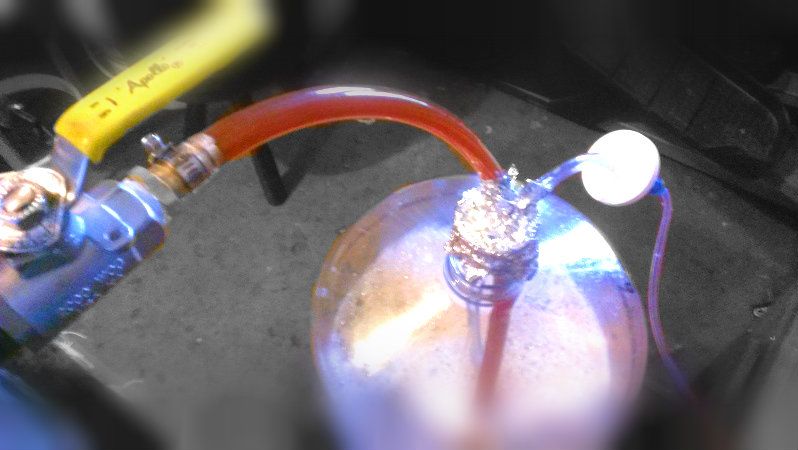
Awhile back I had made a Hop Taco for my kettle based on plans I found from Knights of the Mash Fork.  It seemed to work fairly well for keeping the hops out of the pickup tube and out of the carboy, but it made clean up very difficult.  It was cumbersome and awkward, I couldn't really clean it in place, I couldn't clean the kettle with it in place, and removing the pickup tube was difficult since the hop taco would inhibit spinning it.  Once free the Hop Taco was strewn with hop particles making it hard to clean as they would get caught on the wire ends that were frayed around the edge (also great for stabbing your hand during removal, cleaning, and replacing).  If I was able to get it clean, I then had to try to get it put back together again which proved to be just as difficult as removing it.  Finally, after a long and tiring double brewday I walked away leaving the hops, orange zest, and trub in the bottom of the kettle and didn’t go back to clean it until it was too late.  There was quite a bit of mold and what looked like possible rust on the taco and I ended up just throwing it out since it was difficult to use anyways.

I still needed a way to keep the hops from clogging my pickup tube though.  I made a version of the Hop Spider that proved useless.  Most of my hops would just get caught in the upper layer of nylon and remain suspended above the wort so I would have to remove the spider and dip it into the boiling wort with each addition.  After only a few batches that mechanism was relegated to the same fate as the Hop Taco.  Since then I have been using paint strainer bags or nylon sacks I got from the produce section (designed for keeping fruit free from fruit fly attacks while they sit out); they worked well until I had to clean out all those hop sacks after each brewday, some of which get caught under/around my pickup tube.

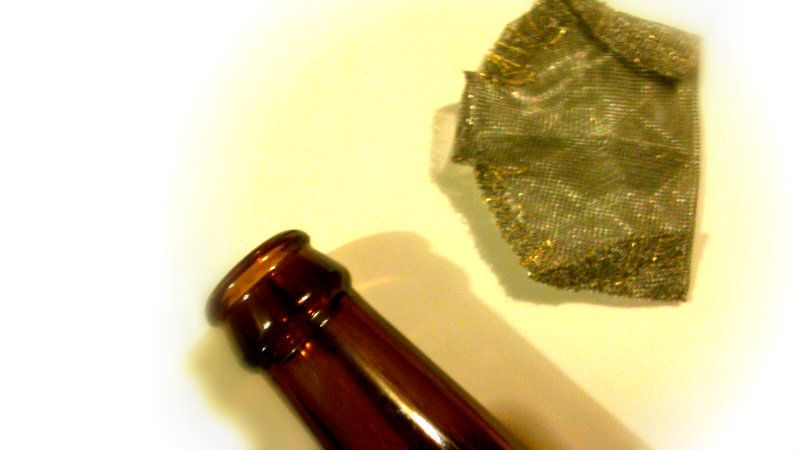
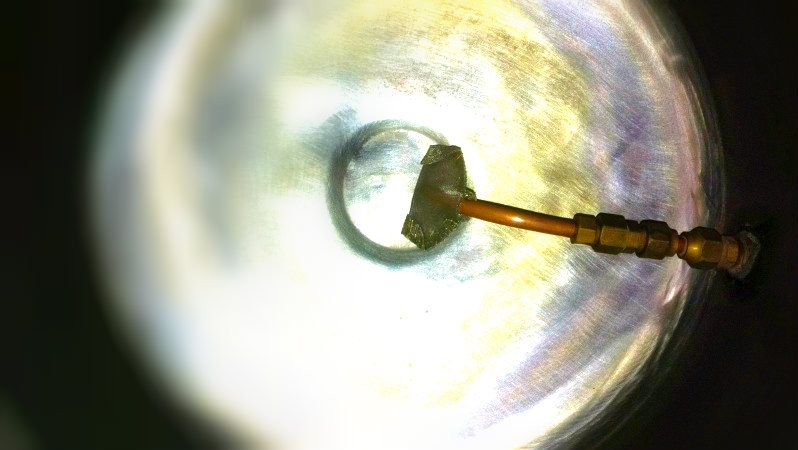
All of this leads me to a new dilemma, what is the easiest way to add hops to the boil allowing for the best extraction and aroma, as well as the easiest clean up afterwards while keeping hops (as well as spices) out of the pickup tube and carboy?  This has lead me back to the Hop Taco, just redesigned.  I found a small fine mesh Stainless Steel strainer at Walmart for $7.  The SS ensures that it won’t react negatively to the low pH and hot temperatures of the boiling wort as well as keeping it from rusting.  The fine mesh should keep more particles out, and I am hoping that this includes pellet material as well.  The smaller size allows for greater ease in cleaning as well as removal, and less to clean once the brew session is done (the larger one had more surface area to clean and more wire fray to catch hop pieces on).

For this version I used soft brass wire 0.41mm in thickness.  Many of the models I found online call for SS thread, but I can’t find any, and the copper wire I used on the last rendition was way too thick which made it difficult to get a tight stitch, and with the smaller size on this edition, the stitching needs to be tight.  I did break the wire a couple times, but was able to get a fairly tight stitch, and I doubled the coverage by looping around the outside first, then passing through along the edge as well.  I crimped the edges to leave a lip where the opening is for a hose clamp to grab onto and keep it on the pickup tube.

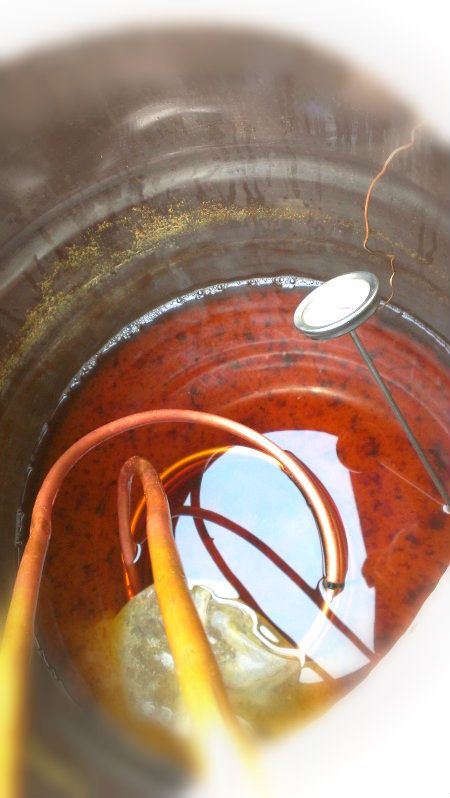
Now all I need to do is find some time to brew with it!  I've got a pound of 2012 Simcoe pellets, ½# Meridian and Calypso, and quite a few pounds of Chinook and Cascade homegrown hops waiting in the freezer, as well as a pound of Mosaic on the way.  And with nothing hoppy it looks like I am needing to brew an IPA very soon, which will be much easier with my new wort chiller that I am going to fit with a whirlpool option to attach to the new March Pump I am getting for Christmas.

***EDIT:  When used for a Dopplebock with whole leaf hops it worked great.  When used on a 10 gallon IPA with copious amounts of pellet and leaf hops it clogged shut rendering the pump and ball valve useless.  Will be trying a SS braid in its place to see how that works.***

Tuesday, November 27, 2012

Review: Slap Yo Momma (Wet Hopped White IPA)


The last of the three Wet Hop beers, this one is very complex, with big fruits and deep layers to dig through.  It doesn't have near the hopiness needed for a a White IPA, but still goes well beyond a standard Wit.

Look: Foggy gold with thick buttermilk colored head.  Head stays tight for awhile then becomes a thin whisp of bubbles on top.  Good lacing.  The beer sparkles.

Aroma: Big Belgian esters, pear, apple, strawberry, orange, tangerine, clove, coriander, grapefruit, pepper, floral, spicy, chalky yeast, sweet grains, subdued hops, honestly, it is hard to tell where the hops end and the spices begin, and where the spices end and the yeast starts.  This is one complex nose.

Taste: Pear, pepper, clove, ginger, herbal, chalky yeast, citrus, sweet grains, floral hops, rose water, alcohol, coriander.

Mouthfeel: Big fizzy medium-light body w/ pulling dry finish , chalky.  Bitterness is balancing and spot on.

Overall: The hops are pretty low for an "IPA" and fresh hops, but it is a good beer.  Bitterness presents in the finish to clear off the complex palate.  Drinks like a stronger / hoppier Wit.  Really enjoy it even though the hops are fading quick.

Monday, November 19, 2012

Recipe: The Becca 2012 - Third Trimester Tripel: When Things Get Funky (Tripel w/ Brett)


Last year I made an Imperial Stout with Cherries, Smoke Malt, and Chipotles named for my wife, Becca, A Smokin Hot Mother Of A Stout.  The beer didn't really suit her much since she can't stand to drink it.  I had been looking for a beer she would really enjoy to become the new Becca.  One of my first beers, batch 3 to be exact, was a Belgian Golden Strong, and my wife loved it, and I have wanted to rebrew to what I originally wanted.  The original turned out much darker than gold, and much sweeter than I had wanted; many people likened it to a sweet Tripel.  I had originally taken 1 gallon of that beer and put it on Brett like Matilda.  The Brett never really took hold (Reinhardt's Flemish Wild and Matilda dregs), so I hit it with Supplication dregs and turned it decent sour.  I have longed to make another beer like it again.  Enter the perfect solution to my delimma.

I used basically the same recipe as before, just All Grain instead of partial mash.  A 50/50 blend of Continental Pilsner malt and Domestic Pale Malt forms my base, along with about 20% White Wheat Malt.  Add a little Belgian Aromatic for some maltiness and touch of depth, and roughly 15% sugar to dry it out as well as boosting the gravity.  In the original recipe I used clear candi sugar which is expensive table sugar when it comes to the flavor contributions, so I just used table sugar.  The original recipe had Sterling hops, but I went with Santiam on this batch since I have a good 5oz in the fridge already.  I took some of the final runnings of my Wee heavy  and boiled it up for an 1800ml starter that I ran for a few days and then put in the fridge to stop the growth of the Brett from continuing too much.  I had snagged a package of the Wyeast PC Trappist Blend strain not knowing that it had Brett in it, and had needed a beer to brew with it so it seems the Lord's providence worked in my favor.

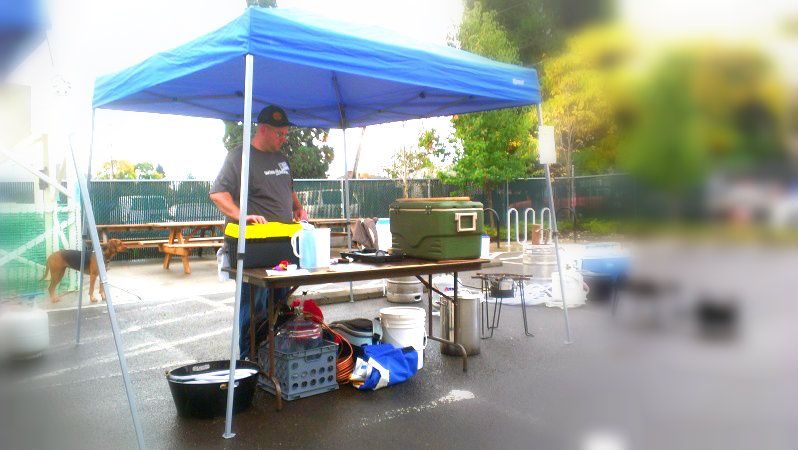
This beer seemed apt to become the new Becca since she loved the original, and she enjoys funky beers.  Seeing as she is in her third trimester with our second child, this year's rendition is The Becca - Third Trimester Tripel: When Things Get Funky.  Now I only needed a day to brew it... enter in the email from Denny Conn... our brew club needed one more brewer for Teach A Friend to Brew Day, and I jumped on it quick.  An easy brew, single rest, low mash temp, simple malt bill, sugar to boost the OG and dry it out, 2 hop additions, chill and pitch.  
__________________________________
Stats:
5.75 gallons
1.079 OG
1.007 Est Fg
9.4% Est ABV
32 IBUs
5 SRM
__________________________________

Fermentables:
4.25#  Weyermann Pils
4.25# Great Western Pale
3.0#  White Wheat Malt
0.75# Belgian Aromatic Malt
2.25# Table Sugar
75 Minutes @ 148*F
82% Extract Efficiency
82% Brewhouse Efficiency
__________________________________

90 Minute Boil:
FW - 2.0 oz Santiam ~ 6.0AA% (Home Grown)
10 mins - 1.0 oz Santiam ~ 6.0AA% (Home Grown)
__________________________________

Fermentation:
6 gallon Better Bottle
15 mins Aeration
Wyeast PC 3789 Trappist Blend - 1.8L Starter 
36 Hours @ 68*F
24 Hours @ 70*F
14 Days @ 75*F
1 Week @ 55*F
__________________________________

Additional:
Gypsum 1/2 t (mash), 1/2 t (boil)
Calcium Chloride 5/8 t (mash), 1/2 t (boil)
Whirfloc - 1 tab
Nutrient
__________________________________


Brewed @ Oakshire.  Brewday went smoothly.  Got slightly higher efficiency than I expected and ended up with extra wort.  Racked into 6 gallon Better Bottle and pitched yeast @ 3:00pm. Drove home and aerated with pump for 15 minutes.  Placed in ferm fridge @ 68, transfered 3/4 gallon out into sanitized 1 gallon jug.

At 7 the next morning (16 hours) there was a 4" krausen already.  This yeast is ripping through the wort and is a true top-cropper.  Attached a blow off to both fermenters.  Jumped temp up later that night to get a little more fruity expression from the yeast since the Trappist High Gravity is known for a subtle and spicy character at lower temps and I want a balance between esters and phenols.  Bumped up temp gradually over the coarse of a few days to restrain fusel alcohols and promote yeast expression.

After 4 days the gravity was down to 1.025.  After 1 week it was down to 1.010.  After 2 weeks the FG is down to 1.007, tastes of clove and pepper with hints of pear and strawberries, light banana.  This yeast is ferocious.

Thursday, November 8, 2012

Review: Just Freshinin' Up - Wet Hop Red

When I wrote the recipe for this beer I was looking for a dank and sticky Red Ale, and I got it, kind of.  Unfortunately the hops weren't as big as a presence as I had hoped for and they are fading quick, but they still show off.  It is definitely more of an American Brown with the color and somewhat more restrained hops, but good none the less.  I had hoped for more citrus and pine from the load of Chinook.  I would like to rebrew this one again next year and back off the crystal malt a touch, cut the roast barley back quite a bit, and load up on a lot more Chinook.

Look:  More Brown than Red, this beer pours a murky chestnut with ruby hues under a thick sticky beige head that leaves great lace all the way through.

Aroma: Smells of big resin, thick sticky hops, pine cones, dark fruit, citrus, spice, raisins, burnt sugar, light roast, sweet breads, caramel & toffee, fruity.

Flavor: Taste hits big with resin, followed by pine cone, malty, bread dough, caramel, burnt sugar, roast grain, raisins, grapefruit, clean.

Mouthfeel:  Semi sweet with a firm bitterness, malty, nice carbonation, medium body.  Sticky hops coat the tongue and linger.  Carbonation is fairly high helping to lift the lingering hops for a cleaner finish.

Overall: Beer turned out nice.  I was looking for big malt and resin and I got it.  Color is way too dark, but the flavor is great.  Fermentation is clean, carbonation is a little high (gushes at room temp, but FG is still the same and no gushing at fridge temps).  I was hoping for more pine and citrus from the Chinook.  Unfortunately the hops are beginning to fade after only a month or so.