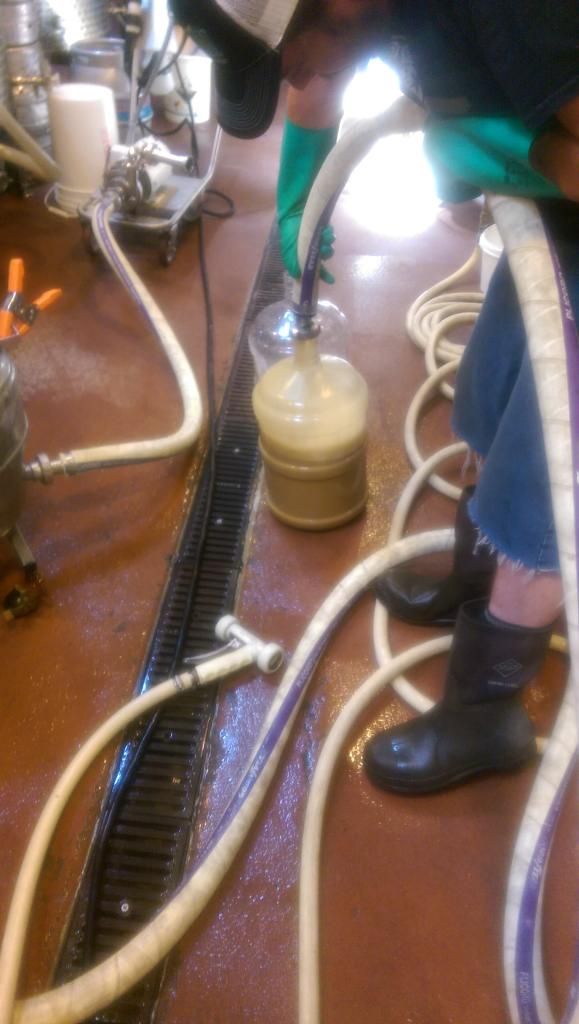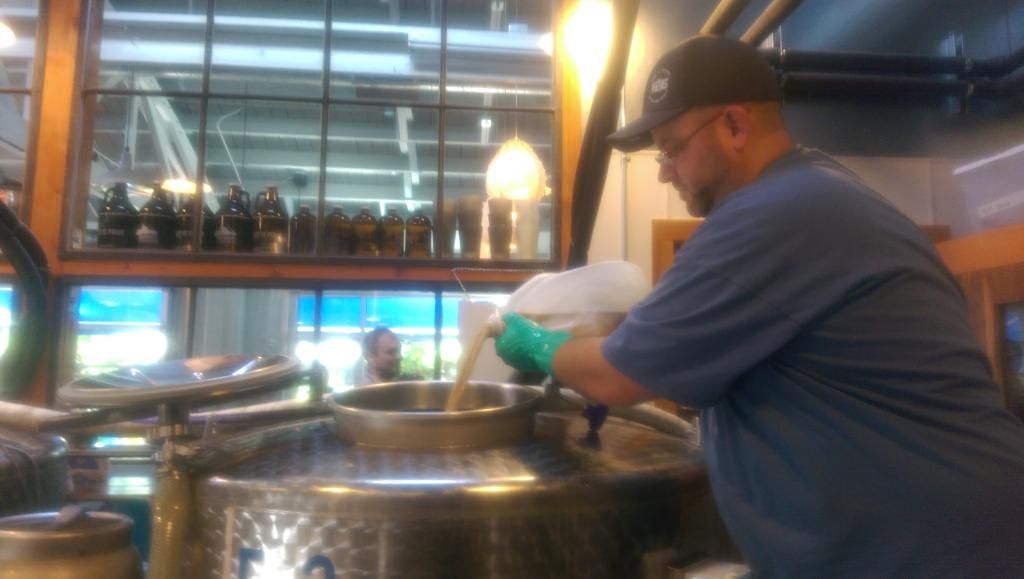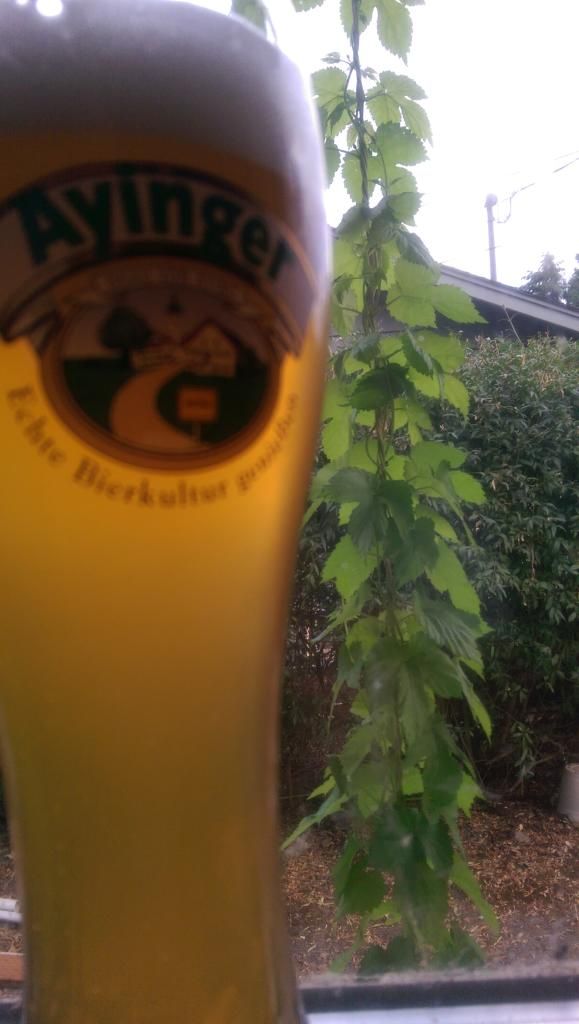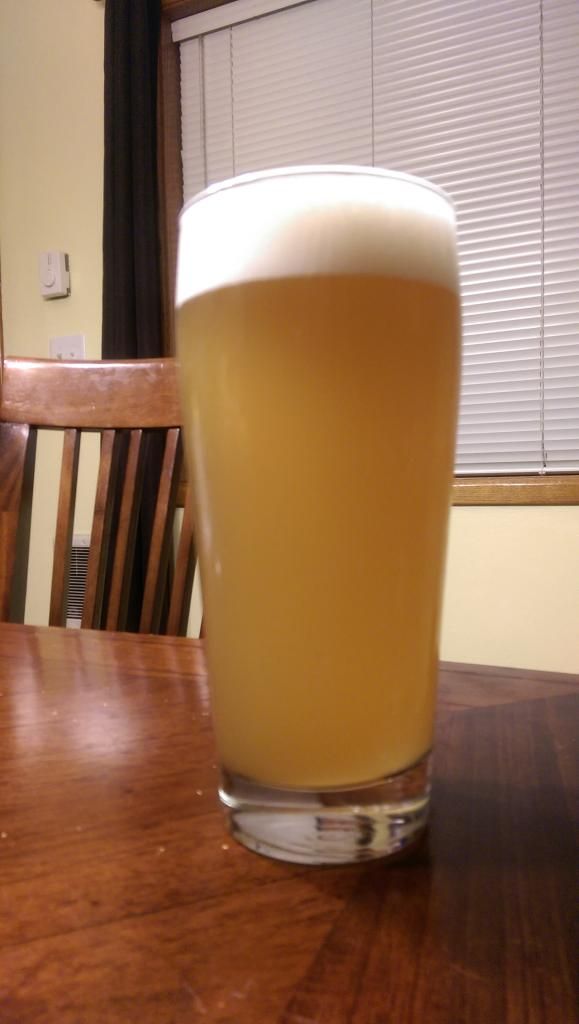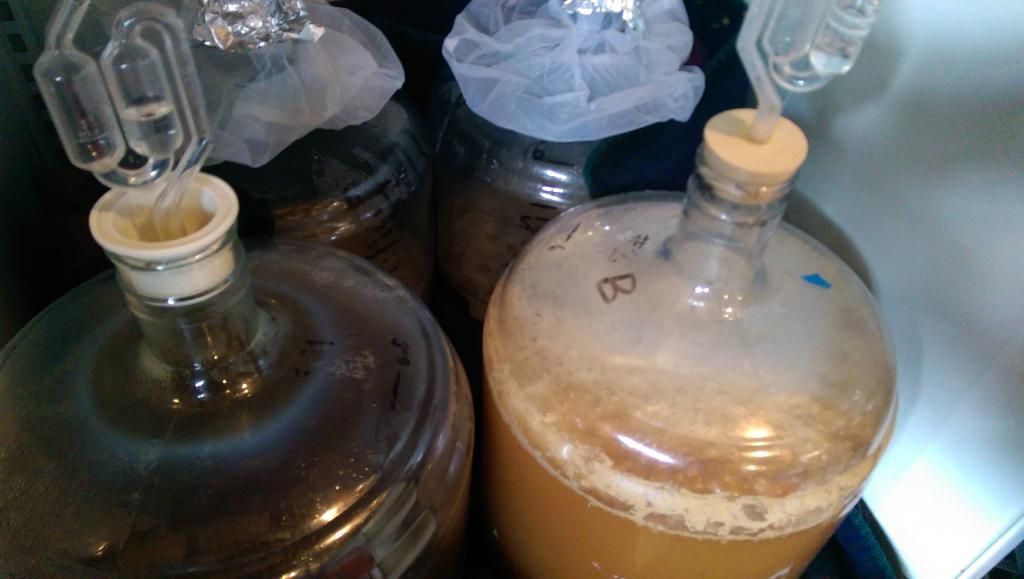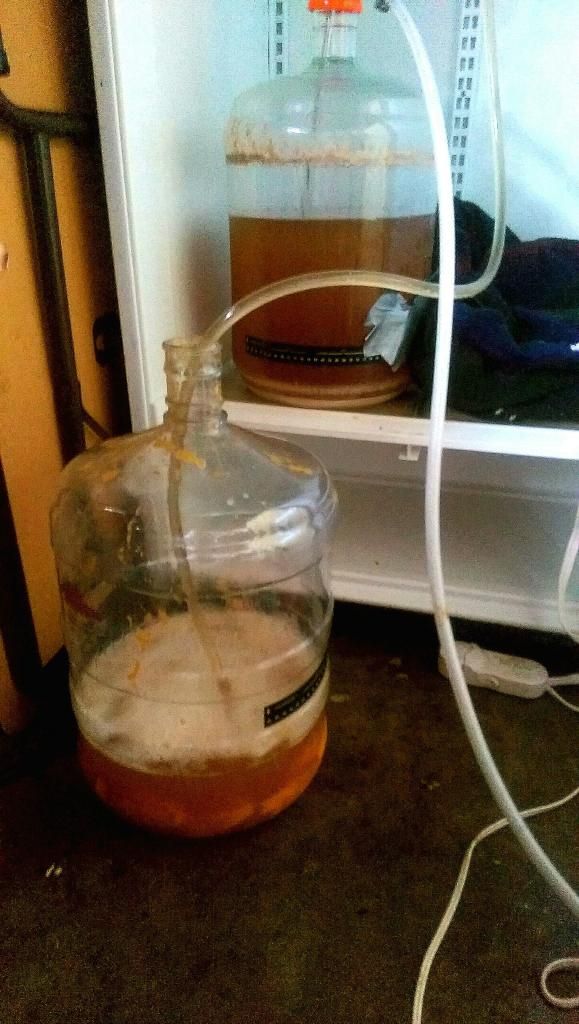
After primary was done it was yogurty, and tart, but not as tart as I wanted. I also had a few pounds of Mango chopped up in the freezer. I added the beer to the fruit to age for a few weeks, and also fermented some pure Mango juice with the Lacto for some more fruit flavor and sourness. On bottling I added a little food grade Lactic Acid to make it pop just a little more.
Monday, August 4, 2014
#67 RE: Fresh (Mango Berlinerweisse)
Wednesday, July 30, 2014
Update: A Barrel, and A Brewer for A Day (Or Two)
It has been a busy past few weeks and in our world, it isn't going to slow down anytime soon. Wanted to give a quick update for what is in the works since there is nothing completed at the moment to post about.
I was able to squeeze in a brewday just over a week ago for 16 gallons of Belgian Blonde which I had made 2.5# of Invert Sugar for. This will be going into a 14 gallon wine barrel that I was given by a friend. Trying to get a bone dry barrel to swell was not an easy task. I started yesterday morning and it is still dripping today, but nothing like the waterfalls pouring out when I first added water. I put a holding solution of Citric Acid (1g/L) and Potassium Metabisulfate (2g/L) in there to kill any acetobacter or mold that might have been inside, and to keep it swollen and ready for this weekend when I move the beer into it.
| Some seepage from the top staves |
| Falling drip of water |
| Another Drip Shot |
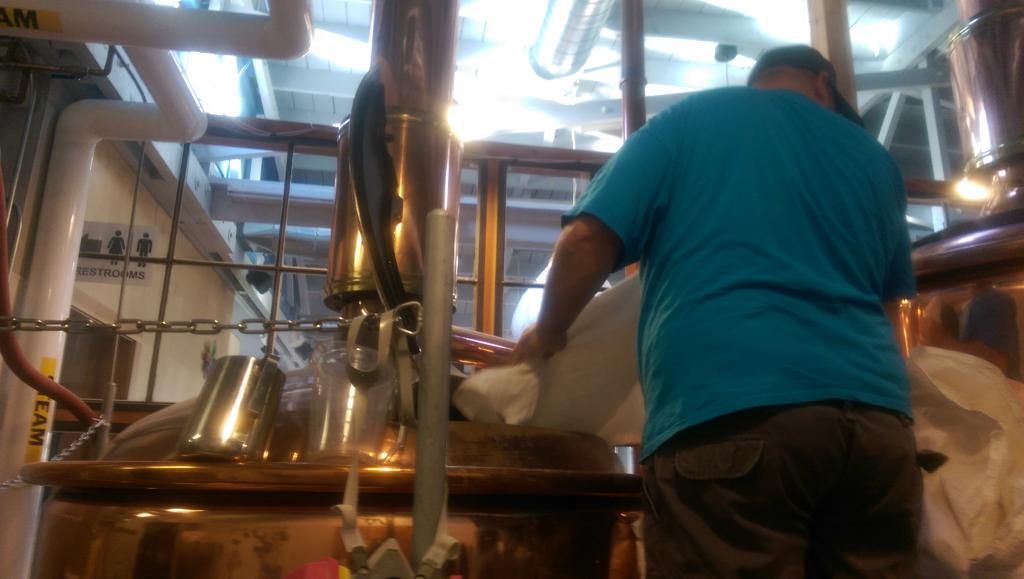
I also spent this past Saturday and Yesterday as a brewer for a day at Falling Sky Brewing. It was my prize for winning Best of Show in February. We weren't able to rebrew my beer since they don't do sours, but we did a mock of it which was fun. We mashed and soured the wort on Saturday, then went back on Tuesday to finish it off with a boil and hopping.
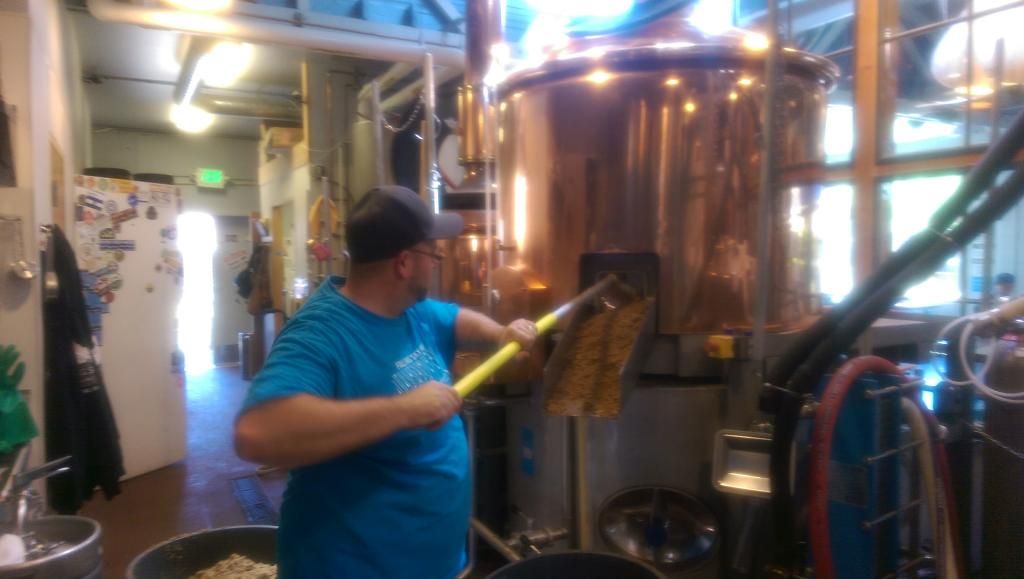
| Adding the grains to the mashtun |
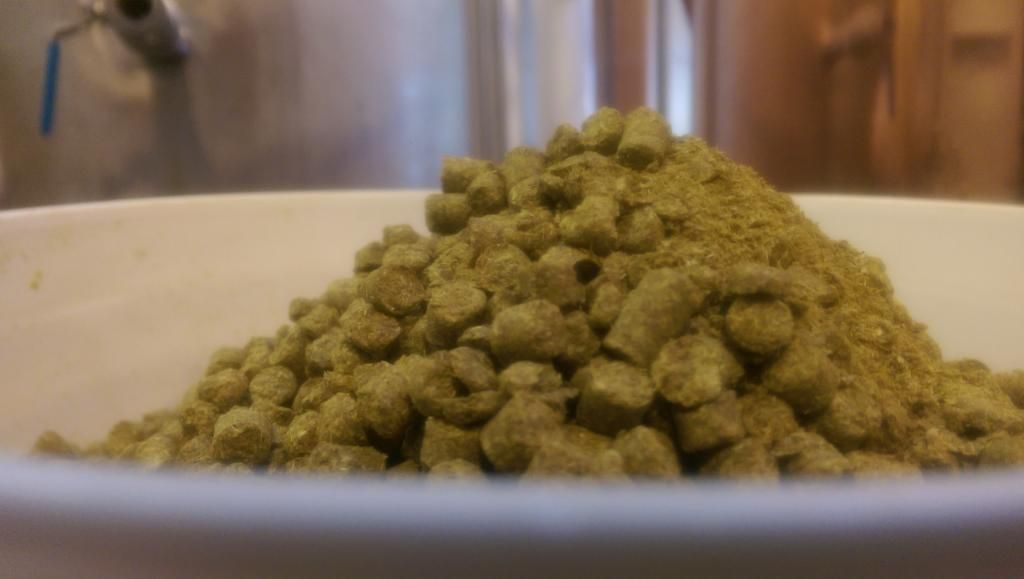
| 12oz Citra Mash Hops |
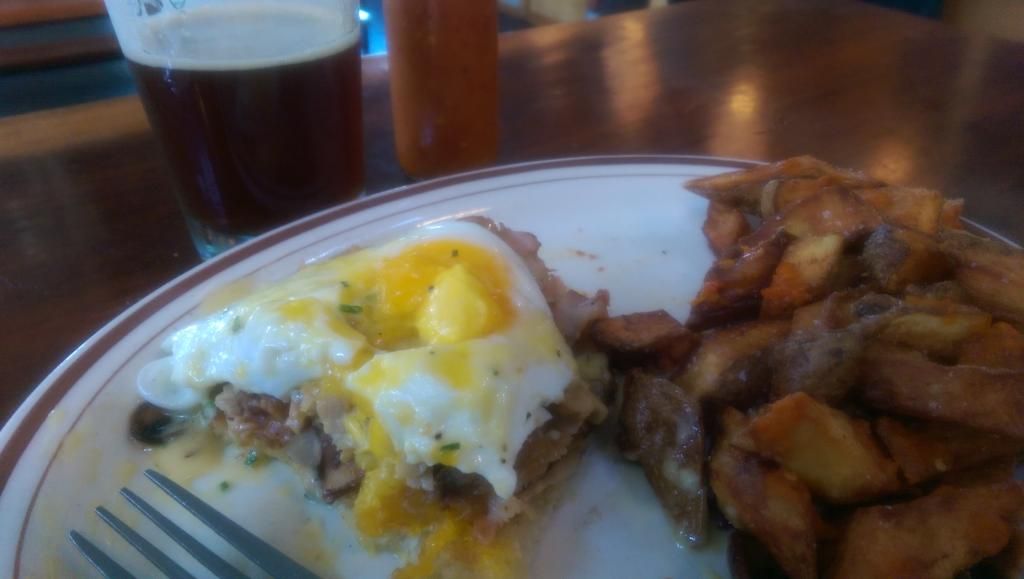
| Brunch at the brewery, Pork Benedict |
| Cleaning out the Lauter Tun |
| Simcoe, Galaxy, 291 |
| Free wort for me to take home and play with |
| Surprise lunch visitor came to see me brew |
| The yeast is in |
Wednesday, July 23, 2014
Review: #66 Becca's Bavarian (German Hefeweisse)
Look: 2/3
Pours a light golden, lightly hazy, hue under a thick moussey white head with tight small bubbles. Head fades fairly quickly to a thick cap and leaves lots of chunky lace. Carbonation bubbles flutter up through the beer.
Aroma: 7/12
Pours a light golden, lightly hazy, hue under a thick moussey white head with tight small bubbles. Head fades fairly quickly to a thick cap and leaves lots of chunky lace. Carbonation bubbles flutter up through the beer.
Aroma: 7/12
Ripe banana jumps out of the glass on first sniff at a medium intensity. A medium-low note of vanilla bean follows, as well as a medium level of spicy clove. Low levels of crackers, chex, and light bread crust linger under the fruits and spices. Mild wafts of strawberries round out the finish. The aromas could pop some more which would make this beer shine.
Flavor: 15/20
Tastes just like a banana milk shake. Medium-high banana esters give way to low levels of wheat chex, a nice medium spicy clove note, and even a touch of cinnamon. There is a light bubble gum, and mild tartness as well, no bitterness.
Mouthfeel: 2/5
The beer is juicy, with a medium body, and a spritzy, dry, crisp finish, touch of phenols. Carbonation needs to be higher as it is fairly low to style.
Overall: 6/10
Wonderful marriage of banana and clove, neither one dominates the other. The mild notes of vanilla, wheat, and bubble gum play well and add a level of complexity. A few things to work on is the carbonation, haze, and head. Bottle conditioning a Hefeweisse works much better as you are really able to get that higher level of carbonation that drives much of the aromatics up out of the glass more and would help increase the head retention. It also gives you the ability to swirl the yeast up and add to the glass which is very hard to do with a keg.
32/50
Flavor: 15/20
Mouthfeel: 2/5
The beer is juicy, with a medium body, and a spritzy, dry, crisp finish, touch of phenols. Carbonation needs to be higher as it is fairly low to style.
Overall: 6/10
Wonderful marriage of banana and clove, neither one dominates the other. The mild notes of vanilla, wheat, and bubble gum play well and add a level of complexity. A few things to work on is the carbonation, haze, and head. Bottle conditioning a Hefeweisse works much better as you are really able to get that higher level of carbonation that drives much of the aromatics up out of the glass more and would help increase the head retention. It also gives you the ability to swirl the yeast up and add to the glass which is very hard to do with a keg.
32/50
Wednesday, July 16, 2014
RECIPE: #66 Becca's Bavarian (German Hefe)
| Hefe's In The Back |
My wife loves a good, yeasty, estery, spicy German Hefe. Last time I made one she actually gave me an extra brewday as a gift to brew it and part of that gift was that she brewed it with me. Of course, I really enjoy a great Hefe too. They work great as the liquid in pancakes, and taste great alongside them. They are crisp, fruity, spicy, dry, wet, they hit the spot on a warm Summer afternoon while working in the yard.
The first ever Hefe I made was with yeast I had cultured from Sierra Nevada's Kellerweisse beer, and it tasted great. I wanted to go for that again this time too. I added the yeast dregs from a single bottle to 10ml of soy based culture media for a few days. When I was ready to step it up I added the yeast from 2 more bottles along with the vial to 150ml of wort that was stirred for a few days. This whole starter was added to 1000ml of wort which was stirred for a few more days, then decanted prior to pitching. From conversations I had a few years ago with Bill Manley from SN, this yeast does great with open fermentation, and if it is used under pressure, sucessive batches are too clean. I don't plan on doing another one for at least another year, so I plated the yeast from the starter to keep it banked for future use.
Friday, July 11, 2014
RECIPE: #65 Enygma (Mystery Saison)
![]() |
| Stepping up yeast from plate |
The yeast isn't the only mystery in this beer. The hops I used are multiple unknown varieties grown semi-wild that I picked last year. A brewer used to live at the house. It was purchased by another person who lets them grow on the corner of the lot on the fence where they all intertwine into one another. No one knows what the individual varieties are, but I do know there are more than 2 different varietals in that cluster of bines. I picked a pound (dried) of cones, and decided to use them in this Saison. Could be spicy, could be fruity, could be dank, could be pithy, could be floral, could be a blend of all of these. We shall see. I split this batch with a German Hefe and Berlinerweisse, so the grist is wheat heavy.
Due to the mysterious nature of the yeast and hops in this beer, I named it Enygma, a name I have wanted to use for awhile now. Part of the mystery... the yeast that is supposed to finish super dry bottomed out at 1.012 but the same mash and wort made a Hefe that terminated at 1.006. Still fairly dry though.
Wednesday, July 9, 2014
I Mash In My Sleep: Overnight Mashing
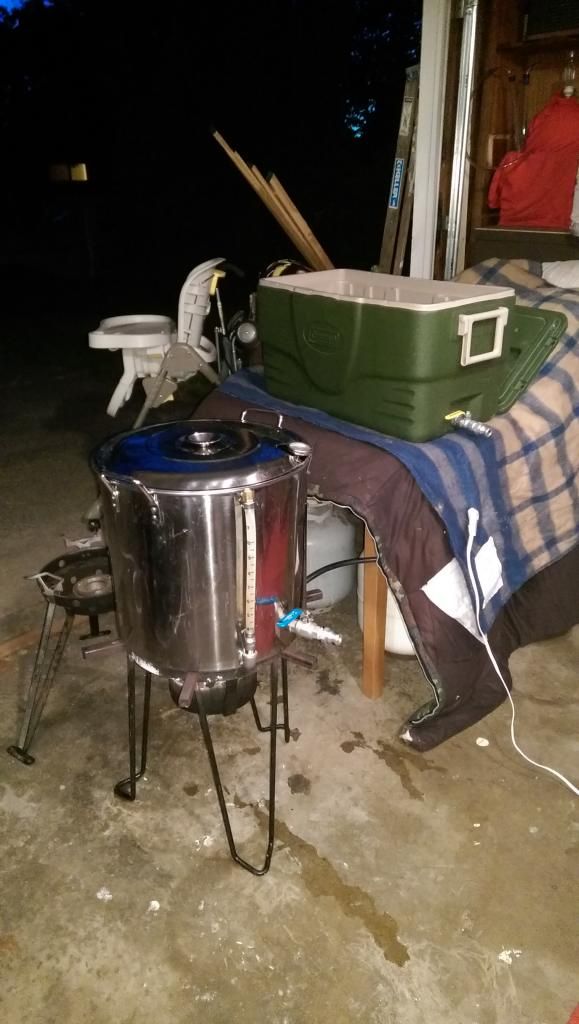
I use a cooler for my mash. I mash a fewer degrees higher than I normally would, and keep a normal pH. Basically I follow my standard All-Grain mash with batch sparge, except I go to sleep for the night during the mash itself. After doughing in, I wrap the cooler in an electric blanket, and then also wrap it in a sleeping bag. I lose about 1*F per hour, and usually mash 9-10 hours total. I also mash for 10 gallon batches to get my MLT near maxed out to improve heat losses.
Subscribe to:
Posts (Atom)