

Showing posts with label split fermentation. Show all posts
Showing posts with label split fermentation. Show all posts
Tuesday, February 3, 2015
RECIPE: #79 Blonde Jokes (Belgian Blonde)

Monday, August 4, 2014
#67 RE: Fresh (Mango Berlinerweisse)
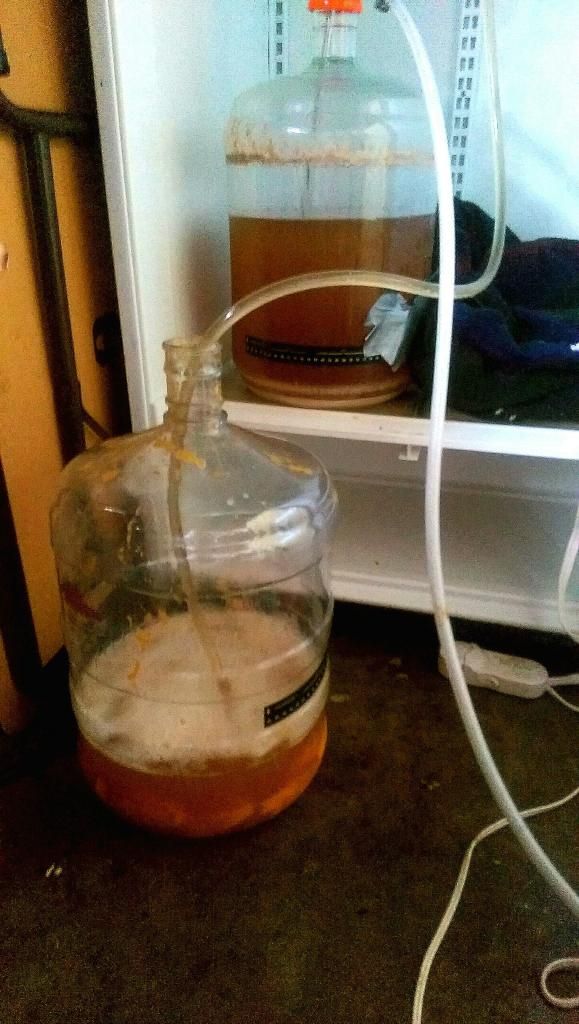 Another beer my wife really enjoys is a tart, light, spritzy, wheaty Berlinerweisse. As do I. And since the grists for my Hefeweisse I made for her and this Berliner are so close, why not make one of each at the same time. Last time I did this I had a bad sour mash. This time I opted for a single boil of both beers to 8.5 gallons, and then split them for fermentation. I topped off the Berliner to dilute it to the proper strength, and the IBUs were perfect for both. I have the Cascade Lacto strain, and decided to let it have fun all on its own for a week before introducing any Sacc to encourage good acid development in a short time. I pitched big too, 1L starter of a very fierce bacteria, then hit it with some Kolsch yeast to finish the work, lower the gravity, and drop the pH even more.
After primary was done it was yogurty, and tart, but not as tart as I wanted. I also had a few pounds of Mango chopped up in the freezer. I added the beer to the fruit to age for a few weeks, and also fermented some pure Mango juice with the Lacto for some more fruit flavor and sourness. On bottling I added a little food grade Lactic Acid to make it pop just a little more.
Wednesday, July 16, 2014
RECIPE: #66 Becca's Bavarian (German Hefe)
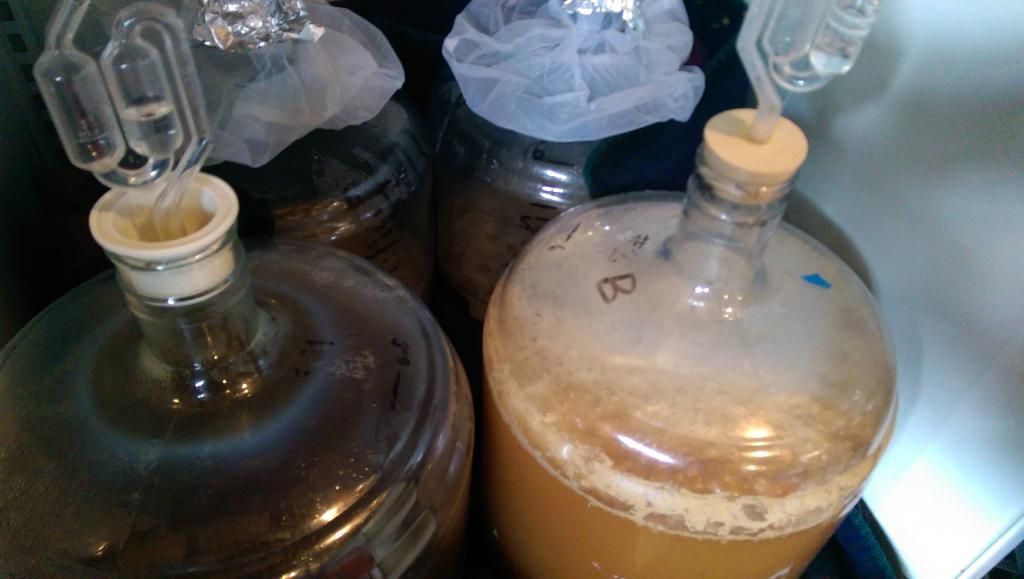 |
| Hefe's In The Back |
My wife loves a good, yeasty, estery, spicy German Hefe. Last time I made one she actually gave me an extra brewday as a gift to brew it and part of that gift was that she brewed it with me. Of course, I really enjoy a great Hefe too. They work great as the liquid in pancakes, and taste great alongside them. They are crisp, fruity, spicy, dry, wet, they hit the spot on a warm Summer afternoon while working in the yard.
The first ever Hefe I made was with yeast I had cultured from Sierra Nevada's Kellerweisse beer, and it tasted great. I wanted to go for that again this time too. I added the yeast dregs from a single bottle to 10ml of soy based culture media for a few days. When I was ready to step it up I added the yeast from 2 more bottles along with the vial to 150ml of wort that was stirred for a few days. This whole starter was added to 1000ml of wort which was stirred for a few more days, then decanted prior to pitching. From conversations I had a few years ago with Bill Manley from SN, this yeast does great with open fermentation, and if it is used under pressure, sucessive batches are too clean. I don't plan on doing another one for at least another year, so I plated the yeast from the starter to keep it banked for future use.
The first ever Hefe I made was with yeast I had cultured from Sierra Nevada's Kellerweisse beer, and it tasted great. I wanted to go for that again this time too. I added the yeast dregs from a single bottle to 10ml of soy based culture media for a few days. When I was ready to step it up I added the yeast from 2 more bottles along with the vial to 150ml of wort that was stirred for a few days. This whole starter was added to 1000ml of wort which was stirred for a few more days, then decanted prior to pitching. From conversations I had a few years ago with Bill Manley from SN, this yeast does great with open fermentation, and if it is used under pressure, sucessive batches are too clean. I don't plan on doing another one for at least another year, so I plated the yeast from the starter to keep it banked for future use.
Monday, July 8, 2013
Review: BANGARANG The Twins - Saison
As the heat starts to really set in for the summer, it is always good to have a Saison ready to drink. As I like to do with my Saisons, this one is bottled with Brett. I have become a big fan of the Dupont strain and Brett at bottling. The last time I used this combo I took 2nd place in a BJCP comp 7 months after bottling. We'll see what happens with this one after another 8 months in the same comp (at 1 year old). It's twin brother fared well in its category in a recent comp, so this one shouldn't do too bad. The Twins have the same flaw, not enough bitterness, and a low hop profile, but overall, both drink nicely in the heat, very refreshing. If you blend the two together, it makes for a lovely beer, akin to a Biere de Garde, earhty, musty, malty, light fruitiness, crisp.
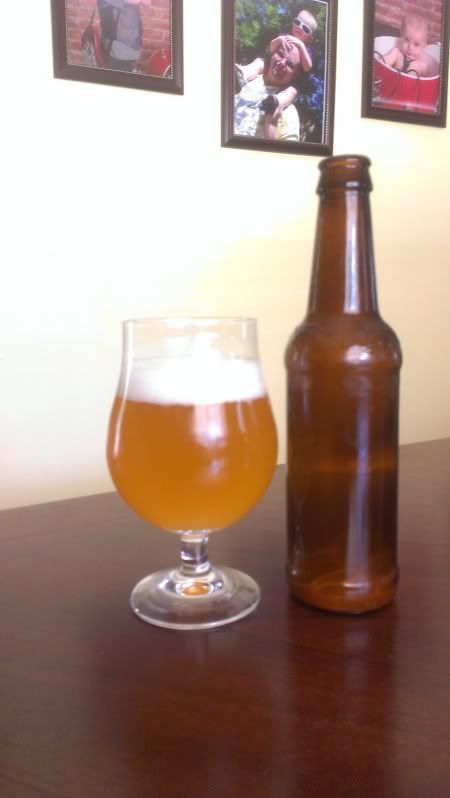 Look: Pours a hazy orange-gold with big white head that fades a little fast to a whisky cap that lasts. Bubbles flutter up throughout, bits of pellicle float on top.
Smell: smells like tons of over ripe fruits, can't pinpoint, tropical, and bright stone fruits. Basement funk follows, hints of tea, spices, noble hops are light, hint of compost.
Taste: Taste follows the smell, big fruits tropical and stone, lemon, tart, spicy, pepper, a lot of other spices I can't pinpoint. Light toasty malt and Pils sweetness.
Mouthfeel: Spritzy and light on the tongue, medium body with a bone dry finish. Bubbly. Balanced, but needs more bitterness.
Overall: Nice Saison. Needs a little more bitterness, just like the Pils that makes up the other half of the Twins. The depth of fruitiness makes it hard to tell where the Saison yeast ends and the Brett begins. The spiciness is evident but I can't define it. Great balance between bright fruits and spices, with a subtle funk starting to take shape. Enjoyable, light, refreshing, as a Saison should be.
Monday, April 8, 2013
Recipe: BANGARANG - The Twins (3rd Place - German Pilsner & Saison)

Thursday, March 14, 2013
Increased Output: Multiple Beers With Minimal Effort
 I learned early on that I needed to find a way to brew more beer without taking away more time from my family and ministry. Although this seems impossible, I found a trick that has allowed me to double my output while keeping my brew schedule light. I began doing this in my 5th month of brewing and have used it a lot ever since. Basically, make one beer into 2 (or more). There are a couple options for doing this, some require a little more time and effort, others are no more difficult than making a single 10 gallon batch.
Friday, February 8, 2013
Recipes: Identity Crisis II (Black IPA) & 2nd Place - Homie's Hop Sock (IPA)

Tuesday, March 20, 2012
Yogurt... In My Beer?
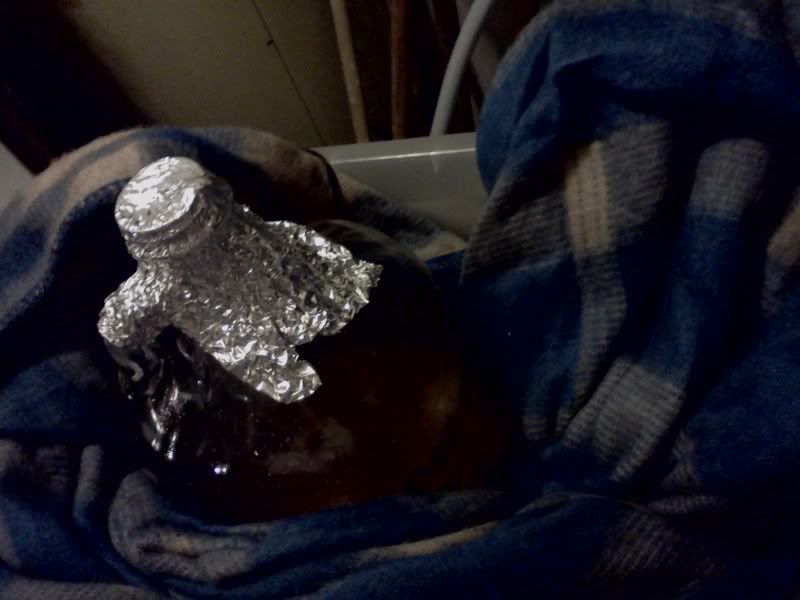 So much cleaning, so much sanitizing, so much stressing about whether I would ever be able to brew a clean beer again, and then the inevitable happens... another infected batch. I had stripped apart my conical, soaked it in PBW and hot water for over a day, and then left it in bleach for nearly a week. After brewing up 8 gallons of Blonde Ale to split between the conical and my Better Bottle (that had housed the infection as well) as a test to see if I had rid myself of it, I let them both ferment for a week. I pulled samples of both of them to taste, smell, and check the gravity. What I found from that conical was so much different than the Better Bottle. Dull, lifeless, dirty fruit, watery, and 3 points lower, diagnosis: INFECTED! With that, I resigned my efforts to salvage the fermenter, after all I had done, it was to no avail, and thus, a new fermenter for brewing up sours was born. And with all my renewed passions towards sours, it happened at just the right time. I was already planning on souring half the batch anyways, this just made it easier.
I pulled a gallon of the beer from the ball valve that went straight into a glass jug that had housed my Brett starter before it went into the leftover wort from this brew session, and had yet to be cleaned. Given a few months, the Brett should build up a nice pellicle and funk it up quite a bit. In the conical, I added a 1/4 cup of a starter I had built up from the dregs of Russian River's Consecration last summer, as well as a 1/4 cup of the Lambic I brewed last September using yeast I cultured from blackberries growing wild in my neighbor's backyard. I tossed in about 8 cubes of French Oak that were previously used by a winery in Lodi, CA to revive an old barrel as well. I also have a starter from RR Supplication that I won't be adding, at least not right now, because there is a lot of head space in that vessel right now and that culture has some definite acetobacter from when I used it in a bucket on another brew.
Just for the fun of it, I also made a 1L starter with 750ml water and 250ml Apple Juice, and 100g DME, that I cooled to 115*F, and pitched in 1/3 a serving Zoe Non-Fat Plain Greek Yogurt, which I inserted my temp control probe into and set it to 115*F wrapped in the heating blanket I received from a friend. 3 days later, the temp is constant at about 39*C (~100*F). When I poured a sample it fizzed like Alkaseltzer, which is good, that means carbonation, which means that something is going on. A sniff gives hints of yogurt, clean, nothing off in the aroma. A taste gives off sour apples, and a light yogurt twang. I effectively cultured Lacto from Greek Yogurt! After a few more days, I added 3/4 gallons of water mixed with 1.25# Clover Honey to bring it up to 4L, and give it a week or so at 100*F. Once this gallon of Lacto fermented Mead is ready to go, I will add it to the main Blonde Ale in the conical, along with another 1.25# of Clover Honey in a gallon of water, and let her ride for a good 6-8 months. Then I will add back in the gallon of Brett only portion, and hit it with 2-3# of fresh Apricots this Summer. This will bring the total volume of beer up to 6 gallons, with a new OG of 1.041 (1.037 prior to honey), and a FG of near 1.002 (or less) for a 5% ABV oak aged, wild Honey Blonde Ale.
Here's to innovation and infections!
Sunday, March 18, 2012
Review: Heart Murmur - Atrium
 It is always fun to test different ingredients and how they work and produce different attributes. A single malt, a single hop, a single yeast strain. Different combinations can produce different results. In this case, a single change of yeast strain produces vastly different results. One batch of wort, 100% Great Western Pale Malt, 3.0 oz of EKG hops to finish the beer (Magnum for bittering), to make 8 gallons of 1.052 wort, split two-ways. One received WY 1469 West Yorkshire, this one WY 1968 London ESB. It is amazing how the two yeast produced 2 vastly different beers, one malty, complex, hoppy, but not bitter, medium body, yet dry and light on the tongue; very impressive beer. As the following review shows, the second yeast, not so much, bitterness is pronounced, as are the hops, no malt character at all, dry, thinnish, light fruity esters, phenols, acetaldehyde. As with the West Yorkshire, the name comes from a flutter in a heart test called a Heart Murmur, which triggered some more tests; seeing as I was using all EKG hops, I decided to run with that as the name. Atrium comes from the location of the heart, in the lower section of the heart as is London in England when compared to West Yorkshire (the yeast for the other half of the beer).
Look: Pours a light orange with 1/2 finger pure white head, brilliant clarity, head fades slow to a thick cap that sticks around and leaves a great lace throughout.
Aroma: Hoppy, grassy, floral hops, light nuttiness, not much malt character, hoppiness is pronounced. Light banana esters, spicy.
Taste: Tastes of hops, floral, spicy phenols upfront and carry through, lots of cloves and pepper, clean malt but not much more. Banana, and some other light fruitiness. Phenols dominate the palate, covers up what should be there, wish there was more of a malt backbone.
Mouthfeel: Bitterness is pronounced, malt is missing, light, somewhat bland and watery, dry phenolic finish with a lasting bitterness. Acetaldehyde leaves a sticky mouthfeel, and astringent as well.
Overall: Not at all the blend of malt and hops, complex, balanced beer that the same wort produced with the West Yorkshire Yeast. Amazing how different these beers turned out. This beer has the bitterness and tons of flawed fermentation characters thanks to the brewery pitch of hop sludge. The more I drink this version, the more I want to pour it out.
Thursday, March 15, 2012
Review: Heart Murmur - Ventricle
 I honestly am very impressed with this brew. The more I drink it, the more I think it needs to become my house beer. It's simple, light, balanced, and delicious. It's actually quite complex for being only one malt and one hop. I will be posting a second review of "this beer" soon. I brewed 8 gallons of this wort and split it to 2 different Better Bottles and pitched 2 different yeast strains. This beer is all Great Western Pale Malt (3L) to 1.052, mashed for 1 hour @ 147*F. It has a bittering charge of 1oz Magnums for 60 minutes, and an ounce each of EKGs @ 15, 5, and FO (8 gallons). FG was 1.009 for an ABV of 5.7%. This batch was fermented w/ WY 1469 West Yorkshire. During an EKG for my blood pressure spike a few months ago, there was a flutter in the test called a Heart Murmur, which triggered some more tests; seeing as I was using all EKG hops, I decided to run with that as the name. Ventricle comes from the location of the heart, the ventricle is in the lower section of the heart as is West Yorkshire in England when compared to London (London ESB was the yeast for the other half of the beer).
  Appearance: Pours a hazy golden-orange with a tight, pure white 1/2 finger head that persists and fades to a thick cap on top. Lacing is thick and sticks nice along the top.
Aroma: Smells of peaches, nectarines, and bananas, floral hops, faint citrus fruits, grassy, white pepper, bread dough, yeast, honey, herbal.
Taste: Taste mirrors the nose, floral hops, fruity, not yet ripe apricots, spicy, grassy hops, bread dough and yeast, floral alcohol, honey.
 Mouthfeel: Medium-Light body, light on the tongue but not thin, dry finish, lingering bitterness in the back of the throat. Crisp and refreshing. Carbonation is light.
Overall: Very impressed. Great marriage of malt and hops, complex hop and malt character for a SmAsH brew, yeast creates an amazing fruity bouquet and draws out a depth to the malt, the bitterness is subdued, yet balances well with the dry finish. Very refreshing. The yeast haze is not to style, but I could care less about clarity.
Wednesday, March 7, 2012
Laminated Envelope
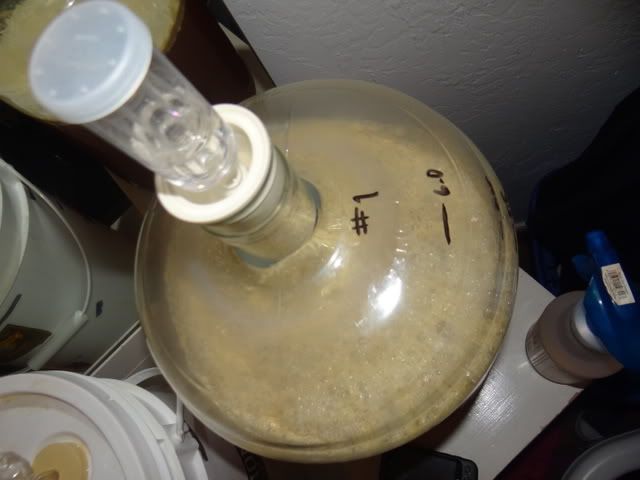 After all of the infections in my past 8 batches, then cleaning and sanitizing all the equipment, it was finally time to test it. I made some new adjustments to my brew house to help facilitate the brewday as well. I split my cold and hot water lines for my laundry and added Fresh Water hoses to it so I have water in the brew house now (no more running back and forth to the bathroom for strike and sparge water, or cleaning). I also got some plastic 4.5 cup measuring cups for hops. While my strike water was heating, I thought it best to calibrate my thermometer only to find it was 7*F off, meaning that on the past few batches when I thought I was mashing at 147*F, I was really at 140*F... thus 83% attenuation on my Bitters with yeast that stops at 72%. This also made my mash hit 159*F instead of 153*F, so I hit it with cold water until it evened out at 153*F.
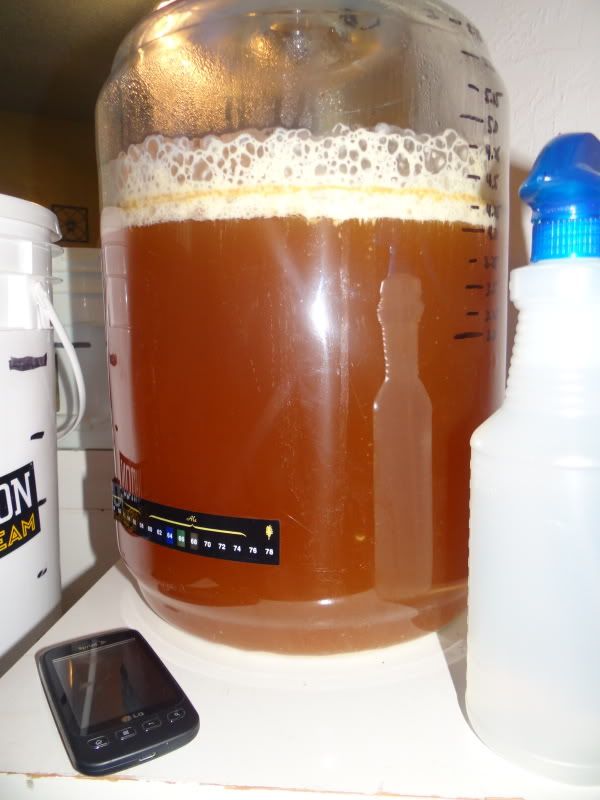 After I ran off my first runnings, I hit it with my sparge water and gave it a good mix. Started to run off the second runnings and noticed that it was quite slow from 7.5-8 gallons, then no movement at all... my very first stuck sparge (23 batches). I gave it a good stir, recirculated, and ran off the remainder to 10 gallons @ 1.040. 1.040 was supposed to be my OG post boil. I hit 90% efficiency. Had to think on the fly for this one. I didn't want a 1.050 Blonde Ale, so I topped it off with cold water to hit 12 gallons preboil @ 1.033, and added another 0.10 oz of Zeus for the adjusted bittering. Boiled it down to 10.5 gallons in an hour for an OG of 1.037 (should have boiled another 15-20 minutes to get it closer to my desired OG of 1.040). My Immersion Chiller - designed for 5 gallon batches - took the 10.5 gallons from boiling to 90*F in about 22 minutes, not bad (another 15 minutes to get it to 65*F).
After letting it settle, and sanitizing my Better Bottle, conical, and a 6.5 gallon plastic bucket, I started running it off into the Better Bottle (measurements are fully calibrated on it). At  about 1.75 gallons, I stopped the flow and dumped it from the BB to the bucket, then filled the BB to 4 gallons and dumped it into the conical (which was severely off on its measurements). Then I sent 4 gallons to the BB and the last of it to the bucket (2.5 gallons total). I aerated the BB and conical and pitched the 1.5L West Yorkshire starter into the two batches. I pitched a starter of Brett I made from Orval previously into the bucket for a Brett Blonde with the extra wort (didn't want to pitch the yeast for 8 gallons into 10.5).
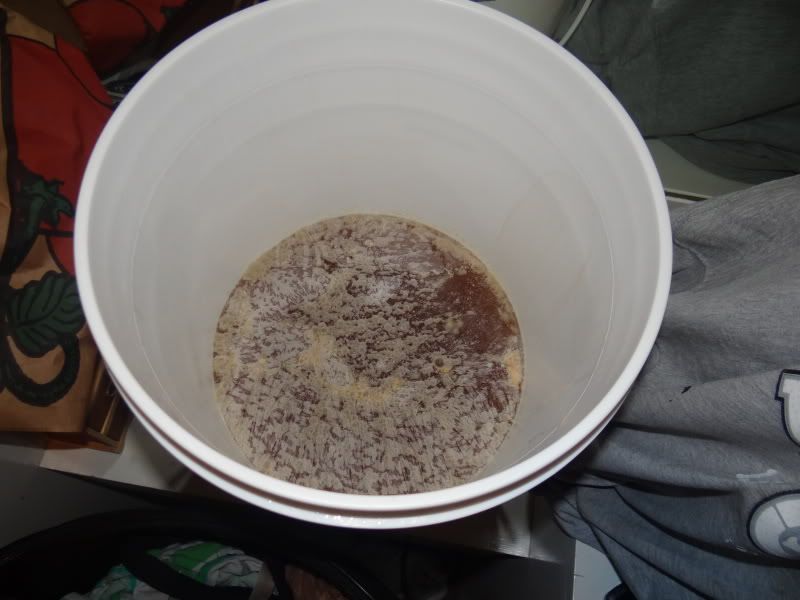 about 1.75 gallons, I stopped the flow and dumped it from the BB to the bucket, then filled the BB to 4 gallons and dumped it into the conical (which was severely off on its measurements). Then I sent 4 gallons to the BB and the last of it to the bucket (2.5 gallons total). I aerated the BB and conical and pitched the 1.5L West Yorkshire starter into the two batches. I pitched a starter of Brett I made from Orval previously into the bucket for a Brett Blonde with the extra wort (didn't want to pitch the yeast for 8 gallons into 10.5).
The Blondes were rocking within 16 hours, and full bore by 30 hours, but the Brett Blonde was still a no-go at 42 hours, so I dumped the rest of the Orval starter into it before work and came home to a nice pelicle. After another 36 hours the pelicle is full bore and bubbled up nicely. Another 24 hours later and the Brett Blonde has a krausen. Wort stability test was still showing no activity at one week, which is awesome, I opened it and it is pure fresh wort.
After one week, I took samples and readings on all of them. The Better Bottle smells of peaches, melons, and a touch of sweet malt at 1.010. The conical is at 1.007, the aroma is lightly phenolic and has a light dirty fruit smell... I am thinking the conical is infected and will now house sours only which sucks since it would be perfect for lagers, yet I want to do more sours so that works too. The Brett Blonde is acidic, light, funky, a little fruity, and slightly oxidized (I dumped the whole 2L 8 month old starter into 2.5 gallons, to be expected), and it is @ 1.007 as well.
_______________________
American Blonde Ale
10.5 gallons
20 IBUS
4 SRM
3.5 ABV
_______________________
11# Pale Malt
1# Carafoam
0.5# Honey Malt
45 minute mash @ 153*F
90% Efficiency
_______________________
60 minute boil
60 mins 0.20 oz Zeus 15.4% AA
25 mins 1.00 oz Amarillo 10.4% AA
0 mins 1.00 oz Amarillo 10.4% AA
_______________________
1/4 tsp Gypsum - Mash
3/8 tsp Calcium Chloride - Mash
1/4 tsp Gypsum - Boil
1/2 tsp Calcium Chloride - Boil
1/4 tsp Yeast Nutrient 12 mins
1 tab Whirfloc 12 mins
_______________________
Chill to 62*F
Pitch 1.5L Starter WY 1469 West Yorkshire
Split to 3 fermenters
Ferment 68*F for 7 days
Ambient for 21 days
Bottled 18 - 12 oz bottles w/ 4 carb tabs each from Better Bottle only
Soured all remaining beer
_______________________
OG 1.037
FG 1.010
3.5 ABV
_______________________
11# Pale Malt
1# Carafoam
0.5# Honey Malt
45 minute mash @ 153*F
90% Efficiency
_______________________
60 minute boil
60 mins 0.20 oz Zeus 15.4% AA
25 mins 1.00 oz Amarillo 10.4% AA
0 mins 1.00 oz Amarillo 10.4% AA
_______________________
1/4 tsp Gypsum - Mash
3/8 tsp Calcium Chloride - Mash
1/4 tsp Gypsum - Boil
1/2 tsp Calcium Chloride - Boil
1/4 tsp Yeast Nutrient 12 mins
1 tab Whirfloc 12 mins
_______________________
Chill to 62*F
Pitch 1.5L Starter WY 1469 West Yorkshire
Split to 3 fermenters
Ferment 68*F for 7 days
Ambient for 21 days
Bottled 18 - 12 oz bottles w/ 4 carb tabs each from Better Bottle only
Soured all remaining beer
_______________________
OG 1.037
FG 1.010
Just for fun... the name of the beer came from an infamous day for a co-worker that she will never live down. Back when our new branch was just opening and didn't have their own laminating machine, they would send any items for laminating to our main branch. The branch sent a couple new membership cards over to have laminated and placed into an envelope that was ready to mail to the members. The sticky note said "Please laminate and mail to the members" meaning, laminate the cards, place in envelope, and mail. The blonde of all blondes placed the cards into the envelope, then laminated the envelope and sent it back to the branch with a big question mark. Thus, an apt name for a Blond Ale... Laminated Envelope.
Friday, February 24, 2012
Here's To Hoping It's Gone
Over the 3 day weekend I took the time to thoroughly clean and sanitize some of my equipment. As I was able to deduce that the infection spread through 1 yeast into 2 fermenters, I knew what I needed to care for. I started by giving all 3 fermenters a 17 hour soak in hot PBW  over night. I gave it the recommended ½ cup dosage for the 15-25 minutes, and left it for 17 hours. I came to find out that I actually didn’t need to use that much if I was doing an elongated soaking, but at least this way I know they are clean. After this I filled a bucket with the PBW solution from one of the Better Bottles, removed the brass ball valve from my conical (it smelled like mushrooms – not cool), and placed the conical into the bucket so that the threads could get a good soak. At this point I filled the Better Bottles with cold water and 3 cap fulls of bleach. After a few hours I removed the bleach water and refilled the Better Bottles with PBW solution to help clean out any bleach. I then rinsed each one 5 times with hot water, and had my wife smell test them for any bleach. I also added the bleach to the bucket that previously contained the PBW and soaked the bottom and threads of the conical overnight. The next morning I put my bottling bucket spigot on the conical (same size threading) and filled it up with the bleach water as well (topped off with more cold water and extra bleach), and that has been soaking for 5 days. Tonight I will give it a thorough rinse with PBW and hot water and then let it dry out.
 over night. I gave it the recommended ½ cup dosage for the 15-25 minutes, and left it for 17 hours. I came to find out that I actually didn’t need to use that much if I was doing an elongated soaking, but at least this way I know they are clean. After this I filled a bucket with the PBW solution from one of the Better Bottles, removed the brass ball valve from my conical (it smelled like mushrooms – not cool), and placed the conical into the bucket so that the threads could get a good soak. At this point I filled the Better Bottles with cold water and 3 cap fulls of bleach. After a few hours I removed the bleach water and refilled the Better Bottles with PBW solution to help clean out any bleach. I then rinsed each one 5 times with hot water, and had my wife smell test them for any bleach. I also added the bleach to the bucket that previously contained the PBW and soaked the bottom and threads of the conical overnight. The next morning I put my bottling bucket spigot on the conical (same size threading) and filled it up with the bleach water as well (topped off with more cold water and extra bleach), and that has been soaking for 5 days. Tonight I will give it a thorough rinse with PBW and hot water and then let it dry out.
Next week I have an extra day off after taking the youth group to the coast for a weekend retreat, and I am going to brew up a batch of beer to test the Better Bottle and Conical. After talking to Michael Tonsmeire (Mad Fermentationist), I decided to do an American Blonde Ale since this style will show any signs of infection, and will probably still taste good if it does get infected. I worked up a recipe for it and will finally get to use the Amarillo
Friday, February 10, 2012
It's Been Awhile
As you can easily see, it's been awhile since I posted on the blog, and I thought that an update might be in order. Here are a few things I have been working on and brewing. After the last brew when I tested my efficiency, stabilized my system, and began to work on my own brewing "software" a lot has happened.
I brewed a partigyle Wee Heavy with Heather Tips and a Scottish 90- that was aged on Oak and Laproiage Islay Scotch. The beers didn't turn out as I'd liked.  They are way too fruity and not very malty. The 90- is much further down this line than the Wee Heavy. All of this is recipe based. I added both c120 & Special B which added tons of fruit and none of the caramel and subtle dark fruits I was looking for. The peat malt came off quite phenolic. Using 1056 subdued any maltiness I was looking for and through off lots of fruit. I have already reworked the recipe to remove the c120 and Special B, and added French CaraMunich and CaraVienna for light caramel and toasted sugar, and British Dark Crystal for more of the same, and went for 1968 London ESB to pull of a heavily malty character.
 They are way too fruity and not very malty. The 90- is much further down this line than the Wee Heavy. All of this is recipe based. I added both c120 & Special B which added tons of fruit and none of the caramel and subtle dark fruits I was looking for. The peat malt came off quite phenolic. Using 1056 subdued any maltiness I was looking for and through off lots of fruit. I have already reworked the recipe to remove the c120 and Special B, and added French CaraMunich and CaraVienna for light caramel and toasted sugar, and British Dark Crystal for more of the same, and went for 1968 London ESB to pull of a heavily malty character.
I also brewed a second partigyle, a 10.6% Imperial Stout with Chipotle & Cherries, and a  Session Stout with Orange and Cinnamon. The big beer was fermented for 3 1/2 weeks, then aged 1 week with Chipotle and 3.75# Sweet Cherries, then another 3 weeks with just the cherries, then aged 1 more week on its own before bottling. It is quite smooth, fruity, dark, rich, chocolaty, and a slight roast. The second beer was quite devoid of character. I took a tip from Gordon Strong and cold steep some more Chocolate Malt, C75, and Black Patent, boiled it with more orange zest, and added it to the fermenter. I also added Malto-Dextrin at bottling for some more body and also offset all the oil from the orange zest so there is still great foam and head retention.
 Session Stout with Orange and Cinnamon. The big beer was fermented for 3 1/2 weeks, then aged 1 week with Chipotle and 3.75# Sweet Cherries, then another 3 weeks with just the cherries, then aged 1 more week on its own before bottling. It is quite smooth, fruity, dark, rich, chocolaty, and a slight roast. The second beer was quite devoid of character. I took a tip from Gordon Strong and cold steep some more Chocolate Malt, C75, and Black Patent, boiled it with more orange zest, and added it to the fermenter. I also added Malto-Dextrin at bottling for some more body and also offset all the oil from the orange zest so there is still great foam and head retention.
For Christmas I got my refractometer and and an aquarium temp control unit (I will post more about this in another post). I also got a second Better Bottle which was great for my next brew session. I did a "SmAsH" (Single Malt and Single Hop) type beer. I say type because I used Magnums for the bittering addition since EKGs are low in Alpha Acids and way too expensive. I used Great Western Pale Malt, and finished the batch with 3oz of EKG hops in the last 15 minutes of the boil. I then split the 8 gallon batch into 2 Better Bottles and pitched 2 different yeasts: WY 1968 London ESB and WY 1469 West Yorkshire. Come end of fermentation I used the new temp controller to up the temp for a Diacetyl Rest. I then crashed the beers to clear them. The whole thing went great, but I ended up under carbonating them since the app calculates based on temp and I used the crashed temp not the ferment temp.
 a second Better Bottle which was great for my next brew session. I did a "SmAsH" (Single Malt and Single Hop) type beer. I say type because I used Magnums for the bittering addition since EKGs are low in Alpha Acids and way too expensive. I used Great Western Pale Malt, and finished the batch with 3oz of EKG hops in the last 15 minutes of the boil. I then split the 8 gallon batch into 2 Better Bottles and pitched 2 different yeasts: WY 1968 London ESB and WY 1469 West Yorkshire. Come end of fermentation I used the new temp controller to up the temp for a Diacetyl Rest. I then crashed the beers to clear them. The whole thing went great, but I ended up under carbonating them since the app calculates based on temp and I used the crashed temp not the ferment temp.
My library finally got Farmhouse Ales after a year of waiting for it. While reading it I brewed a simple Saison using the WY special Farmhouse Ale strain. I mashed at 147*F, the same that I did last Summer when I brewed my two Saisons using the Dupont strain WY 3724 Belgian Saison, but the beer didn't finish as low as I had hoped (the 3724 took the beers down to 1.004 & 1.005, 3726 to 1.008). After a week in the Better Bottle at a constant 75*F, I primed and bottled in champagne bottles for added stability against the higher carbonation and the possibility that the beer might not have been finished at bottling.
I have also made a lot more adjustments to the brewing spread sheet I created. I added a refractometer adjustment section that takes the Brix and calculates OG, efficiency, and once fermentation is finished converts for alcohol to give FG, and ABV. I also added all of the malts with gravity, Lovibond, and cost from the homebrew shop as well as flavor descriptions. I was able to get a list compiled of all the hops in one of the fridges with all the Alpha Acids. I will be adding the cost and flavor aroma profiles for all of the hops as well and adding the second fridge's stock as well.
I also used my temp controlled fridge to maintain a constant 71*F to carbonate the Saison and my Imperial Stout. I will be posting some taste reviews soon on all these beers once they are carbed up and ready, so be watching for these blogs as well as a how-to-build your own dual stage temp controller for $40 (why pay $150 for a Johnson or Ranco).
Subscribe to:
Posts (Atom)