Showing posts with label Wee Heavy. Show all posts

Wednesday, June 25, 2014

Review: #55 The Callen 2013 (2nd Place Oaked Wee Heavy)

Scottish Wee Heavy.  I really enjoy them, but have not been able to make one I enjoyed in my 2 previous attempts.  One was infected and had lots of cherry pie.  The other was left to age on the yeast too long and tastes like pot roast (great for cooking stew, chili, or Corned Beef).  For this one I used a base of Golden Promise for a richer and sweeter malt character, and layered on top of it Cara-Pils for body, and British Dark Crystal, Carastan, and a hint of Special B to play up the rich toffee and dark fruits.  I wanted this one to hit hard on all cylinders.  Add to that aging it in the keg for a few months on second round oak chips and some Bourbon.  Almost perfect.  Needs a couple tweaks.  10.4% tastes nice, should drink great this fall after a few more months in the cellar.

Aroma: 10/12
The first thing to hit the nose is dark plums, caramelized figs, and rich toffee.  Behind this is a dark crusty bread.  Layered in and around the malts are medium-low notes of vanilla, barrel juice, and char.  Notes of molasses and burnt raisin linger in the back with a finish of alcohol.  The malts are dominant, but the level of aroma is medium high at most which is too style, malty, but doesn't jump out of glass like other styles.

Appearance: 3/3
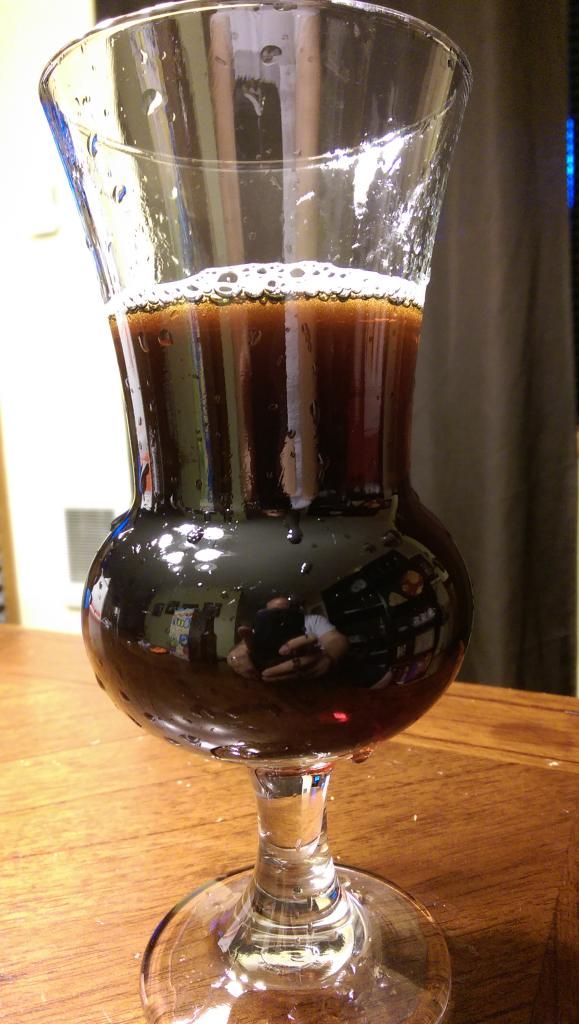
Poured into a traditional Scottish Thistle glass at cellar temps, the beer is a clear dark brown with deep garnet highlights under a thin wispy khaki head that remains as a ring all the way through.  Leaves no lace, but lots of legs slip on the glass with each sip.

Taste: 12/20
As you sip you're greeted with rich malts, dark bread crust dominates.  Not much of the dark fruits from the nose though which is sad, but there is a good medium level note of burnt sugar.  Touch of age is on the palate with a hint of Sherry, but this is behind the woody oak, Bourbon juice, notes of vanilla, and a deep char from the wood.  The Bourbon character is low, the wood a little more expressive, but not by much.  Quite sweet.

Mouthfeel: 2/5
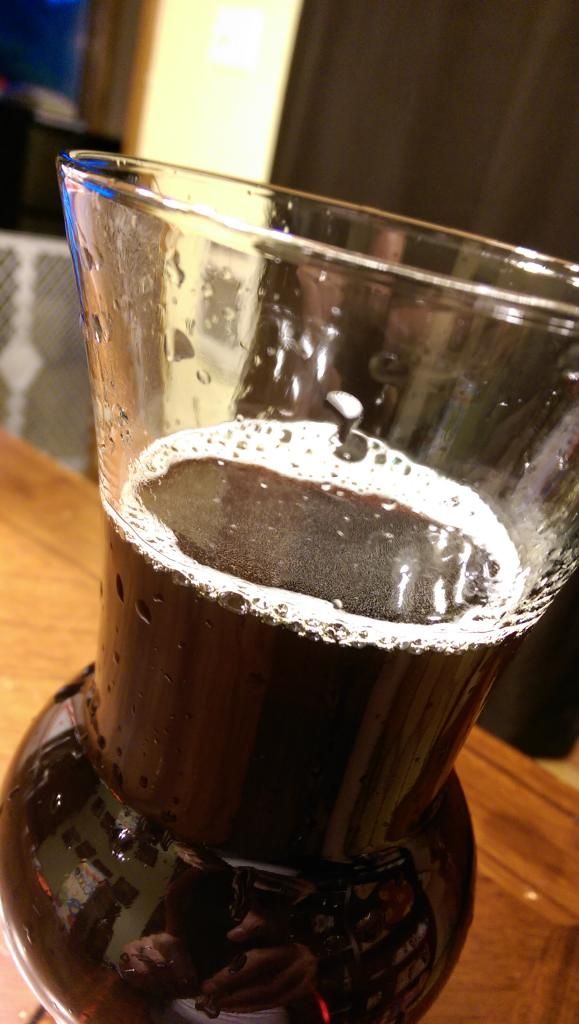
The beer is full and chewy, sweet, borderline cloying.  Low carbonation as to style.  The finish is sweet and full and rich, not really a trace of hop bitterness.  Definite warmth from the high alcohol, but it is clean.  The finish is flabby, needs some pH adjustment to finish a little cleaner on the palate.  Also need to use fresh hops instead of homegrown ones that are a little old, needs a touch of bitterness to balance it out.

Overall:  6/10
This beer is rich.  Super malty, with big alcohol warmth.  Great blend of oak and dark fruits and melanoidins in the nose, and caramel and oak on the tongue.  As far as a base recipe, I am thinking I hit it on this rendition, but still needs some tweaks on water and pH to help the finish, as well as a beefier IBU to help with all the sweetness and aging.  The oak and Bourbon need some help.  I actually think that this beer would be better with a little more oak, and Rum instead of Bourbon.  A touch of acid in the glass helps the finish round out better and cleanses the palate on the swallow.

33/50

1/31/15*** This beer took 2nd Place in Wood Aged Beers at the 2015 KLCC Homebrew Competition***

Friday, January 31, 2014

RECIPE: #55 The Callen 3.0 (2nd place Oaked Wee Heavy)

Wee Heavy.  The one style I have brewed 2 other times before and failed at.  One was in the middle of a repitched yeast off a used plastic conical that infected nearly 8 batches of beer.  That Wee Heavy, even without being an infected gusher, had way too much cherry and no caramel at all.  The next one was a semi-descent beer except for the autolysis which made the beer taste like pot roast... but it works great in chili or to braise beef.  

I enjoy a good Wee Heavy on a cold Winter night when I want a big, heavy, malty, sweet desert in a glass.  It is a very hard style to get right too.  Too much bitterness and a lower FG you have more of a Strong Ale.  Too little bitterness and a higher FG and it is too sweet.  Balancing the mouthfeel, the FG, the bitterness, and the flavor profile is absolutely key.  This of course becomes even harder as you go bigger.  More alcohol changes the mouthfeel, adds sweetness, but makes it finish a little dryer than the FG can make you think it will.  Then toss in the cellaring factor which will inevitably lower the IBUs as isomerized Alpha Acids drop out of solution.

Tuesday, October 23, 2012

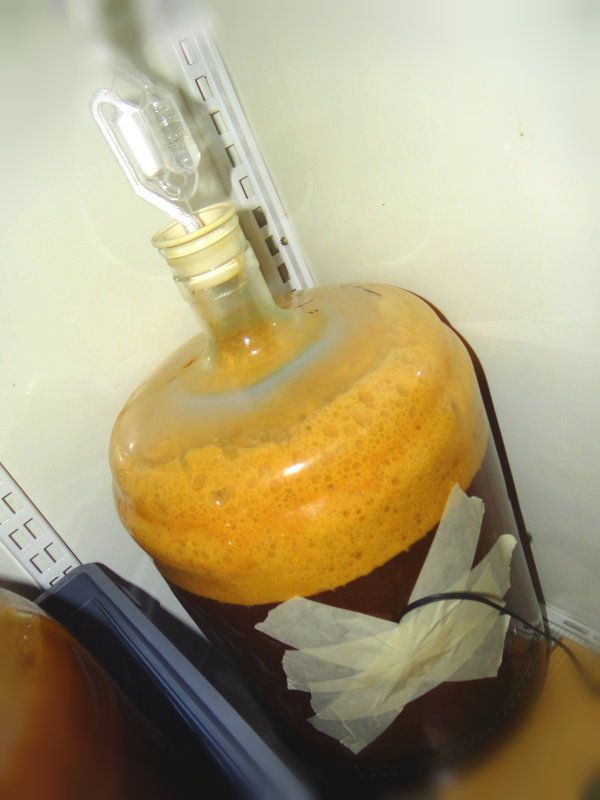
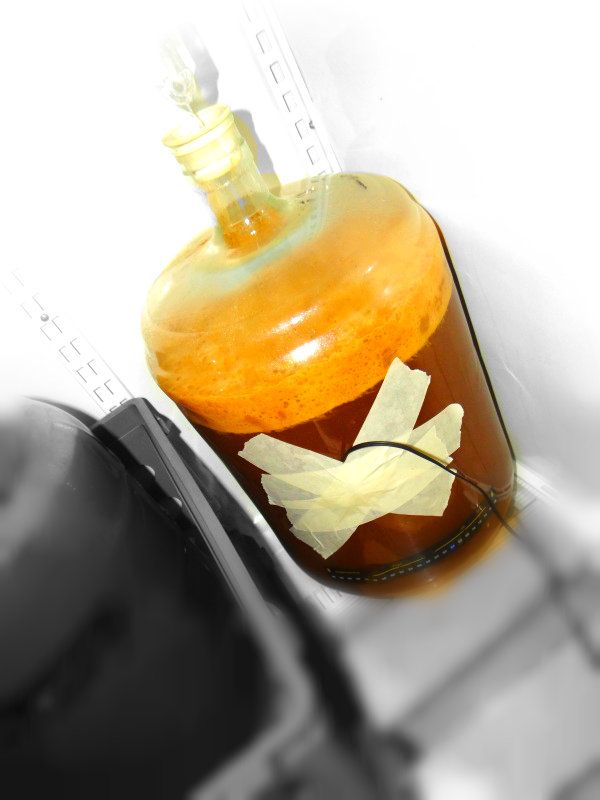
The Callen's Killer Krausen

Came home tonight to find this awaiting me in the ferm fridge.  Only 4.8 gallons of wort in this 6 gallon Better Bottle and I'm still in danger of a blow off.  Man this beer is ripping like mad.  Glad that I didn't top off with that 1/2 gallon of water already.

Recipe: The Callen 2012

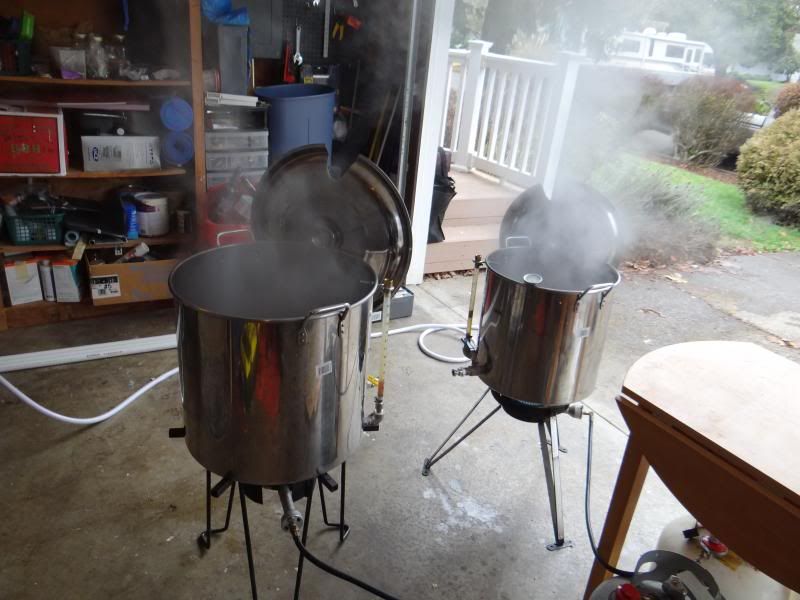
Glug, glug, glug goes the wort in the kettle.  Honestly I was shocked at the syrupy string that pulled off of the tubing when I moved it from the container I vorlauf into, but the noise in the kettle during the last hour of the 2.5 hour boil was like a sound effect used for a tar pit in a cartoon.   What more should I expect form a 1.105 OG Wee Heavy?


Last year about this time I brewed a Scottish Wee Heavy that didn't turn out right.  First off, I used American Caramel malts that were too dark as well as 1056 which is not known for making a malty beer.  Then the beer got infected.  Lots of cherry notes present themselves in last year's version.  This year I went for a brand new recipe from the bottom up.  New base malts, new character malts, new yeast, new hopping regimen, new beer.  I started with a base split between Great Western Pale and Maris Otter for a nice toasty/biscuity English feel.  Next I added in some MFB Munich malt for a little more malt character.  On top of this I did a 3 way split of MFB CaraMunich 40, 120, and British Dark Crystal 75 for a deep caramel and toffee layer with some burnt sugar and a hint of dark fruits, with a touch of Roast Barley for color and to help dry out the finish some so it won't be too cloyingly sweet.  Pulled enough for a 2 1/2 hour boil for a little more kettle caramelization and better efficiency.  Tossed in some Fuggles for a touch of bitterness to balance it out.  Fermented it with a mixed yeast culture of Wyeast 1469 West Yorkshire and 1056 American Ale that came from my Brown Ale that turned out quite nice.  The Yorkshire strain should give me some nutty and slight dark fruit character as well as a full mouth feel, lots of malt character, and the American Ale should help it stay clean and finish the fermentation up completely.  Even with the 158*F mash I am hoping for a good 75% attenuation putting me in the 1.026 FG range for 10.0% ABV.  With the controlled temp on the ferment I am hoping to be drinking this bad boy by Christmas.


Stats:
4.5 gallons
1.105 OG
1.035 Fg
9.5% Est ABV
24 IBUs
19 SRM
__________________________________

Fermentables:
11.0#  Great Western Pale Malt
9.5#  Crisp Maris Otter
2.0# MFB Munich
0.75# MFB CaraMunich 40L
0.75# MFB CaraMunich 120L
0.75# Crisp British Dark Crystal 75/85L
0.12# Crisp roast Barley
65 Minutes @ 158*F
60% Extract Efficiency
56% Brewhouse Efficiency
__________________________________

150 Minute Boil:
90 mins - 2.0 oz Home Grown Fuggles ~ 6.7AA%
__________________________________

Fermentation:
Chilled to 65*F
6 gallon Better Bottle
1469 West Yorkshire & 1056 American Ale - 3/4 pint of slurry from Brown Ale
15 mins of aeration with pump 
5 Days @ 62-64*F
9 Days @ 68*F
4 Days @ 82*F
5 Days @ 72*F
14 Days @ Ambient Garage Temps
__________________________________

Additional:
Gypsum 5/8 t (mash), 3/8 t (boil)
Calcium Chloride 3/4 t (mash), 1/2 t (boil)
6 Taps Yeast Nutrient
1 Whirfloc Tab


Boil off was slightly more than I thought and I got slightly less volume and a higher OG which worked since my FG was higher than I wanted due to a higher mash temp.  I factored my strike temp for all the grains but left out the crystal and roast until the end and hit 158*F instead of the 155*F I wanted and just went with it since last time I tried to cool off my mash I over cooled.  Aerated with pump for 15 mins.  Signs of fermentation started to show with in 12 hours, krausen building at 24.  High Krausen after 48 hours, fermentation is cranking along nicely.

Down to 1.049 after 7 days.

Down to 1.039 after 2 weeks

Down to 1.035 after 2.5 weeks

Wednesday, May 23, 2012

Review: The Callen


I set out to do a partigyle Wee Heavy and 80 Schilling.  The hope was to brew a big Scotch Ale to name after my son Callen as an owed to our heritage, as the label reads:
"For such a wee lad, he is a heavy one.  Assertive and bold, but effervescent, one would do well to watch in amazement as this one ages.  Or enjoy him while he is young and smooth, w/ hints of flowers and earth; ne’er a harshness to him at all.  Take your time with him, and ponder the many intricacies of what he is; if you go too fast you’ll miss the wonders of truly knowing him, and he may just sneak up and bite ya’ in the ars!"
To start with, C120 and Special B may not have been the best choice.  But knowing exactly what went wrong on this batch recipe wise will not be easy since the yeast that I pitched was a slurry of 1056 from a previous batch that I had no idea was infected with a wild yeast.  Gushing bottles, fruity esters, what might be Brett L.  Makes for a decent Belgian Dark Strong, too bad that's not what I was trying to brew.

Appearance:  Pours a deep copper (muddy from the yeast being stirred up by the gusher infection) with a super thick beige head that persists for days and leaves a thick cap for the entire drink.  Great lacing, and lots of carbonation.

Smell:  Smells of fake cherries, dark fruits, burnt sugar, faint bread crust, pears, strawberries, flowers.

Taste:  Tastes like it smells, cherries, burnt sugar, toffee, fruity, pie crust, spicy heat in the finish - smooth yet warm.  Honestly I get hints of Trader Joe's 2012 Reserve Belgian beer less the chocolate and over the top spice.

Mouthfeel:  Medium-full consistincy, sweet but warm finish, carbonation makes it lighter on the tongue and leaves a smooth finish.  (If I add a touch of Lactic acid to the glass it makes the whole thing pop).

Overall:  For a Belgian Dark Strong it would be very nice (maybe back off on the fake cherries some though).  As a Wee Heavy if fails miserably.  The gusher infection is very fruity, lots of cherry, and tears through residual sugars thus the gushing.  Hoping that the pie cherry flavor eventually begins to morph to some horse blanket and some acid as well, thinking Old Ale after some time in the cellar maybe.  We'll see where this one goes in time.


Thursday, February 16, 2012

Beyond Just Bottles

As previously posted, I had a bad score from my Brown Ale at a BJCP home brew competetion that showed signs of infection, and after some research and questions about cleaning and cleaning products, and sanitization, I seemed to be getting some headway... or I thought. I was under the impression that this was a bottle here, and bottle there, and had established what I was going to do to fix it...that was until last night. I opened another Brown Ale to see if it would have issues, and was met with Old Faithful. I grabbed that last 5 bottles and one, after the other, nothing but gushers. Alarmed doesn't begin to describe it; neither does rage, but that wassn't the end of it. I grabbed one of the Ambers that I had made 2 weeks after the Brown, that consequently I had repitched the yeast on. No gushing, but the flavor is lacking all the crystal malt character and it is watery. Open the 90- (repitched the yeast into this as well) from the partigyle I had done: GUSHER! Run to the cellar and grab the Wee Heavy from that same partigyle (which got the same repitch as the 90-): GUSHER! Grabbed the Session Stout with Orange Zest and Cinammon (repitched from 90-): GUSHER! This beer had been entered into the same competion and received remarks about over carbonation and lack of flavor. This beer was also a partigyle with my 10.6% Imperial Stout that also received the same yeast; it is carbing up right now, and have no clue about how far the infection has gotten on it, but over the course of the month it aged on cherries the FG dropped from 1.028 to 10.24. I will be crash cooling this one and drinking quicker than expected.


I thought it was all about the bottles, but with the rapid advance of the infection in all the batches it appears to be the repitching of the yeast. The Brown took 5 months to show signs of infection. The Amber 4.5, and is not fully there yet (only a 6 pack left). The 90- and Wee Heavy 3 months, the Stout, less than 2. I am still going to have to get all new bottling equipment as well since all 5 batches went through it all and I'd rather not risk the infection having taken hold of in my nozzle, tubing, wand, bucket, etc., and end up in my other beers as well. This is causing some paranioa as well; my 8 gallons of ESB had all new yeast, and I under primed due to a mishap with the app I use, and thought it would never carbonate. But now it has a decent amount of carbonation. Could just be the time and temp finally giving it what it needed. Could be the same infection (they have the same "oil slick" on the top of the beer as all these others had, could be residual cleaner, could be infected). I am going to get all the ESB in the fridge and drink quick. I will leave out a few bottles for a couple months and see if they turn into gushers as well just so I can know for sure. If the Saison gets infected, I am not too concerned, but still would like it to stay clean. I also am now concerned about the West Yorkshire and 3726 Farmhouse Ale yeasts I used, since I washed them and kept them, but I used the same mason jar lids w/ rubber seals that I used for storing the 1056 that infected all the others, and I didn't boil my jars or lids, just StarSan.


Time to go back to the basics again. Gonna drain-pour multiple batches this weekend, have to buy new Bottling Bucket, spigot, tubing, wand, and I have an email out to the Mad Fermentationist about the best way to kill any bacteria in my Better Bottles since he moves from wild to clean to wild to clean in his with no ill effects.

Friday, February 10, 2012

It's Been Awhile

As you can easily see, it's been awhile since I posted on the blog, and I thought that an update might be in order. Here are a few things I have been working on and brewing. After the last brew when I tested my efficiency, stabilized my system, and began to work on my own brewing "software" a lot has happened.

I brewed a partigyle Wee Heavy with Heather Tips and a Scottish 90- that was aged on Oak and Laproiage Islay Scotch. The beers didn't turn out as I'd liked. They are way too fruity and not very malty. The 90- is much further down this line than the Wee Heavy. All of this is recipe based. I added both c120 & Special B which added tons of fruit and none of the caramel and subtle dark fruits I was looking for. The peat malt came off quite phenolic. Using 1056 subdued any maltiness I was looking for and through off lots of fruit. I have already reworked the recipe to remove the c120 and Special B, and added French CaraMunich and CaraVienna for light caramel and toasted sugar, and British Dark Crystal for more of the same, and went for 1968 London ESB to pull of a heavily malty character.

I also brewed a second partigyle, a 10.6% Imperial Stout with Chipotle & Cherries, and a Session Stout with Orange and Cinnamon. The big beer was fermented for 3 1/2 weeks, then aged 1 week with Chipotle and 3.75# Sweet Cherries, then another 3 weeks with just the cherries, then aged 1 more week on its own before bottling. It is quite smooth, fruity, dark, rich, chocolaty, and a slight roast. The second beer was quite devoid of character. I took a tip from Gordon Strong and cold steep some more Chocolate Malt, C75, and Black Patent, boiled it with more orange zest, and added it to the fermenter. I also added Malto-Dextrin at bottling for some more body and also offset all the oil from the orange zest so there is still great foam and head retention.

For Christmas I got my refractometer and and an aquarium temp control unit (I will post more about this in another post). I also got a second Better Bottle which was great for my next brew session. I did a "SmAsH" (Single Malt and Single Hop) type beer. I say type because I used Magnums for the bittering addition since EKGs are low in Alpha Acids and way too expensive. I used Great Western Pale Malt, and finished the batch with 3oz of EKG hops in the last 15 minutes of the boil. I then split the 8 gallon batch into 2 Better Bottles and pitched 2 different yeasts: WY 1968 London ESB and WY 1469 West Yorkshire. Come end of fermentation I used the new temp controller to up the temp for a Diacetyl Rest. I then crashed the beers to clear them. The whole thing went great, but I ended up under carbonating them since the app calculates based on temp and I used the crashed temp not the ferment temp.

My library finally got Farmhouse Ales after a year of waiting for it. While reading it I brewed a simple Saison using the WY special Farmhouse Ale strain. I mashed at 147*F, the same that I did last Summer when I brewed my two Saisons using the Dupont strain WY 3724 Belgian Saison, but the beer didn't finish as low as I had hoped (the 3724 took the beers down to 1.004 & 1.005, 3726 to 1.008). After a week in the Better Bottle at a constant 75*F, I primed and bottled in champagne bottles for added stability against the higher carbonation and the possibility that the beer might not have been finished at bottling.

I have also made a lot more adjustments to the brewing spread sheet I created. I added a refractometer adjustment section that takes the Brix and calculates OG, efficiency, and once fermentation is finished converts for alcohol to give FG, and ABV. I also added all of the malts with gravity, Lovibond, and cost from the homebrew shop as well as flavor descriptions. I was able to get a list compiled of all the hops in one of the fridges with all the Alpha Acids. I will be adding the cost and flavor aroma profiles for all of the hops as well and adding the second fridge's stock as well.

I also used my temp controlled fridge to maintain a constant 71*F to carbonate the Saison and my Imperial Stout. I will be posting some taste reviews soon on all these beers once they are carbed up and ready, so be watching for these blogs as well as a how-to-build your own dual stage temp controller for $40 (why pay $150 for a Johnson or Ranco).