Showing posts with label yeast culturing. Show all posts

Friday, July 6, 2012

Review: Cavendish & Cloves Collide

Yes, this review is long overdue, like, 14 months overdue.  I brewed this Hefeweisse the last weekend in March of 2011.  First double batch, first step mash, first time culturing yeast from bottles, first open fermentation.  Lots of firsts.  Also a last... the last bottle.  I enjoyed the last bottle of my hefe on 4th of July with breakfast: Chocolate Clove French Toast.  The pairing was heavenly.  As I enjoyed the aroma and flavor of the beer, and paired it with the meal, I decided it needed a review, something to compare with when I rebrew this beer, as I will do soon.  I had forgotten how much I loved the beer, and was glad to get the itch to brew a new one.


Look: Pours a crystal clear goldenrod with a huge billowing white head until the yeast get swirled in and it goes murky and the head turns light beige with flecks of brown in it.  Carbonation roles up the middle of the hefe glass and keeps the head lasting to the very end.  Faint lacing.

Aroma: Smells of over-ripe bananas and clove.  The esters and phenols are balanced and very prominent as they should be.  Hints of vanilla and strawberries come up as well, mild bubblegum.  Sweet malt.  No hops.

Taste: Taste mirrors the nose with lots of banana and clove, touch of cinnamon, a little strawberry and bubblegum, fresh cereal, sweet malts, grainy.  Tart.  No hop presence.


Mouthfeel:  Rich and creamy, big carbonation dances on the tongue keeping it light, dryish finish, sweet, just enough bitterness to balance.


Overall:  Very impressed with how this beer turned out and how it held up since everyone says they have to be drank fresh.  Big banana and clove, both in balance, light vanilla and bubblegum, tart finish, big carbonation and great head, light malt sweetness and graininess.  Biggest problem (not from age, it was in the beer 14 months ago as well) is the lack of protein haze.  Without swirling up the dregs and adding them to the glass this beer is crystal clear.  The lacing is lacking as well, but could be from the age.

Friday, May 18, 2012

Bring On The Bugs

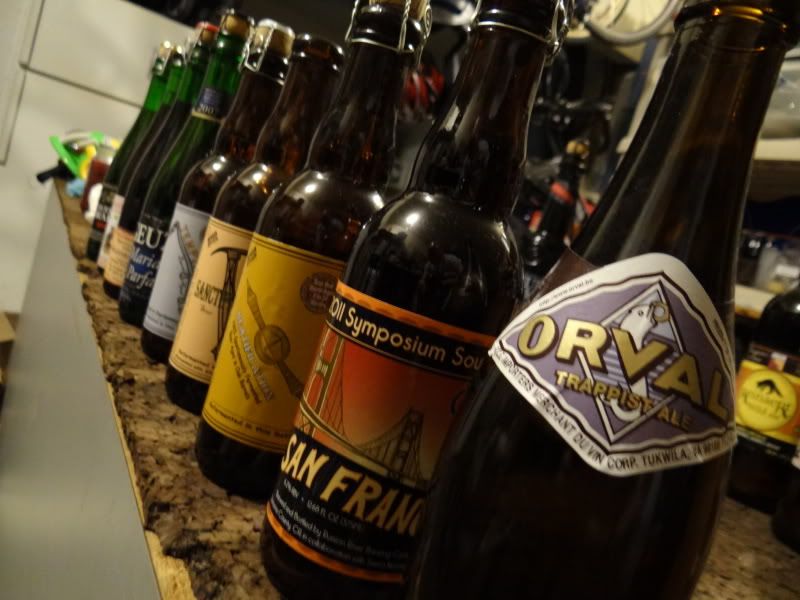
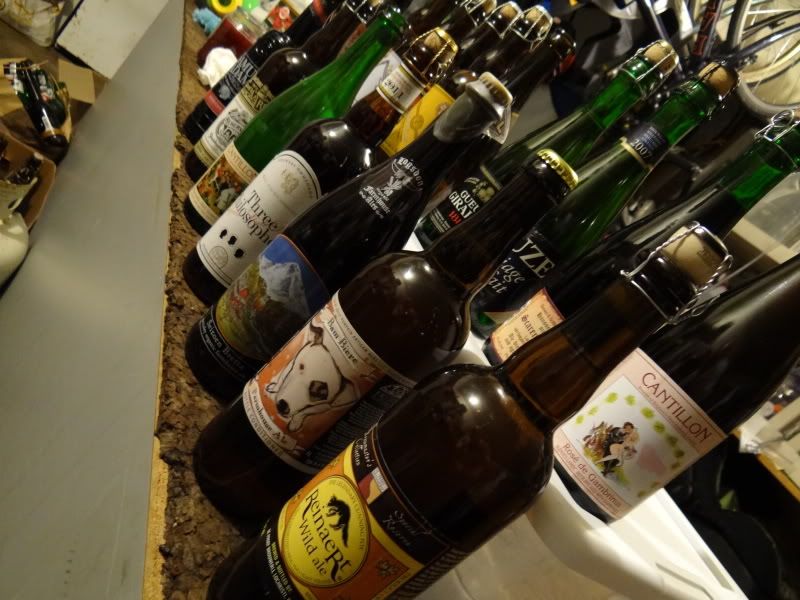
I've been thinking about building up my reserves for sour dregs to add a little more depth and complexity to my sour beers.  The two that have finished were good, but I only used one type of dregs to achieve them and my hope is to add a lot more to the following batches.  Previously I have used Russian River's Supplication and Consecration.  Recently I built up the dregs from there Sanctification which is brewed with only Brett, with Lacto and Pedio in secondary, and bottled with Brett alone (thus removing the champagne yeast that they use in all the other sours at bottling), as well as dregs from a bottle of Jolly Pumpkin Bam Biere which has a great pellicle.  I added the dregs from a bottle of Oude Beersel Oude Geuze Vielle to my Lambic as well as dregs from some of my homebrew, Cantillon, and a dose of Logenberry Mead from my buddy that had gotten infected.  

I've got quite a few bottles of different sours that I was considering culturing from, such as, RR Beatification (among other RR offerings), Cantillon Rose de Gambrinus, Oakshire Scookumchuck, Girardin 1882 Black Label, Boon Oude Geuze Mariage Parfait 2007, and Hannsens Scarenbecca Kriek.  What I was thinking was to make a 1.030 starter wort from DME and Apple Juice, transfer into water bottles and put it in the freezer until I drink one of these bottles, at which point I will pop the cork, pour the beer, flame the lip, and add dethawed starter wort to the dregs in the bottle then place foil on top and leave at ambient to grow.  After some time I will be able to swirl up the starter of which ever one/ones I want to use, pour some off into the beer I am brewing, and add some more starter wort to it to feed it and keep the culture going.  This will give me variety, and since I have lots of 1 gallon jugs, I can add JP to one, Cantillon to another, Hannsens to another and RR to another, and compare how they turn out, then blend to the desired effect I want.


One problem that I hit was with the bottle of Fantome Saiosn D'Erezee Prentemps that I did this with.  I ended up with Icebergs on top (Large clumps of mold) and a Sea Cucumber floating around in the liquid (large carpet of mold).  According to another homebrewer and sour  maker he has had this same issue when the starters are grown in too hot an environment.  Another issue that Mike Tonsmeire threw my way, and I was reminded of again while reading Wild Brews again, is that mixed cultures like this will be very difficult to keep in balance.  Inevitably the Sacc strain will die off and autolize, the Lacto (especially in un-hopped stater wort) and Pedio will multiply rapidly, and the Brett will not keep up with the acid bacteria.  If this were to happen, successive batches would become very sour and not have much other flavor components to keep the beer in balance with the proper flavors and aromas, just sour.  What he recommended, and the way I will probably go, is to just pitch the dregs into a batch, let it age, bottle, and then pitch the dregs from my bottled beers into new sours along with other dregs, age, bottle, repeat, and so on.  This will give me a large diversity of bugs and wild yeasts from different breweries, as well as a house character as my current bugs and yeasts are repitched and morph from batch to batch.  With all the different sours I have going right now, it sounds like a good option.


Add to this my culture of Lacto from yogurt, and my Brett starters - 1 Orval, 1 Reinhardt's Flemish Wild Ale, and I will be getting some Brett C from an all Brett beer that some buddies have going, I should be looking at quite a bit of funk to funk around with.

Thursday, April 5, 2012

Infecting My Infection Experiment

A few weeks ago I brewed up a basic American Blonde recipe to test my fermenters to see if I had effectively killed off the infection that may have been housed in them from previous batches.  The conical version of the beer seemed to be infected from the start so I decided to sour up the whole lot of it.  After checking the final gravity on the Better Bottle version and tasting it, I decided that I didn't have to have 5 gallons of this one bottled and could go for a half batch or so.  It seems a little thin with a FG of 1.005.  The flavors are nice, but the body is a little off.  I shouldn't have expected much different since I pulled 10.5 gals (post boil) from 12.5# of grain, and with such a low OG (1.037) even taking up the mash temp to 153*F wasn't going to stop it from finishing low.  Thus the decision to purposely infect the infection experiment batch.

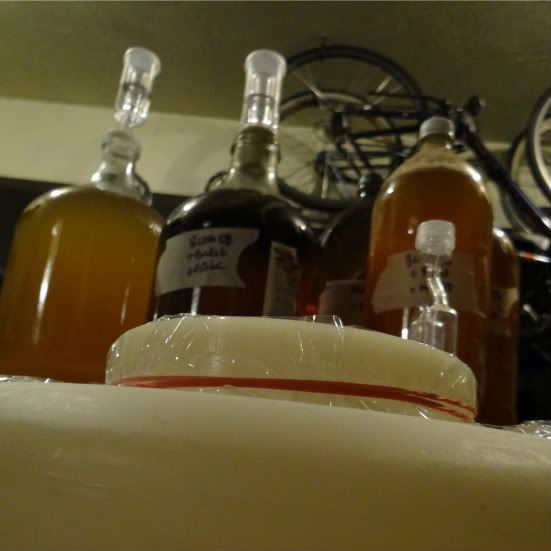
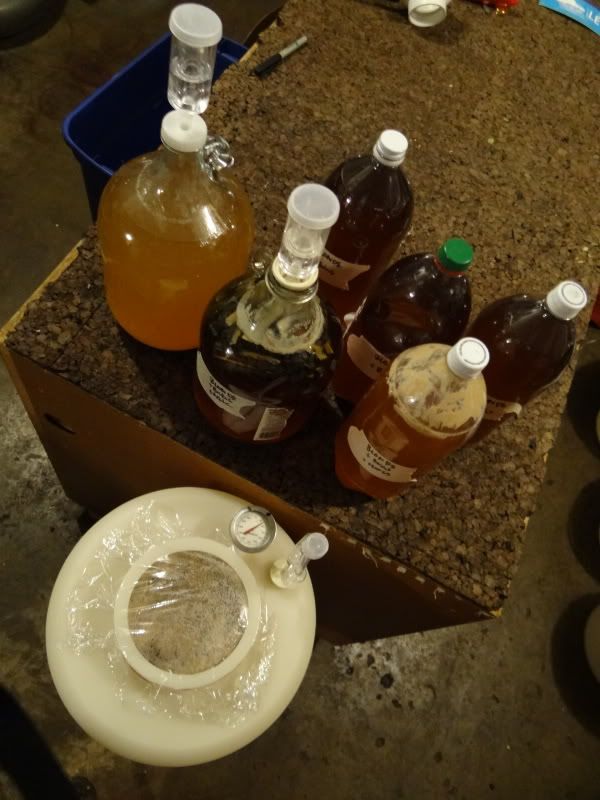
On the conical, I diverted 1 gallon to a jug that housed a Brett starter to funk up, and I hit the remainder with 1/4 cup starter from Russian River Consecration and 1/4 cup of my Lambic along with 8 pieces of French Oak.  After a few days it was tasting quite oxidized, so I moved it out of the conical into smaller containers.  I put all the oak into one jug so it will be over oaked and used to blend into the final mix.  The rest was put into 2L bottles with a small addition of sugar.

I bottled 18 bottles worth from the Better Bottle using carb tabs just so I can know exactly how the final batch actually turned out.  The rest I transferred into the conical where I added the entire 2.5 gallons of this wort fermented on all Brett, the gallon of Bretted conical beer, and added 1.25# Clover Honey for added sugars.  I put a piece of saran wrap over the top so that I can easily look inside at what is going on with out allowing oxygen in every time I take a peek.  The saran wrap is kind of fogging up from the honey fermenting, which started out as a ring of foam as is began to dissolve from the bottom of the conical and start to ferment and slowly developed into a full krausen by 2 days later.

The plan is to let the Better Bottle version now in the conical funk up with Brett for a few months while the original conical version sours in the 2L bottles.  After 3 months or so, I will drain off a couple gallons of the Bretted conical into 2L bottles and add a 1 gallon starter of Lacto and honey, as well as a couple of the 2L soured bottles to get the souring bugs going in the Brett only version.  After some time passes I will pull some more form the conical and add the remaining 2L bottles of soured Blonde as well as the oaked sour Blonde to the mix.  Come the end of summer, I will have 2 gallons of Blonde Ale on Brett, and about 8 gallons of soured, oaked, wild Blonde which I will split 3 gallons onto cherries, 3 gallons onto apricots, and keep 2 gallons straight giving me a total of about 10+ gallons.  We will see how time plays this one out. 

Tuesday, March 20, 2012

Yogurt... In My Beer?

So much cleaning, so much sanitizing, so much stressing about whether I would ever be able to brew a clean beer again, and then the inevitable happens... another infected batch. I had stripped apart my conical, soaked it in PBW and hot water for over a day, and then left it in bleach for nearly a week. After brewing up 8 gallons of Blonde Ale to split between the conical and my Better Bottle (that had housed the infection as well) as a test to see if I had rid myself of it, I let them both ferment for a week. I pulled samples of both of them to taste, smell, and check the gravity. What I found from that conical was so much different than the Better Bottle. Dull, lifeless, dirty fruit, watery, and 3 points lower, diagnosis: INFECTED! With that, I resigned my efforts to salvage the fermenter, after all I had done, it was to no avail, and thus, a new fermenter for brewing up sours was born. And with all my renewed passions towards sours, it happened at just the right time. I was already planning on souring half the batch anyways, this just made it easier.


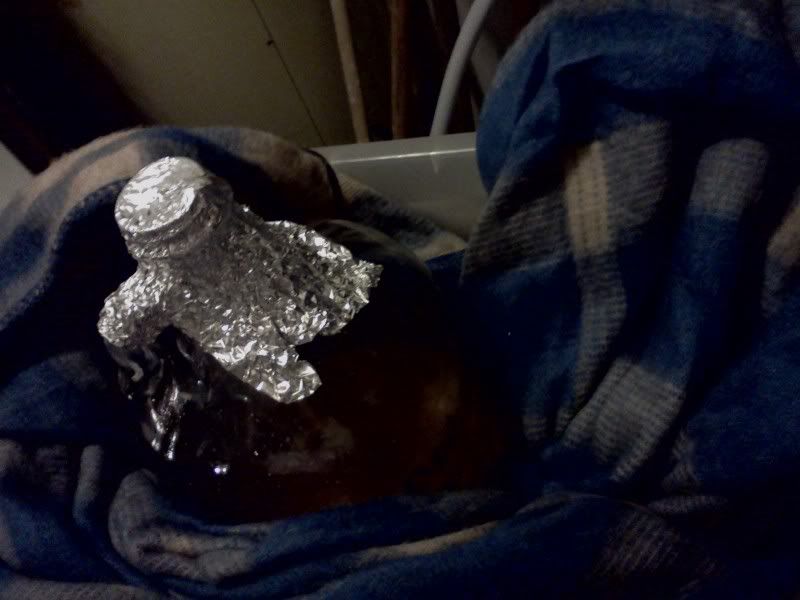
I pulled a gallon of the beer from the ball valve that went straight into a glass jug that had housed my Brett starter before it went into the leftover wort from this brew session, and had yet to be cleaned. Given a few months, the Brett should build up a nice pellicle and funk it up quite a bit. In the conical, I added a 1/4 cup of a starter I had built up from the dregs of Russian River's Consecration last summer, as well as a 1/4 cup of the Lambic I brewed last September using yeast I cultured from blackberries growing wild in my neighbor's backyard. I tossed in about 8 cubes of French Oak that were previously used by a winery in Lodi, CA to revive an old barrel as well. I also have a starter from RR Supplication that I won't be adding, at least not right now, because there is a lot of head space in that vessel right now and that culture has some definite acetobacter from when I used it in a bucket on another brew.


Just for the fun of it, I also made a 1L starter with 750ml water and 250ml Apple Juice, and 100g DME, that I cooled to 115*F, and pitched in 1/3 a serving Zoe Non-Fat Plain Greek Yogurt, which I inserted my temp control probe into and set it to 115*F wrapped in the heating blanket I received from a friend. 3 days later, the temp is constant at about 39*C (~100*F). When I poured a sample it fizzed like Alkaseltzer, which is good, that means carbonation, which means that something is going on. A sniff gives hints of yogurt, clean, nothing off in the aroma. A taste gives off sour apples, and a light yogurt twang. I effectively cultured Lacto from Greek Yogurt! After a few more days, I added 3/4 gallons of water mixed with 1.25# Clover Honey to bring it up to 4L, and give it a week or so at 100*F. Once this gallon of Lacto fermented Mead is ready to go, I will add it to the main Blonde Ale in the conical, along with another 1.25# of Clover Honey in a gallon of water, and let her ride for a good 6-8 months. Then I will add back in the gallon of Brett only portion, and hit it with 2-3# of fresh Apricots this Summer. This will bring the total volume of beer up to 6 gallons, with a new OG of 1.041 (1.037 prior to honey), and a FG of near 1.002 (or less) for a 5% ABV oak aged, wild Honey Blonde Ale.


Here's to innovation and infections!

Thursday, February 16, 2012

Beyond Just Bottles

As previously posted, I had a bad score from my Brown Ale at a BJCP home brew competetion that showed signs of infection, and after some research and questions about cleaning and cleaning products, and sanitization, I seemed to be getting some headway... or I thought. I was under the impression that this was a bottle here, and bottle there, and had established what I was going to do to fix it...that was until last night. I opened another Brown Ale to see if it would have issues, and was met with Old Faithful. I grabbed that last 5 bottles and one, after the other, nothing but gushers. Alarmed doesn't begin to describe it; neither does rage, but that wassn't the end of it. I grabbed one of the Ambers that I had made 2 weeks after the Brown, that consequently I had repitched the yeast on. No gushing, but the flavor is lacking all the crystal malt character and it is watery. Open the 90- (repitched the yeast into this as well) from the partigyle I had done: GUSHER! Run to the cellar and grab the Wee Heavy from that same partigyle (which got the same repitch as the 90-): GUSHER! Grabbed the Session Stout with Orange Zest and Cinammon (repitched from 90-): GUSHER! This beer had been entered into the same competion and received remarks about over carbonation and lack of flavor. This beer was also a partigyle with my 10.6% Imperial Stout that also received the same yeast; it is carbing up right now, and have no clue about how far the infection has gotten on it, but over the course of the month it aged on cherries the FG dropped from 1.028 to 10.24. I will be crash cooling this one and drinking quicker than expected.


I thought it was all about the bottles, but with the rapid advance of the infection in all the batches it appears to be the repitching of the yeast. The Brown took 5 months to show signs of infection. The Amber 4.5, and is not fully there yet (only a 6 pack left). The 90- and Wee Heavy 3 months, the Stout, less than 2. I am still going to have to get all new bottling equipment as well since all 5 batches went through it all and I'd rather not risk the infection having taken hold of in my nozzle, tubing, wand, bucket, etc., and end up in my other beers as well. This is causing some paranioa as well; my 8 gallons of ESB had all new yeast, and I under primed due to a mishap with the app I use, and thought it would never carbonate. But now it has a decent amount of carbonation. Could just be the time and temp finally giving it what it needed. Could be the same infection (they have the same "oil slick" on the top of the beer as all these others had, could be residual cleaner, could be infected). I am going to get all the ESB in the fridge and drink quick. I will leave out a few bottles for a couple months and see if they turn into gushers as well just so I can know for sure. If the Saison gets infected, I am not too concerned, but still would like it to stay clean. I also am now concerned about the West Yorkshire and 3726 Farmhouse Ale yeasts I used, since I washed them and kept them, but I used the same mason jar lids w/ rubber seals that I used for storing the 1056 that infected all the others, and I didn't boil my jars or lids, just StarSan.


Time to go back to the basics again. Gonna drain-pour multiple batches this weekend, have to buy new Bottling Bucket, spigot, tubing, wand, and I have an email out to the Mad Fermentationist about the best way to kill any bacteria in my Better Bottles since he moves from wild to clean to wild to clean in his with no ill effects.

Wednesday, October 19, 2011

Spontaneous Fermentation Update

Awhile back I did a time line blog of the yeast starters I was making from the wild yeast and bacteria living on the skins of wild blackberries living in my neighbor's yard and from locally grown organic peaches. The brew day has come and gone, and I thought I would fill in the specifics and update on how the beer has progressed thus far.

The recipe:
6.25# Pilsner Malt (54%)
2.25# Vienna Malt (20%)
2.00# Flaked Wheat (17%)
1.00# Caravienne (9%)

90 minute boil
FW Hops 0.4oz Styrian Bobek 3.8AA pellets
15 min 0.6oz Styrian Bobek 3.8AA pellets

10 min 1.50z Cake Flour
5 min 1tsp Coriander, Crushed

Mashed 60 mins @ 152*F
Sparged w/ Boiling water

5.25 gals
OG 1.057
FG 1.002
IBU 10
ABV 7.2%


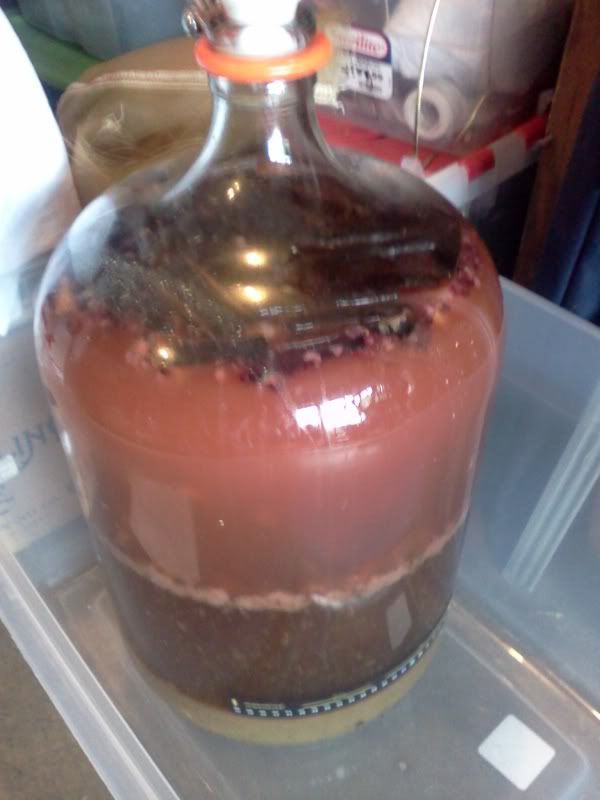
I mashed at 152*F, I was shooting for 154, but added too much cold water when I was too hot, and it cooled it down too much. I sparged with boiling water to try to extract as much sugar as possible and even some tannins as well. At the end of the 90 minute boil I added some cake flour for extra dextrins and starches for the Brett to chew on over the long fermentation. I cooled it as usual and ran it into the fermenter. I added the 2 starters to it whole, all the wort, fruit, bacteria, yeast, a couple ants, everything. I didn't aerate it since oxygen feeds bad bacteria, and inhibits Lacto growth. It looked kind of stratified until the next day as the different parts were layered, wort, trub, break material, fruit, starter, etc.


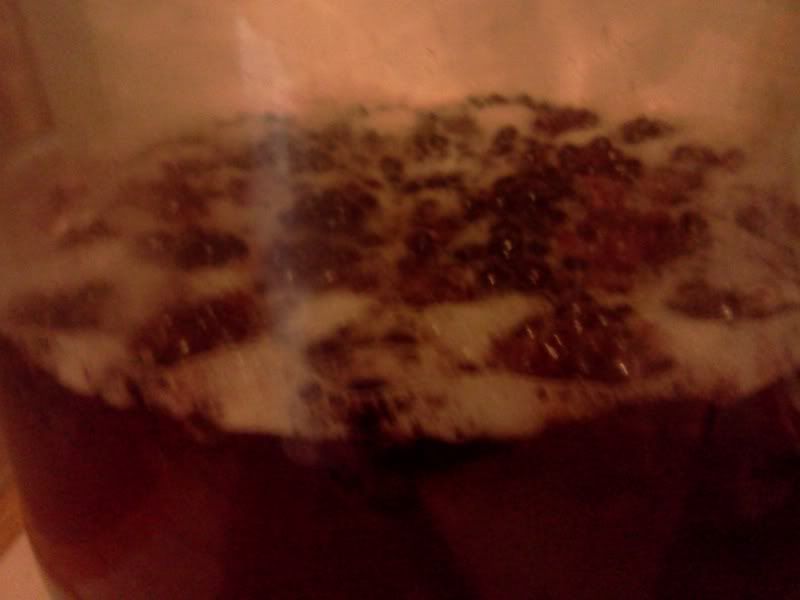
After a few days I noticed some odd activity. There was no krausen, but I had used S-Foam, and foam inhibitor, so it is quite possible that it was fermenting and not putting up a krausen. I did notice lots of little tiny bubbles shooting up and feeding a fluffy foam at the top though, and I assume this was from the Lacto working since it releases CO2. Another day later and I saw the wort churning away like any other beer fermentation, so things were going good.


I let it go for a few weeks with out tasting it, and finally on week 3 I gave it a taste. Nice, light, clean tartness, clean fermentation, no off flavors, mild funkiness, slightly fruity, not much oak character, gravity was 1.005. Quite happy with it. I tasted it again 1 week later and the oak is starting to show some; I will be watching this since I don't want it to be too oaky. If it gets where I want it I am going to rack the beer off, remove the oak, and add the beer back to the trub, yeast, and fruit for longer conditioning and funkdifying. So far I am very pleased. I even used the yeast to ferment a cider.

NOTE: This beer took 1st place in Sour Beers and won BEST OF SHOW in February 2014 at the KLCC BJCP comp.

Thursday, August 11, 2011

What I'm Working On Now

Wanted to put out an update on what I have going right now. No beers fermenting. No beers in secondary. The 2 Saisons are carbing up right now, and should be ready in the next few days. I have 2 recipes written up for September, one super hopped pale ale, and one spontaneous fermentation (another blog post will be dedicated to that one soon).

At this point what I'm working on is starters/cultures. As stated in an earlier post 3 Beers, 1 Mash, I did a Berliner Weisse with the soured last runnings of a mash that made my Hefe and hoppy American Wheat, and then pitched WY 1007 German Ale, and a starter I had cultured from the dregs of Russian River Supplication into primary together. The beer is amazing, and I didn't make the same mistake with the yeast cake on that as I did with the starter of yeast I cultured for the Hefe (dumped it all). But I needed something to do with the yeast to save it. As I was brewing my Saisons 6 weeks ago, I drew off the last runnings from both mashes and boiled them with a small amount of hop pellets for about 45-60 minutes. I let them cool and then dumped it into a 3 gallon bucket. I added the entire slurry (full mason jar) to the 1.5 gallons of wort, and added about 30 used medium toast French Oak cubes I got from a buddy who goes to church with a Vintner in Lodi that had come from their barrells. The thought was to save the yeast by inoccluating the oak for future sours. I strapped the lid and air lock on and let it go.

5 weeks later as my son and I were hanging out in the brew house (garage) he was grabbing stuff that looked cool as any 16 month old does, and he pulled the airlock off the bucket. I took it and told him not to touch it like a dad should, but as I was replacing it, I gazed throught the hole and freaked out. What I saw was a giant blob of mold... or so I thought. After posting a How Do I Save It From The Mold forum on BeerAdvocate I was informed it was the pellicle (a layer of Brett that floats on top of the beer as they use the oxygen to reproduce, and also keeps oxygen out, as well as prevents mold and Acetobacteria). Having never seen one before (other than in the bottles of Berliner), I had no way to know. I also sent an email to The Mad Fermentationist who confirmed the same. After chatting it up with him over quite a few emails I decided to rack the beer into glass jars to continue as opposed to leaving them in a bucket that is permeable to oxygen and has about 1.5 gallons worth of head space. When I opened the bucket it smelled very sour, like a strong aroma from Rodenbach condensed. Almost vinegary, but not quite. I racked the beer into a 1 gallon jug and a 1/2 gallon jug, siphoned up a lot of slurry, forced as many oak cubes in as I could fit, and then added a little sugar to it to kick start a little fermentation to fill the head space with CO2. After 5 days, the beer has cleared, and a pellicle is forming on top again (see the big pic at the top of this post).

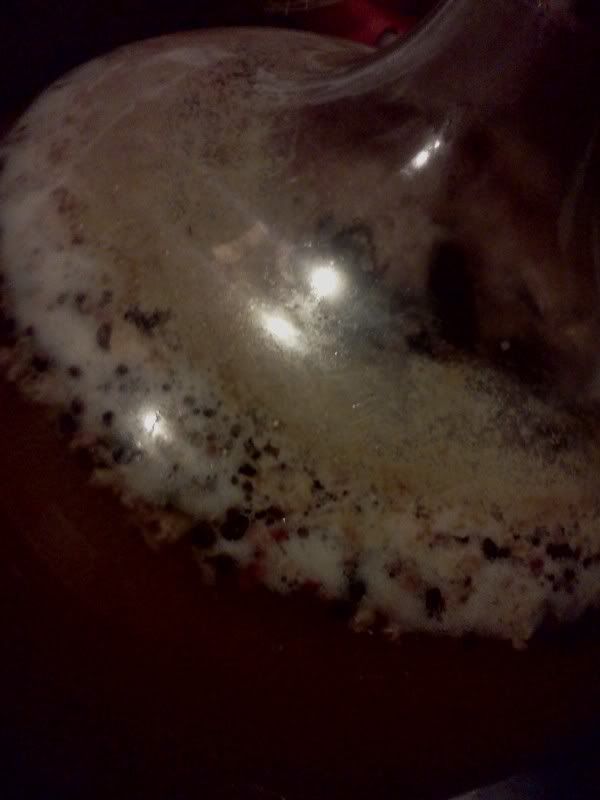
I also have a starter from a bottle of Orval I have built up that I used some of in bottling one of my Saisons. It should give me some nice Brett character here in the coming months, and taste great next summer. I also enjoyed a RR Consecration a few weeks ago and have built up a starter of the dregs from that as well. It has a very soft powdery coating on top with a layer of slime underneath, and some white, slimy looking flat things floating here and there... sounds like it is working, this is what pedio is supposed to do... right!?! My hope is to get them built up for future sours/wilds, including an all Brett beer fermented with only wild yeast.

I will continue to post updates from time to time as things progress, and new experiments pop up.