Showing posts with label French Oak. Show all posts

Thursday, May 2, 2013

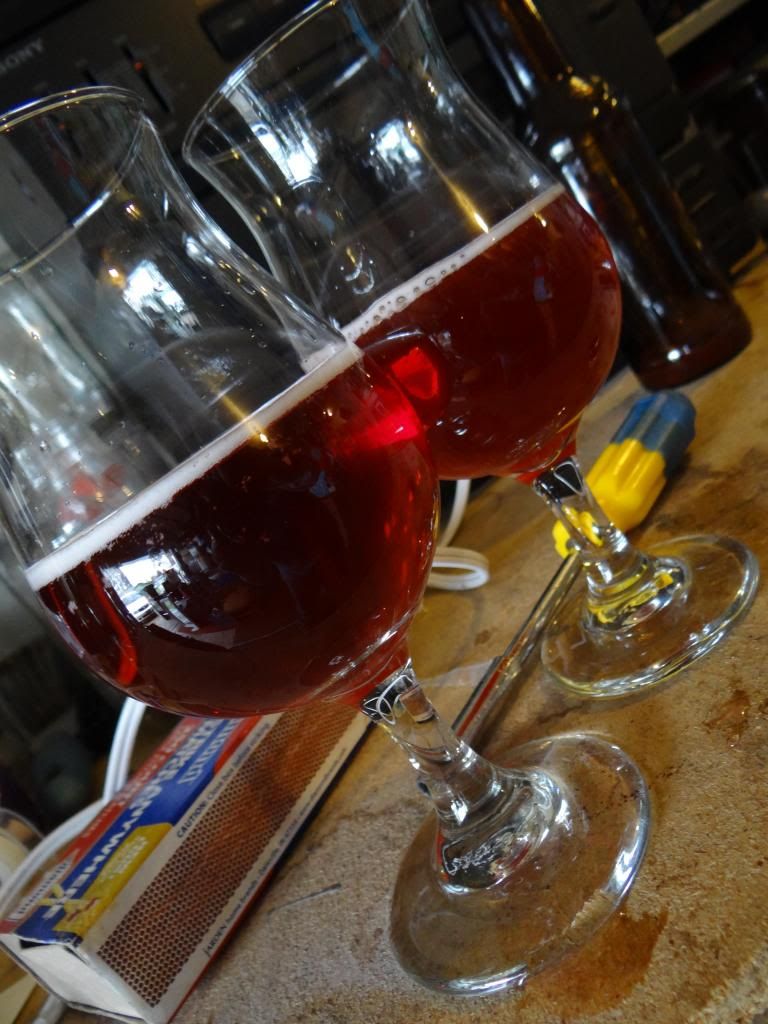
Review: The Judith (Oaked Blackberry Sour Blonde)


The next beer in the Where the Wild Things Are series, this beer began its life as an American Blonde Ale brewed to see if my gear was infection free post deep cleaning after an infection string swept my brew house.  I didn't really want 9 gallons of Blonde, and half the batch was discovered to be infected, so I soured the majority of it.  After a few months on Brett, then a few more souring, I added different fruits to the split batches.  This one got fresh blackberries from the backyard in September, as well as a healthy dose of French and American Oak.

Look:

Pours a deep red to violet, thick white head drops fast to a tight ring that stays all the way through.  No real lace is left.  Super clear.


Aroma:
Smells like Brett funk and berries.  Hints of tropical fruits from the Brett, and some deep oak with hints of wine barrel.

Flavor:
Taste mirrors the smell, basement funk, dusty, tart, lemons, berries, fruity, tannic oak, wine, light oxidation (cardboard) in the finish, clean acid - no acetic.

Mouthfeel:
Puckering sour from the fruit, lactic acid, and super dry finish.  Oak tannins, balanced to sour.

Overall:
Very nice fruit sour.  Complex.  Great color, sour, funky, fruity.  Could use a little more fruit, or drink it sooner as the jammy fruit is starting to fade from what it was in mid February (just post carb).  Definitely a good wild ale.  Deep oak.  The oxidation is lower in this version than in the version that got mangoes and dry hops - need to stay out of my sours or flush with CO2 (now that I have it).

Tuesday, October 9, 2012

Recipe: Carol "Lambic" 2.0 (Where the Wild Things Are)


As I sip on my “Lambic” from last year, which I am very pleased with, I am very anxious to brew another one.  This time I will use the same yeast culture from the last one as I saved the entire cake from the last brew in a gallon jar in the fridge.  This year I am going to go with a grist that is much more traditional, 65% Pils, 35% Raw Wheat, mashed @ 158*F.  Last year I had some character malts like Vienna and CaraVienne which are not traditional and I’m not sure they added any needed complexity other than color.  I also had a flavor hop addition which is pointless in a beer aged for a year, coriander was the same.  I added some cake flour last time for a little more dextrins to chew on since my mash temp was fairly low. 

I could always do a turbid mash, but why?  I could also do a cereal mash, but why?  These things are traditional, but do they add anything to the final product that won’t be there (or at least drastically noticed) in the final product?  My first Lambic is quite nice and it was mashed at 152*F, and hit 1.006 in 3 weeks.  The 158*F mash should leave a larger amount of dextrins in the wort for the bacteria and Brett to munch on, and the large pitch of yeast cake should ensure a healthy amount of bugs and Brett as well as autolized yeast for them to eat as well.  That combined with an overnight open cooling in the garage where all my wild stuff is going (which I already fermented a ½ gallon of left over Brown Ale spontaneously in there), and some more dregs from commercial and homebrewed sours should ensure a good, big, powerful, and characterful fermentation from the onset, avoiding some of the enteric bacteria that are not desired.  Add in a 3 hour boil, and aged hops, we are looking at a great start to a second Lambic for next year.


Stats:
5.5 gallons
1.050 OG
1.001 Est Fg
6.6% Est ABV
8 IBUs
3 SRM
__________________________________

Fermentables:
7.5#  Weyermann Pils
4.0#  Flaked Wheat
0.50# Rice Hulls
10 Minutes @ 148*F
10 Minutes @ 152*F
45 Minutes @ 157*F
78% Extract Efficiency
72% Brewhouse Efficiency
__________________________________

180 Minute Boil:
180 mins - 3.4 oz Aged Hops ~ 1.5AA%
__________________________________

Fermentation:
Cooled overnight opened to air in garage
6 gallon glass carboy
Healthy pitch of cake from Carol 1 (cultured from blackberries plus dregs)
Dregs of 3 Fonteins Oude Gueuze
12 months at ambient in garage
__________________________________

Additional:
Gypsum 1/2 t (mash), 5/8 t (boil)
Calcium Chloride 1/2 t (mash), 1/2 t (boil)
1 French Oak Cube in primary


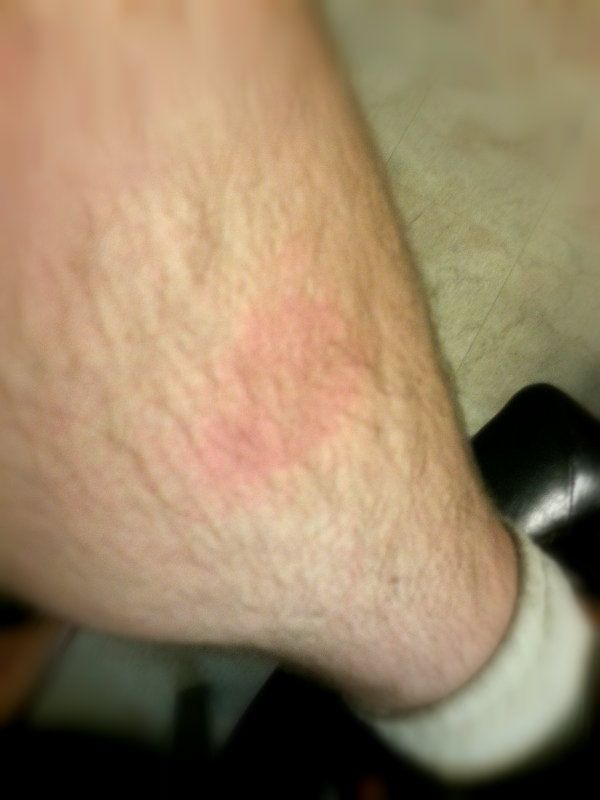
Brew day started off difficult.  I overshot my strike temp and hit a mash temp of 165*F.  After adding cold water I ended up at 148*F.  Added boiling water to get up to 152*F, then added more boiling water to get it up to 157*F, and rested for 45 minutes.  Wasn’t planning on doing a step mash, but oh well.  After collecting 10 gallons of wort I drained the last of the runnings into a separate kettle and boiled it down to about 800ml of 1.080 wort.  I added this to the beer and drew off 1200ml of 1.040 wort from the boil and cooled it to make a starter to my dregs while the wort cooled over night.  I added the dregs from a Hannsens Oude Gueuze to the starter only for a fruit fly to get into it and render it useless.  After a 3 hour boil, I had to move the keggle into the garage for the overnight chilling, and of course, while carrying the 15.5 gallon beast of a brewpot with a scorching hot bottom, I hit my leg with it and burned it quite nicely, luckily I only did it once and got the wort to the garage without spilling any or hurting myself anymore.  I covered it in a large sheer curtain sack that I synched down on the sides, hoping that the Fruit Flies don’t get into there like the starter.  After about 28 hours at ambient temp I racked 5.25 gallons of the wort into the 6 gallon carboy with the yeast cake, oak, and dregs.

Friday, September 14, 2012

Where the Wild Things Are: The Carol


About a year ago, actually, 52 weeks ago, I brewed up a Lambic that I fermented with the yeast I cultured off of blackberries from my backyard and a small starter of yeast from organic peaches grown locally.  After making the wort and adding the entire starter from each yeast to the carboy, I had a "funny" fermentation which consisted of small bubbles flowing up to the top quickly to feed a very small fluffy white head that looked like a single centimeter of soda foam.  Eventually the fermentation looked a little more like normal, but the krausen never really roared up like a normal yeast would.  There were chunks of peach flesh and blackberry, as well as oak chunks on top.  I also added some wild grapes after a month for a little extra yeast.  After only three weeks it was down from 1.053 to 1.006.  Nice and fruity, with a light tartness, mostly tropical and berries.

Over the course of fermentation, I have added dregs from commercial and homebrewed sours to try to get more complexity built up from other sources of Brett and bacteria.  I added some Russian River dregs, Cantillon Grand Cru, Jolly Pumpkin, Oude Beersel, Girardin Black, some infected Logen Berry mead a buddy made, and some dregs from a sour I did with Russian River dregs.  This will ensure a more complex beer, but it also kills much of the work I did culturing the yeast since the final product isn't a showcase of what that yeast can actually do (part of the reason I am going to brew a new one this year with fruit cultured yeast again and leave it alone).

After a few months I noticed a lot of oak character showing, and seeing that I used 5 oz of French Oak that had come from a wine barrel in Lodi, it wasn't any wonder why.  I needed to do something to stop the oaking, but I didn't want to lose all of the goodness in the trub and yeast that is needed for a Lambic to ferment properly.  I racked the beer out of the carboy into my sour bottling bucket and then dumped the trub, yeast, fruit, oak, etc., into a vessel while I cleaned the carboy and removed all the oak.  After this I added a few pieces of oak to the carboy, opened the valve on the bucket and refilled the carboy.  While this was going on I also racked the yeast, trub, and fruit back into the carboy as well.


I noticed an oxidative character beginning to creep in around January, so I brewed a little extra wort on my Saison and added a half gallon to the carboy to displace the head space.  The FG was still at 1.005.  Only took a few days for the fermentation to kick back up and take on the fresh wort.  After about a month or so, it was back down to 1.005.

Given another month, the FG had gotten down to 1.002, and there was a sheen atop the wort slightly resembling an oil slick, not like the pellicles I have seen before on my other sour beers.  By mid summer the taste was nice, funky, tart, clean, fruity, spicy, but lots of oak, so I racked it from the 6 gallon carboy into a 5 gallon, taking some of the yeast sediment at the bottom with it.  Given another month, the oakiness is starting to fade some.  I racked 1/2 gallon out of the carboy and added 1/2 gallon of my sour Blonde ale to try to cut down on the oak a little.  A few weeks later I am happy with the results, and am ready to bottle, and seeing that it is sitting at 1.001, not much more for it to do in the short term.

A beer that I have been watching, shaping, tasting, aging, and waiting on for a year is no simple brown bottle beer.  For this batch I needed to do something special, at least for a few bottles.  I started with 375ml Champagne bottles.  At this point I could go with cork and cage, or cork and cap (Cantillon style), but I opted for a cap and wax seeing as they look very nice, and it's super cheap as well as not requiring extra equipment.  Add to this full labels with art work and it is a very nice show piece, even if it is only 6 bottles worth.

I hope that the beer will carbonate quicker than my other sour which has been bottled for nearly 7 months and is still fairly flat.  Our club has a competition coming up and in late October that I would like to enter this batch into.  I will of course set the bulk of this beer aside to cellar for years to come and continue to develop.

This beer will be the first installment in my new series of beers, dubbed Where the Wild Things Are, named after characters from the children's book made movie.  The first is going to be called The Carol.  One of the main Wilds, he was impulsive, much like brewing a beer with blackberry yeast, adding dregs at random, and over oaking, only to move the beer twice.

NOTE: This beer took 1st place in Sour Beers and BEST OF SHOW in February 2014 at the KLCC BJCP comp.

Wednesday, July 18, 2012

Update: Hops, Promotion and New Schedule, Vacations

It has been awhile since I last posted, there was a nice vacation to Portland with family which included a couple visits to Full Sail's Pilsner Room which was a short walk from the hotel, dinner at Burnside Brewing, as well as lunch at Bridgeport, and a trip to Cascade Barrel House and Belmont Station.  We also had a church campout where, surprisingly, my pastor who always complains about the amount of hops in Pacific NW beers tried my DIPA with 1# of hops in 5 gallons and enjoyed it.  I also got a nice promotion at work which brought new hours and much more work.  The new hours are nice, they give me much more time with the family in the afternoons, and open up the potential for going home after work and getting in a full brewday which will keep weekends opened.  I can even bottle in the evening and not have to worry about finding time on a Saturday morning.

Speaking of brewing and bottling.  I have a second edition Hefeweisse in the works soon, as well as an English Bitter.  I will be bottling the Lambic I brewed last September from the yeast on Blackberry skins in the next week or so.  Gave it a taste this morning and it is very nice, fruity, clean lactic tartness, no acetic, maybe a little high on the oak, but I like oak character, so I am okay with that, no oxidation, slight funkiness.  


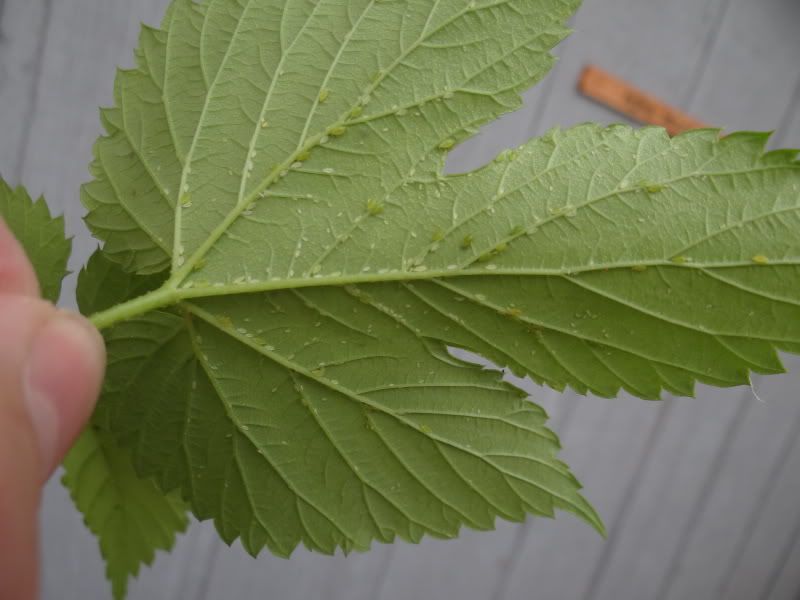
The new hops are coming along quite nicely with much better growth on some of my new first years compared to last years Chinook, which has already surpassed the height of the trellis and I am having to get creative with how to keep it out of the other varietals next to it.  I had quite a bit of Aphid issues this year, and the mild soap spray I used killed them all off, but scorched some of my leaves as well.  I had a buddy who grows lots of hops (I got most of my rhyzomes from his hop yard) come by to take a look at the plants and he recommended fertilizing and longer deeper waterings.  Since giving longer waterings and adding some Miracle Gro the plants are looking much healthier.  I've even got some healthy side arm growth going on my big plants.  All in all it is looking to be a good year of growth; hoping for a decent yield on my Brewer's Gold, AlphAroma, Cascade, Shinsuwase, and maybe even Blisk and Cerara.  Chinook should be good this year.

Monday, May 14, 2012

3 Beers, 1 Mash, Good Deal...


It might just become a yearly brew for me… A triple beer mash that is.  Last year I did a Bavarian Hefeweisse, an American Wheat IPA w/ pineapple, and a Session Sour from a single mash.  This year I did a single mash for 3 more beers.  This year the Hefe was switched out for a Witbier, the Wheat IPA for a clone of 3 Floyds Gumballhead, and the sour mashed Session Sour for a sour mashed “Saison” with oak and Pinot Noir juice.  Made for a great brew day, and hopefully, despite a few hiccups, some great beers.

Single Mash:
11# Flaked Wheat
9.6# Great Western Pale Malt
3# Rice Hulls (for good measure)
5/8 tsp Gypsum
3/8 tsp Calcium Chloride
Single Infusion: 151*F for 60 minutes
Ran off 13.5 gallons.
Split into 2 - 6.75 gallon batches
____________________________________________________________

Witte Comeback:
45 minute boil
FW 0.30oz Sterling AA% Unkown (home grown 7.5% estimated)
15   0.70oz Sterling AA% Unkown (home grown 7.5% estimated)
KO 1.00oz Sterling AA% Unkown (home grown 7.5% estimated)
10 mins 0.80# Flaked Wheat added to boil
KO zest of 2 Cara Cara Oranges, 0.12oz Coriander, 0.12oz Pink Peppercorn, 0.12oz Green Peppercorn (didn’t buy enough spices and missed each addition by half… oops)
Tea of: zest of 1 Cara Cara Orange, 0.20oz Coriander, .12oz Pink Peppercorn, 0.10oz Chamomile steeped 5 mins @ 190*F added to fermenter (1.5 cups)
 ____________________________________________________________

5.0 gallons 3726 Farmhouse Ale yeast slurry
0.5 gallons 3726 Farmhouse Ale + souring bugs/Brett
Fermented @ 83*F 2 days, 78*F for 3 weeks
Blended at bottling
____________________________________________________________

5.5 gallons
OG 1.050
FG 1.005
15 IBUs
4 SRM
5.9% ABV
____________________________________________________________

Gumballhead:
0.75# Caravienne steeped 35 minutes @ 150*F
45 minute boil
FW 0.50 oz Amarillo 9.3 AA%
45   0.30 oz Amarillo 9.3 AA%
15   0.50 oz Amarillo 9.3 AA%
5     1.30 oz Amarillo 9.3 AA%
KO 1.00 oz Amarillo 9.3 AA%
DH  1.40 oz Amarillo 9.3 AA%
____________________________________________________________

1056 American Ale pitch f/ Oakshire
Fermented @ 66*F for 2 weeks
DH @ 66*F for 4 days
____________________________________________________________

***Hit the 1.055 gravity perfect @ 5.0 gals but forgot to drain ½ gallon of StarSan from Better Bottle before racking so ended up with 5.5 gallons @ 1.050.  Added 1# sugar boiled in 1 pint water to the fermenter on day 2 to boost gravity back up making it 1.057, and FG hit low @ 1.007 making for a 6.6% ABV beer instead of 5.5%***
____________________________________________________________

5.5 gallons
1.057 OG
1.007 FG
34 IBUs
5 SRM
6.6% ABV
____________________________________________________________

Vino Cilurzo (Sour w/ Pinot Juice):
Last runnings from mash 6 gallons @ 1.011 soured with 0.10oz of Pale Malt in bucket @ 98*F for 50 hours, smell of yogurt, not much sour, light twang, somewhat astringent.  Went to boil and my burner caught on fire resulting in no boil.  Racked back into the same bucket less grains.  Pulled 1 quart of wort and brought to just under a boil on the stove.  Added hops and steeped for 5 minutes.  Strained into bucket.  Pitched ¼ cup slurry of 3726 Farmhouse + souring bugs/Brett slurry.  Added 3 pieces of French Oak blocks.  Didn’t take OG, estimated @ 1.030.  On day 2 added 3000ml of Pinot Noir concentrate that I scored for free when it was broken in transit to Falling Sky, estimated new OG 1.050.  Smelled of sulfur so I added 3726 Farmhouse slurry for more yeast activity and also added yeast nutrient per recommendations from a fellow brewer.  As of 4 weeks the sulfur smell is gone and a pellicle has formed.  Looking forward to how this one turns out... it will be bottled in early July since I need the bucket for my Flander's Red, and I don't have another fermenter (unless I pull it off to 1 gallon jugs).  At this point FG is 1.010.
____________________________________________________________

1.00 oz Cascade (home grown)
1.00 oz Challenger (home grown)
____________________________________________________________

~ 6.5 gallons
~ 1.050 OG
~ 1.002 FG (unkown, assuming low FG with bugs, Brett, juice)
~5 IBUs
~ 6% ABV

Wednesday, May 9, 2012

Shortened Brewday Update

As I stated in my last post, I severely tweeked two brews to shorten my brew day and make it much easier and less stressful... thus funner, and it was.  My efficiency was slightly lower than I thought it would be but I still hit my numbers where I wanted to.  1.049 for my Wit, and 1.055 for the Gumballhead... then the curve ball.  I was racking the Gumballhead into the Better Bottle with my airstone going just fine while I emptied my mash tun.  After it finished I looked over to see a plume of foam exiting the top... wait a second... why is Starsan foam coming from the... top... of my... oh... !  Yes, after pouring a half gallon of Starsan into my fermenter, shaking to sanitize, putting the shirt over the top to keep the sun from skunking my beer, and putting the stopper in to keep debris and such out, I forgot to empty the Better Bottle before racking into it.  Luckily Starsan is drinkable, unlike Iodophor, and so it just diluted the beer from 5 gals @ 1.055 to 5.5 gals @ 1.050.  To adjust for this I added a pound of sugar to the fermenter to get the gravity back up to about 1.055 so that I will still hit the right ABV (maybe a little higher with how fermentable the sugar is).

As an added bonus I drew off 6 gallons of 1.011 gravity last runnings and soured them for 50 hours @ 95*F.  Smelled like yogurt, not too tart though.  Went to boil it with 2.5# DME and my burner caught on fire at the hose, so no boil.  I pulled 1 quart of wort and brought it to just under a boil and added 1oz Challenger and 1oz Cascade for a frutiy, spicy, floral, citrus hop nose to it and steeped for about 5 mins, then strained it into the other 6+ gallons of unboiled wort in the bucket.  I added some slurry from the 3/4 gallons of Soured Saison I just bottled, and after 2 days it smells of fruit, lactic, and CO2, and I can see the wort churning when I look inside.  Tossed in a couple of my French Oak cubes as well.  In a few months it should be nice and tart and funky.  My thoughts are to add fruit or maybe flowers to it, possibly dry hop.  We'll see how this one turns out for a last minute, last runnings, sour mash that didn't fully sour and never boiled, hopped nose but not boiled, oaked experiment, that I didn't take a gravity reading on.

Be on the look out for the recipes soon.

Wednesday, October 19, 2011

Spontaneous Fermentation Update

Awhile back I did a time line blog of the yeast starters I was making from the wild yeast and bacteria living on the skins of wild blackberries living in my neighbor's yard and from locally grown organic peaches. The brew day has come and gone, and I thought I would fill in the specifics and update on how the beer has progressed thus far.

The recipe:
6.25# Pilsner Malt (54%)
2.25# Vienna Malt (20%)
2.00# Flaked Wheat (17%)
1.00# Caravienne (9%)

90 minute boil
FW Hops 0.4oz Styrian Bobek 3.8AA pellets
15 min 0.6oz Styrian Bobek 3.8AA pellets

10 min 1.50z Cake Flour
5 min 1tsp Coriander, Crushed

Mashed 60 mins @ 152*F
Sparged w/ Boiling water

5.25 gals
OG 1.057
FG 1.002
IBU 10
ABV 7.2%


I mashed at 152*F, I was shooting for 154, but added too much cold water when I was too hot, and it cooled it down too much. I sparged with boiling water to try to extract as much sugar as possible and even some tannins as well. At the end of the 90 minute boil I added some cake flour for extra dextrins and starches for the Brett to chew on over the long fermentation. I cooled it as usual and ran it into the fermenter. I added the 2 starters to it whole, all the wort, fruit, bacteria, yeast, a couple ants, everything. I didn't aerate it since oxygen feeds bad bacteria, and inhibits Lacto growth. It looked kind of stratified until the next day as the different parts were layered, wort, trub, break material, fruit, starter, etc.


After a few days I noticed some odd activity. There was no krausen, but I had used S-Foam, and foam inhibitor, so it is quite possible that it was fermenting and not putting up a krausen. I did notice lots of little tiny bubbles shooting up and feeding a fluffy foam at the top though, and I assume this was from the Lacto working since it releases CO2. Another day later and I saw the wort churning away like any other beer fermentation, so things were going good.


I let it go for a few weeks with out tasting it, and finally on week 3 I gave it a taste. Nice, light, clean tartness, clean fermentation, no off flavors, mild funkiness, slightly fruity, not much oak character, gravity was 1.005. Quite happy with it. I tasted it again 1 week later and the oak is starting to show some; I will be watching this since I don't want it to be too oaky. If it gets where I want it I am going to rack the beer off, remove the oak, and add the beer back to the trub, yeast, and fruit for longer conditioning and funkdifying. So far I am very pleased. I even used the yeast to ferment a cider.

NOTE: This beer took 1st place in Sour Beers and won BEST OF SHOW in February 2014 at the KLCC BJCP comp.

Friday, August 19, 2011

A Yeast Starter w/o Yeast?

I am preparing to make a beer in 3 weeks that will not have yeast added to it for fermentation... well, not directly; I will be adding fruit directly to the unfermented wort to do what is called a Spontaneous Fermentation. Spontaneous fermentation is used in Belgium to make Lambics; the hot wort is pumped into a cool ship (a flat, shallow steel container with no lid) that sits high in a pathway for good night time breezes and awaits the breeze to bring local microflora: wild yeasts, and beer souring bacteria. After a night of cooling and being innoculated with these wild strains, it is transfered into a wooden barrel that is home to wild yeasts and bacterias, and it ferments here for years.

I will be doing something like this, but not quite. The wild yeasts and bacteria that are in the air used by Lambic brewers are mostly from fruit. Fruit have all the organisms needed to make a wild ale: Saccharomyces, Lactobiccilus, Pediococcus, and Brettanomyces. My plan is to add the fruit with these microflora on them directly to the beer and allow the resident critters to do what they naturally do. The fruits contain sugars that will be eaten and increase the alcohol in the beer as well as helping to dry it out, and they contain acids that will help add another layer of sourness to the finished product. I am going to use blackberries and peaches, the blackberries will give a nice acidic and fruitiness, and the peaches will have a large amount of Brett living on the fuzzy skins. I also will be adding French Oak cubes to primary to add some more depth, as well as any microflora living in the wood.


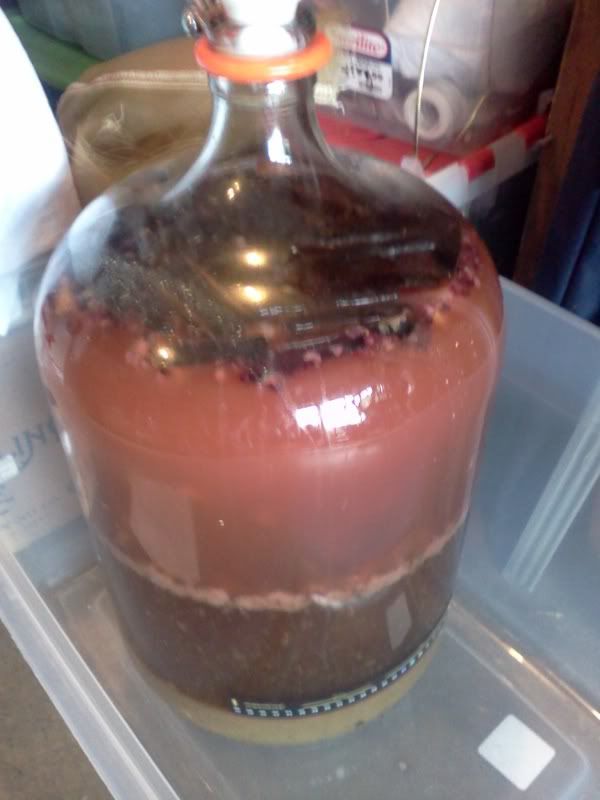
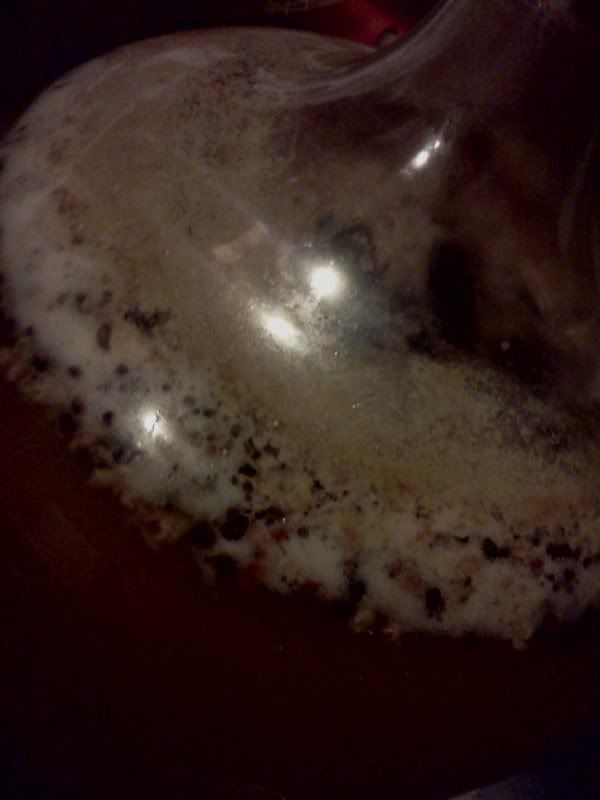
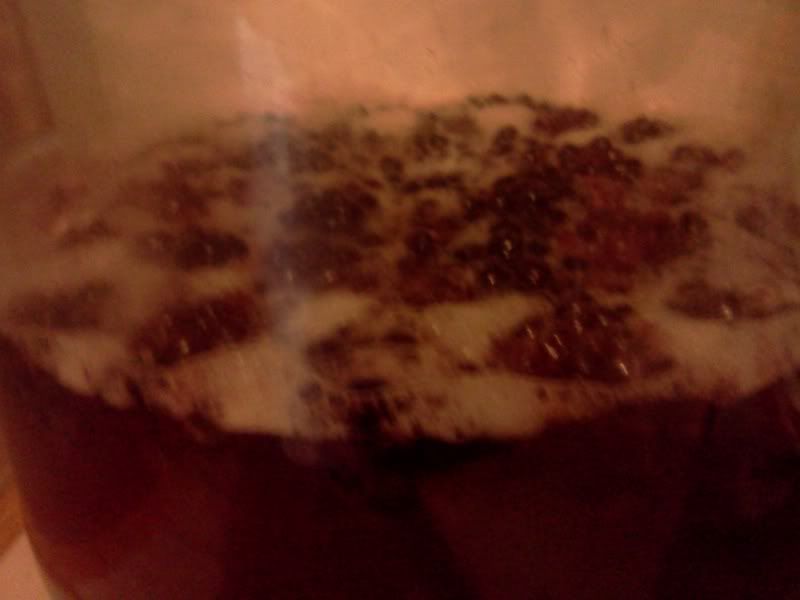
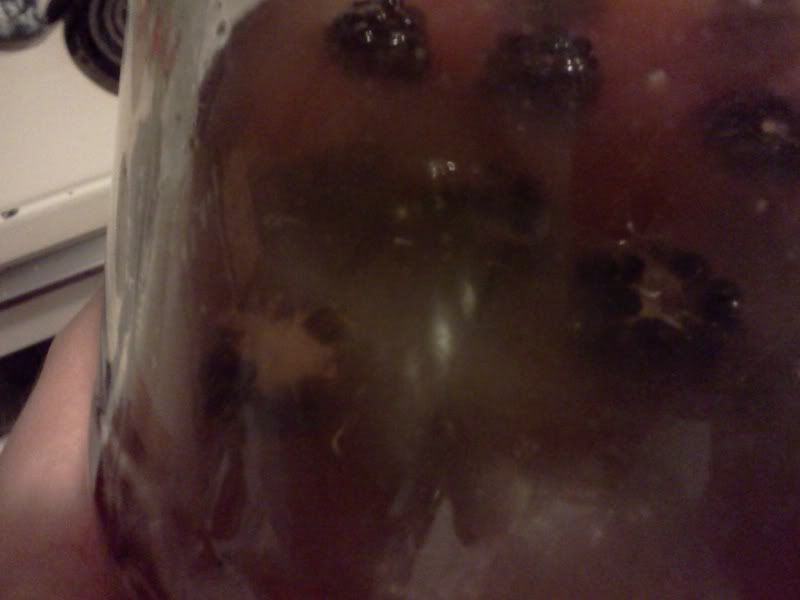
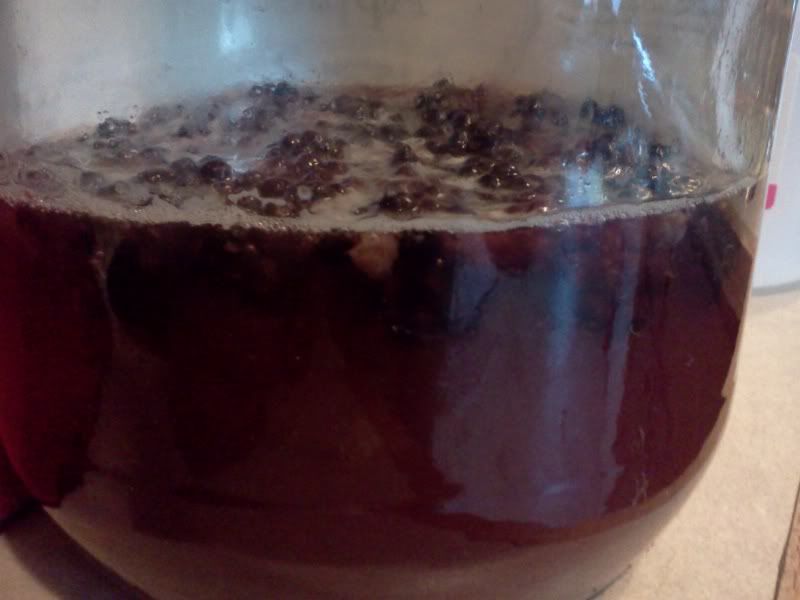
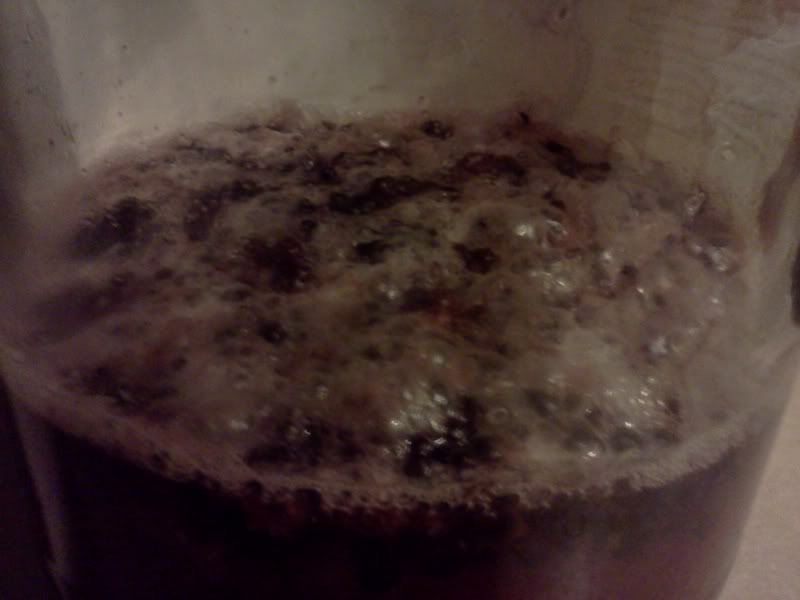
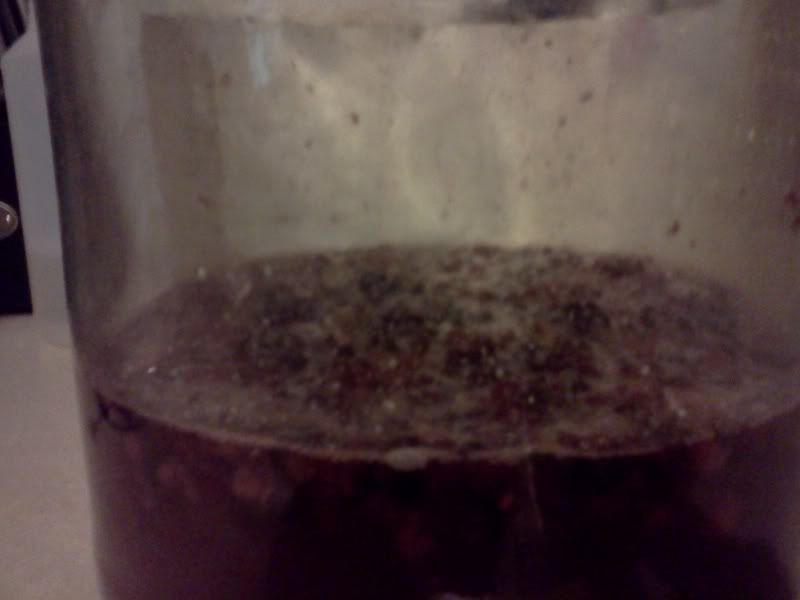
One huge risk I run by doing this is if there is too much oxygen, acetobacterer can grow which can turn the beer to vinegar. So to avoid a slow start to fermentation, I am taking a precaution. I am making starters from the fruit, that I will pitch along with more fruit when it comes time to ferment. So far I have made the starter wort: 200ml Simply Apple Juice and 800ml of water, to 50 grams of light DME, boiled with yeast nutrients. To this I added 15-20 fresh blackberries from my neighbor's bush. It has been 4 days, and it has hit high krausen, has a substantial amount of yeast on the bottom, and is forming a pellicle. It tastes great. Lots of fruit, light alcohol, clean sourness that is more than straight tart blackberry. Here is a progression:
12 Hours - Some signs of growth as the slurry on the bottom is larger than before.


24 hours - the blackberries are starting to float around a bit, and there is quite a bit of yeast (I assume) on the berries on the cores.


36 hours - many of them floating on top and what appears to be fermentation signs on the top. Progressing nicely.


44 hours - definite signs of a good fermentation.


48 hours - krausen has formed, and smells of fermentation.

84 hours - fermentation seems about done, there is a substantial amount of yeast on the bottom, and I see signs of a pellicle forming on top.


I will be updating again soon as I do the starter for the peaches (the Farmer's Market was sold out the other day, hoping to get some tomorrow morning), and again as I step them up, and of course, brew day!

NOTE: This beer took 1st place in Sour Beers and BEST OF SHOW in February 2014 at the KLCC BJCP comp.

Thursday, August 11, 2011

What I'm Working On Now

Wanted to put out an update on what I have going right now. No beers fermenting. No beers in secondary. The 2 Saisons are carbing up right now, and should be ready in the next few days. I have 2 recipes written up for September, one super hopped pale ale, and one spontaneous fermentation (another blog post will be dedicated to that one soon).

At this point what I'm working on is starters/cultures. As stated in an earlier post 3 Beers, 1 Mash, I did a Berliner Weisse with the soured last runnings of a mash that made my Hefe and hoppy American Wheat, and then pitched WY 1007 German Ale, and a starter I had cultured from the dregs of Russian River Supplication into primary together. The beer is amazing, and I didn't make the same mistake with the yeast cake on that as I did with the starter of yeast I cultured for the Hefe (dumped it all). But I needed something to do with the yeast to save it. As I was brewing my Saisons 6 weeks ago, I drew off the last runnings from both mashes and boiled them with a small amount of hop pellets for about 45-60 minutes. I let them cool and then dumped it into a 3 gallon bucket. I added the entire slurry (full mason jar) to the 1.5 gallons of wort, and added about 30 used medium toast French Oak cubes I got from a buddy who goes to church with a Vintner in Lodi that had come from their barrells. The thought was to save the yeast by inoccluating the oak for future sours. I strapped the lid and air lock on and let it go.

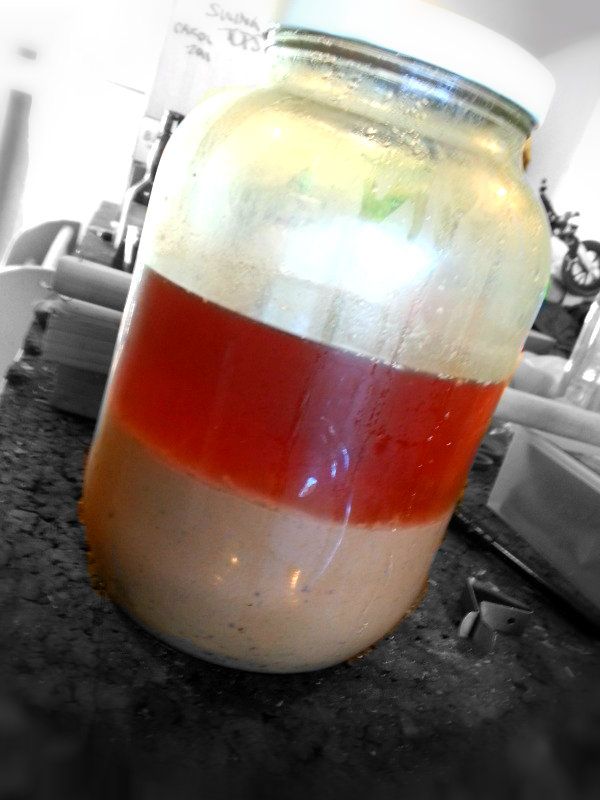
5 weeks later as my son and I were hanging out in the brew house (garage) he was grabbing stuff that looked cool as any 16 month old does, and he pulled the airlock off the bucket. I took it and told him not to touch it like a dad should, but as I was replacing it, I gazed throught the hole and freaked out. What I saw was a giant blob of mold... or so I thought. After posting a How Do I Save It From The Mold forum on BeerAdvocate I was informed it was the pellicle (a layer of Brett that floats on top of the beer as they use the oxygen to reproduce, and also keeps oxygen out, as well as prevents mold and Acetobacteria). Having never seen one before (other than in the bottles of Berliner), I had no way to know. I also sent an email to The Mad Fermentationist who confirmed the same. After chatting it up with him over quite a few emails I decided to rack the beer into glass jars to continue as opposed to leaving them in a bucket that is permeable to oxygen and has about 1.5 gallons worth of head space. When I opened the bucket it smelled very sour, like a strong aroma from Rodenbach condensed. Almost vinegary, but not quite. I racked the beer into a 1 gallon jug and a 1/2 gallon jug, siphoned up a lot of slurry, forced as many oak cubes in as I could fit, and then added a little sugar to it to kick start a little fermentation to fill the head space with CO2. After 5 days, the beer has cleared, and a pellicle is forming on top again (see the big pic at the top of this post).

I also have a starter from a bottle of Orval I have built up that I used some of in bottling one of my Saisons. It should give me some nice Brett character here in the coming months, and taste great next summer. I also enjoyed a RR Consecration a few weeks ago and have built up a starter of the dregs from that as well. It has a very soft powdery coating on top with a layer of slime underneath, and some white, slimy looking flat things floating here and there... sounds like it is working, this is what pedio is supposed to do... right!?! My hope is to get them built up for future sours/wilds, including an all Brett beer fermented with only wild yeast.

I will continue to post updates from time to time as things progress, and new experiments pop up.