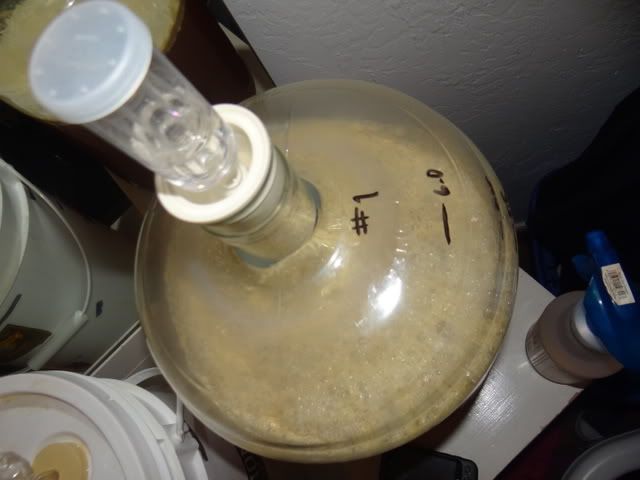
Got this video clip from Matt Van Wyk at Oakshire Brewing this morning. This is the blow off activity on my yeast pitch I gave him at less than 24 hours after pitching onto just under 1 barrel of 10* plato wort. Ferocious!

Showing posts with label Wild Projects. Show all posts
Showing posts with label Wild Projects. Show all posts
Thursday, October 16, 2014

Thursday, September 18, 2014
RECIPE & PROCESS: WTWTA: Ira & Judith
Friday, August 15, 2014
RECIPE: The Becca Begins (Solera Barrel 1st Fill: Belgian Blonde)
 |
| Barrel is all topped up |
I had considered using one of the blue plastic drums from the Homebrew Store that previously housed Liquid Malt Extract, but the potential oxygen uptake on a project of this size was too much for me. I had also tried to figure out a way to do it with a retired 1/2 barrel keg but couldn't find one through legal paths. I had put out an email to the brew club to see if anyone had a lead on one, and a response I wasn't expecting came back: I have a 14 gallon wine barrel that I am not going to use that you can have. Wow! Jackpot!
 |
| Saison and 5 Brett Strains |
 |
| Mash is Drained |
Only time will tell where this one goes from here.
_________________________
Stats:
Gallons: 16.00
OG: 1.054
FG: 1.005
ABV: 6.40%
 |
| Added Invert Sugar to Hot Wort to Dissolve |
SRM: 7.0
Efficiency: 92%
_________________________
Fermentables:
20.00# Weyermann Pilsner (80.0%)
2.50# Special Aromatic (10.0%)
2.50# Sugar, Invert (10.0%)
Mash 10 hours @ 154*F
_________________________
Boil 45 mins
35 2.00 oz Magnum 16.40%AA
_________________________
Kettle Additions:
Gypsum - Mash 1 1/4 tsp; Boil 1 3/8 tsp
Epsom Salts - Mash 1/2 tsp; Boil 1/2 tsp
Calcium Chloride - Mash 1 3/8 tsp; Boil 1 5/8 tsp
Lactic Acid - Sparge 1.4ml
Lactic Acid - Sparge 1.4ml
Yeast Nutrient - 6 taps
Whirfloc - 1 each
_________________________
Fermentation:
Cooled to: 74*F
2 Better Bottles = JasperYeast JY43 Saison slurry from Enygma
2 Better Bottles = JasperYeast JY43 Saison slurry from Enygma
1 Better Bottle = JY33 B Brux & 87 B Brux, ECY B Naardensis, B Custersianus, and B Nanus, Cascade Brewing Lactobicillus Brevis
Barrel = WLP B Brux Trois, BSI B Lambicus, WY B Clausenii, Orval B Brux, Elysian's Mortis B Brux, Flat Tail Brewing "Brett F" wild yeast from local plums, Cascade L Brevis
74*F 2 days
78*F 2 days
85*F 10 days
Ambient Garage Temps for 6+ months
_________________________
Notes:
 |
| Maxed out my 17.5 gallon Kettle |
7/18-19 Brewed alone, mashed all grains in at 8:30pm at 154*F. Dropped to 142*F by 7:30am, loss of 12*F over 11 hours. Sparged and boiled as one batch, added the sugar and end of boil. Cooled wort to 74*F and transferred via pump to 3 Better Bottles at 10:00am . Pitched 2 with JY 43 Saison strain slurry from Enygma, and the other with 5 Brett strains and Lacto. Set controller to 74*F. Positive pressure and bubbles in Saison yeast fermentors within hours, full krausen on all 3 by next morning.
 |
| CO2 Force Racked Into Barrel |
7/23 Jumped up to 85*F
7/27 Pulled samples, tastes great. 1.006, 1.005, 1.004 on the refractometer.
8/2 Wracked off of yeast into cleaned 15 gallon wine barrel. Samples of the JY43 version were lightly sulfury, higher alcohols, fruity, no phenols. The Brett and Lacto version had a bit of funk and over-ripe fruits. Came up short on volume some how, so I racked ½-1 gallon of the Too Small Sour Brett Rye Saison in with a bottling wand shoved into the picnic tap to avoid splashing and filled the headspace. This added BSI Brett Lambicus, Elysian’s Brett B, Wyeast Brett C, Orval Brett B, and Flat Tail’s Brett “F” to the mix as well as more Cascade Lacto.
8/12 Pulled bung to see a pellicle has already formed and took a sample. Light Brett spiciness and funk mingled with fruity alcohol.
8/16 Was able to score some 4D Stainless Steel nails from a super helpful brewer in town that has an amazing barrel aging program. Drilled the head of the barrel about 3/4 of the way down with a 7/64" drill bit and then slid one of the nails into the hole. This gives me the ability to pull samples from the barrel over time and not have to open the barrel itself and expose the beer to oxygen.
Left in garage at ambient temps to age and sour (Max temp in August in garage was 122*F).
Left in garage at ambient temps to age and sour (Max temp in August in garage was 122*F).
Wednesday, April 9, 2014
UPDATE: Prepping for Some Funky Stuff
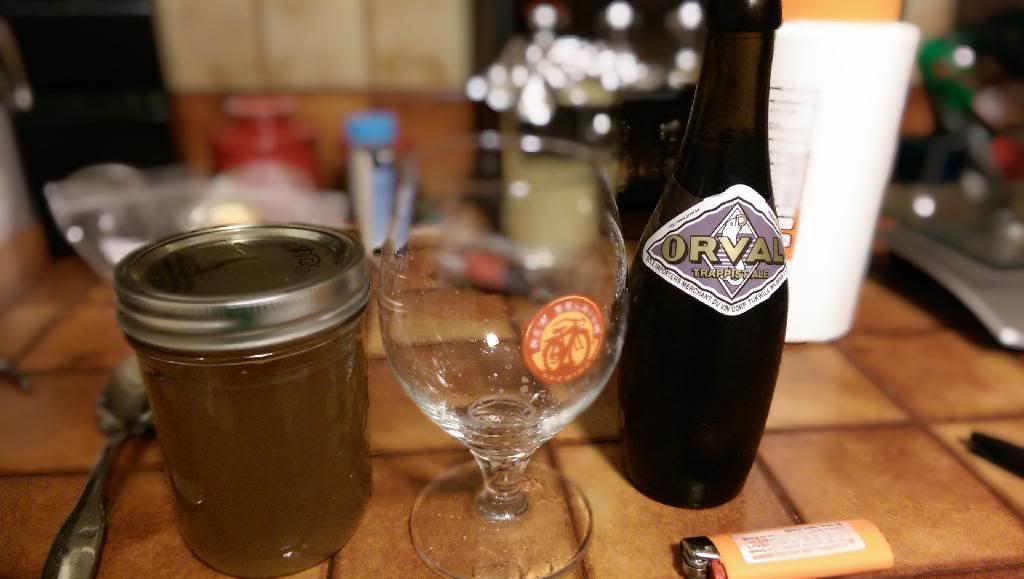
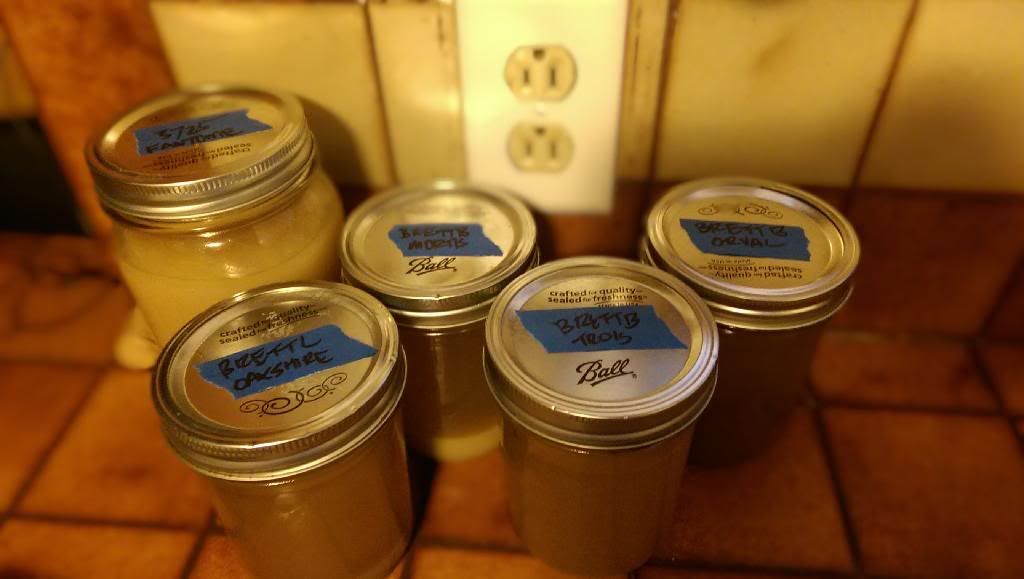 I also stepped up some older Brett strains from the slurries in my fridge like a Brett B I cultured from Elysian's Mortis, a Brett L from a local brewery that hooked me up with a pitch, and a new vial of WLP Brett Trios. I also cultured the dregs from a fairly fresh bottle of Orval to get that funk it is known for. I boiled up some ~1.020 wort and put it into mason jars and then cooled it down. I pitched each strain separately to build them up and left the lid loose for CO2 escaping. When I walk by I tighten the lid and give it a good shake then loosen it up again; by next morning a few were already giving off CO2 and foaming which is great. My buddy Stephen from church plays with bugs too, and he gave me some Brett C from Wyeast and some Brett "F" which was cultured and isolated from plum skins by the brewer at Flat Tail in a neighboring city, Corvallis. These will go into primary alongside some Lacto I cultured up from grains and I am hoping some Lacto from a bottle of Cascade that Stephen and I split the other night on my new deck. He took the bulk of the dregs home to plate and isolate the Lacto, then grow it up, I took the last of the dregs and tossed them into a low gravity solution of Lactose sugar which I have sitting at 105*F right now to try to get some good growth before I brew. All these strains will be pitched along with both WY PC strians of 3726 Farmhouse (Blauges) and 3725 Biere de Garde (Fantome). The hope is that getting the Lacto and Brett cell counts stepped up in starters and raring to go, and pitching at the onset with the smaller pitches of the Saison blend will give a quick turn around for a young and complex beer.
 |
| Allagash Culture |
I also have 3 bottles worth of dregs from the Carol (BOS Lambic) stepping up for a future brew from just that yeast, that may eventually become a full batch at another local brewery...
Lots of exciting yeasties and beasties to play with, just wish I had more time and more wort...
Lots of exciting yeasties and beasties to play with, just wish I had more time and more wort...
Wednesday, December 19, 2012
UPDATE: Carol 2012 (Lambic)
After 2 months of wild fermentation I pulled a taste of the Lambic I brewed in October. It has a distinct bitterness to the sour, much like a 3F or Cantillon, just not as harsh. The sourness is very present for such a young sour, and different from a straight lactic sourness and no acetic. The sour profile contains an acid from (I suspect) some of the early bacterias that weren't in the first edition. There are a few esters in the young beer that are slightly off, not bad, but not totally pleasant. Looks like I have a real Lambic fermentation on my hands with early bacteria and acids from other wild sources before the Lacto or Sacc started doing their thing. I am looking forward to where it goes from here as the Pedio blooms and the Brett takes some of the less desirable esters and acids, and transforms them into (hopefully) wonderful fruity and funky esters. The long aging period should also help some of the bitterness drop out that comes from the hops (if any of the bitterness is from the aged hops at all), as well as some tannins from the French Oak.
Tuesday, October 16, 2012
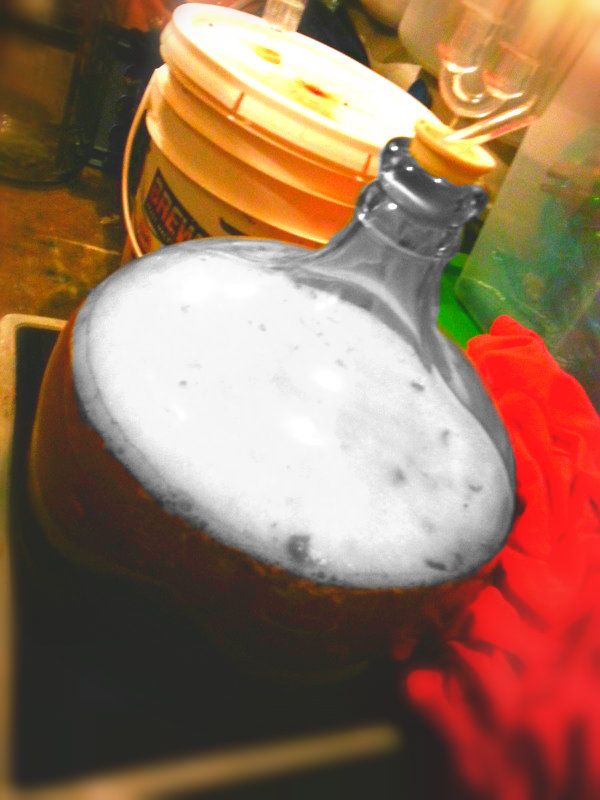
Update: Carol 2.0
Tuesday, October 9, 2012
Recipe: Carol "Lambic" 2.0 (Where the Wild Things Are)

As I sip on my “Lambic” from last year, which I am very
pleased with, I am very anxious to brew another one. This time I will use the same yeast culture
from the last one as I saved the entire cake from the last brew in a gallon jar
in the fridge. This year I am going to
go with a grist that is much more traditional, 65% Pils, 35% Raw Wheat, mashed
@ 158*F. Last year I had some character
malts like Vienna
and CaraVienne which are not traditional and I’m not sure they added any needed
complexity other than color. I also had
a flavor hop addition which is pointless in a beer aged for a year, coriander
was the same. I added some cake flour
last time for a little more dextrins to chew on since my mash temp was fairly
low.
I could always do a turbid mash, but why? I could also do a cereal mash, but why? These things are traditional, but do they add
anything to the final product that won’t be there (or at least drastically
noticed) in the final product? My first
Lambic is quite nice and it was mashed at 152*F, and hit 1.006 in 3 weeks. The 158*F mash should leave a larger amount
of dextrins in the wort for the bacteria and Brett to munch on, and the large
pitch of yeast cake should ensure a healthy amount of bugs and Brett as well as
autolized yeast for them to eat as well.
That combined with an overnight open cooling in the garage where all my
wild stuff is going (which I already fermented a ½ gallon of left over Brown
Ale spontaneously in there), and some more dregs from commercial and homebrewed
sours should ensure a good, big, powerful, and characterful fermentation from
the onset, avoiding some of the enteric bacteria that are not desired. Add in a 3 hour boil, and aged hops, we are
looking at a great start to a second Lambic for next year.
 Stats:
5.5 gallons
1.050 OG
1.001 Est Fg
6.6% Est ABV
8 IBUs
3 SRM
__________________________________
Fermentables:
7.5# Weyermann Pils
4.0# Flaked Wheat
0.50# Rice Hulls
10 Minutes @ 148*F
10 Minutes @ 152*F
45 Minutes @ 157*F
78% Extract Efficiency
72% Brewhouse Efficiency
__________________________________
180 Minute Boil:
180 mins - 3.4 oz Aged Hops ~ 1.5AA%
__________________________________
Fermentation:
Cooled overnight opened to air in garage
6 gallon glass carboy
Healthy pitch of cake from Carol 1 (cultured from
blackberries plus dregs)
Dregs of 3 Fonteins Oude Gueuze
12 months at ambient in garage
__________________________________
Additional:
Gypsum 1/2 t (mash), 5/8 t (boil)
Calcium Chloride 1/2 t (mash), 1/2 t (boil)
1 French Oak Cube in primary
Brew day started off difficult. I overshot my strike temp and hit a mash temp
of 165*F. After adding cold water I
ended up at 148*F. Added boiling water
to get up to 152*F, then added more boiling water to get it up to 157*F, and
rested for 45 minutes. Wasn’t planning
on doing a step mash, but oh well. After
collecting 10 gallons of wort I drained the last of the runnings into a separate
kettle and boiled it down to about 800ml of 1.080 wort. I added this to the beer and drew off 1200ml
of 1.040 wort from the boil and cooled it to make a starter to my dregs while
the wort cooled over night. I added the
dregs from a Hannsens Oude Gueuze to the starter only for a fruit fly to get
into it and render it useless. After a 3
hour boil, I had to move the keggle into the garage for the overnight chilling,
and of course, while carrying the 15.5 gallon beast of a brewpot with a
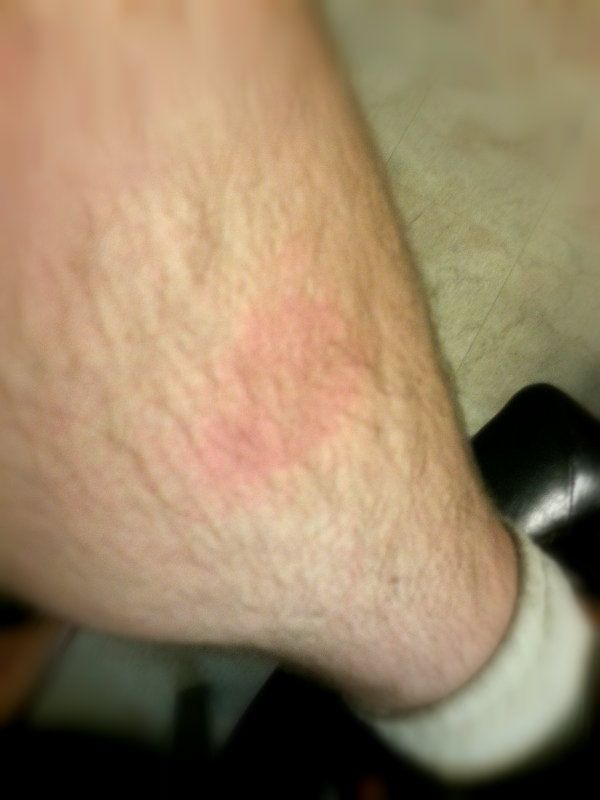
scorching hot bottom, I hit my leg with it and burned it quite nicely, luckily
I only did it once and got the wort to the garage without spilling any or
hurting myself anymore. I covered it in
a large sheer curtain sack that I synched down on the sides, hoping that the
Fruit Flies don’t get into there like the starter. After about 28 hours at ambient temp I racked
5.25 gallons of the wort into the 6 gallon carboy with the yeast cake, oak, and
dregs.
Friday, September 14, 2012
Where the Wild Things Are: The Carol

About a year ago, actually, 52 weeks ago, I brewed up a Lambic that I fermented with the yeast I cultured off of blackberries from my backyard and a small starter of yeast from organic peaches grown locally. After making the wort and adding the entire starter from each yeast to the carboy, I had a "funny" fermentation which consisted of small bubbles flowing up to the top quickly to feed a very small fluffy white head that looked like a single centimeter of soda foam. Eventually the fermentation looked a little more like normal, but the krausen never really roared up like a normal yeast would. There were chunks of peach flesh and blackberry, as well as oak chunks on top. I also added some wild grapes after a month for a little extra yeast. After only three weeks it was down from 1.053 to 1.006. Nice and fruity, with a light tartness, mostly tropical and berries.
Over the course of fermentation, I have added dregs from commercial and homebrewed sours to try to get more complexity built up from other sources of Brett and bacteria. I added some Russian River dregs, Cantillon Grand Cru, Jolly Pumpkin, Oude Beersel, Girardin Black, some infected Logen Berry mead a buddy made, and some dregs from a sour I did with Russian River dregs. This will ensure a more complex beer, but it also kills much of the work I did culturing the yeast since the final product isn't a showcase of what that yeast can actually do (part of the reason I am going to brew a new one this year with fruit cultured yeast again and leave it alone).
After a few months I noticed a lot of oak character showing, and seeing that I used 5 oz of French Oak that had come from a wine barrel in Lodi, it wasn't any wonder why. I needed to do something to stop the oaking, but I didn't want to lose all of the goodness in the trub and yeast that is needed for a Lambic to ferment properly. I racked the beer out of the carboy into my sour bottling bucket and then dumped the trub, yeast, fruit, oak, etc., into a vessel while I cleaned the carboy and removed all the oak. After this I added a few pieces of oak to the carboy, opened the valve on the bucket and refilled the carboy. While this was going on I also racked the yeast, trub, and fruit back into the carboy as well.

I noticed an oxidative character beginning to creep in around January, so I brewed a little extra wort on my Saison and added a half gallon to the carboy to displace the head space. The FG was still at 1.005. Only took a few days for the fermentation to kick back up and take on the fresh wort. After about a month or so, it was back down to 1.005.
Given another month, the FG had gotten down to 1.002, and there was a sheen atop the wort slightly resembling an oil slick, not like the pellicles I have seen before on my other sour beers. By mid summer the taste was nice, funky, tart, clean, fruity, spicy, but lots of oak, so I racked it from the 6 gallon carboy into a 5 gallon, taking some of the yeast sediment at the bottom with it. Given another month, the oakiness is starting to fade some. I racked 1/2 gallon out of the carboy and added 1/2 gallon of my sour Blonde ale to try to cut down on the oak a little. A few weeks later I am happy with the results, and am ready to bottle, and seeing that it is sitting at 1.001, not much more for it to do in the short term.
A beer that I have been watching, shaping, tasting, aging, and waiting on for a year is no simple brown bottle beer. For this batch I needed to do something special, at least for a few bottles. I started with 375ml Champagne bottles. At this point I could go with cork and cage, or cork and cap (Cantillon style), but I opted for a cap and wax seeing as they look very nice, and it's super cheap as well as not requiring extra equipment. Add to this full labels with art work and it is a very nice show piece, even if it is only 6 bottles worth.
A beer that I have been watching, shaping, tasting, aging, and waiting on for a year is no simple brown bottle beer. For this batch I needed to do something special, at least for a few bottles. I started with 375ml Champagne bottles. At this point I could go with cork and cage, or cork and cap (Cantillon style), but I opted for a cap and wax seeing as they look very nice, and it's super cheap as well as not requiring extra equipment. Add to this full labels with art work and it is a very nice show piece, even if it is only 6 bottles worth.
I hope that the beer will carbonate quicker than my other sour which has been bottled for nearly 7 months and is still fairly flat. Our club has a competition coming up and in late October that I would like to enter this batch into. I will of course set the bulk of this beer aside to cellar for years to come and continue to develop.
This beer will be the first installment in my new series of beers, dubbed Where the Wild Things Are, named after characters from the children's book made movie. The first is going to be called The Carol. One of the main Wilds, he was impulsive, much like brewing a beer with blackberry yeast, adding dregs at random, and over oaking, only to move the beer twice.
NOTE: This beer took 1st place in Sour Beers and BEST OF SHOW in February 2014 at the KLCC BJCP comp.
NOTE: This beer took 1st place in Sour Beers and BEST OF SHOW in February 2014 at the KLCC BJCP comp.
Wednesday, September 5, 2012
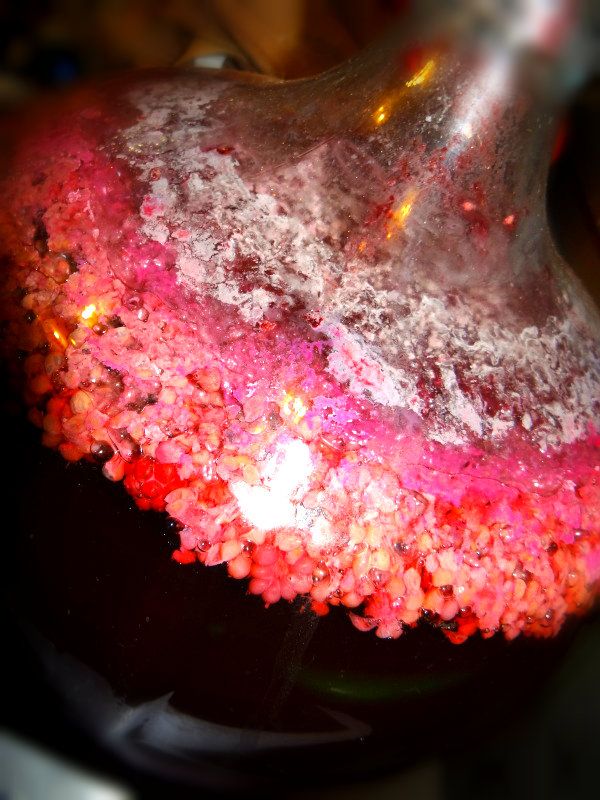
Update: Laminated Envelope - Blackberry Version
Wednesday, June 20, 2012
Sour Blonde Update: Tropicana!
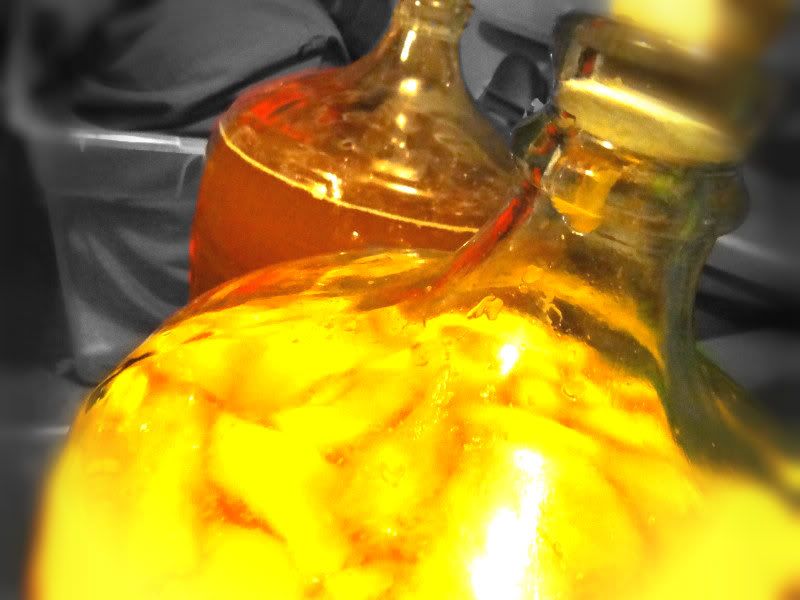
The Blonde Ale has made some advances since I last updated on it. What started as a test batch to ensure my fermenters were free of the infections that hit my other brews, morphed into a sour project when the experiment revealed that my conical was indeed still infected (and much new information leads to the conclusion that it is actually the source of it all). The batch was being housed in 4 glass jugs, and the conical, the former containing Lacto, Pedio, Brett, and oak, the latter containing Brett only. I recently added some 5 gallon glass carboys to the brewhouse, scored at a garage sale for $12 each, couldn't pass it up. I decided to take the just under 3 gallons of oaked and soured version, the 1 gallon of Lacto from yogurt and honey, and the 6 gallons of Brett Blonde and mix them together split into 2 carboys. One remains blended and aging for now (will receive some fruit later), the second received fruit now.
 I did some chatting with fellow homebrewers and sour lovers Mike Tonsmeire (and his friend Seth) and Ryan about possibilities for adding tropical fruits. Both recommended staying away from pineapple unless I was going to back sweeten as they are highly acidic. After looking at the options of guava, papaya, mango, passionfruit, and dragon fruit, I decided on mango (passion and dragon are too expensive). I added one papaya and remembered that I don't much care for it, and one won't impact the flavor enough to worry about it. I also added 3 mangoes skinned and de-seeded. According to a few sources, I would need between 8-10# of mango, and i only added about 3. The cost factor does weigh in, so when I found some Mango Nectar (high fructose corns syrup free) on sale for $3.50 1/2 gallon, I jumped on it. Bought 2 jugs. The juice weighs in at 1.057 OG. I added one jug to the carboy and almost overflowed the vessel. The other I put into one of my glass gallon jugs and then siphoned some of the sour beer in with it to ferment it like a sour/wild Mango cider. Once they are done souring, I will blend them back together before bottling. Who knows what else will happen between now and then though.
Friday, May 18, 2012
Bring On The Bugs
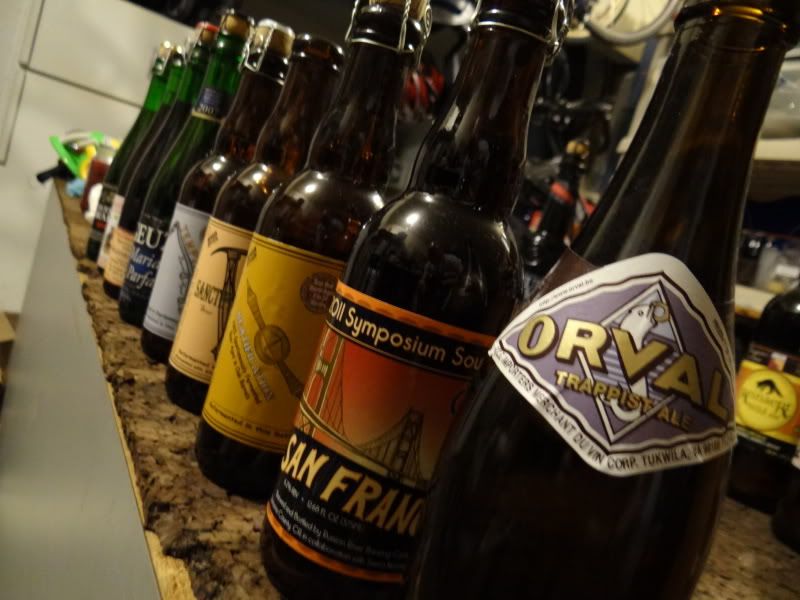
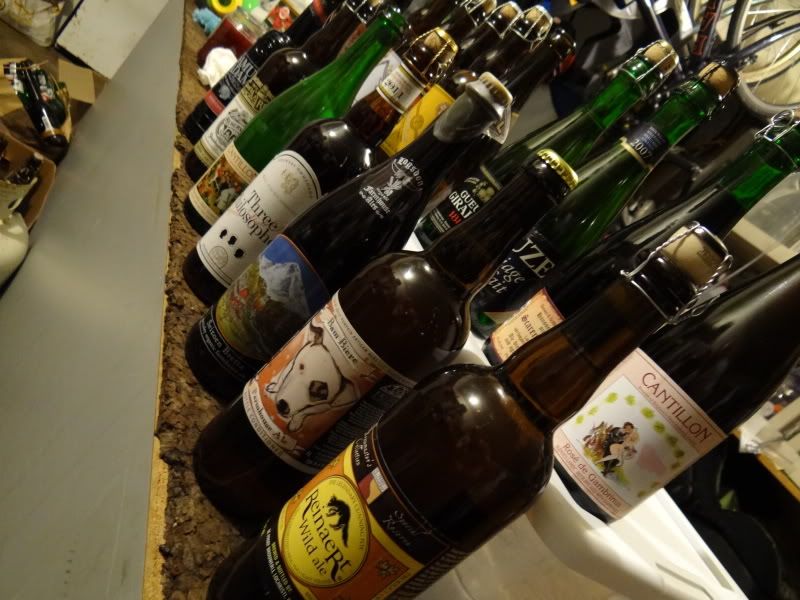
I've got quite a few bottles of different sours that I was considering culturing from, such as, RR Beatification (among other RR offerings), Cantillon Rose de Gambrinus, Oakshire Scookumchuck, Girardin 1882 Black Label, Boon Oude Geuze Mariage Parfait 2007, and Hannsens Scarenbecca Kriek. What I was thinking was to make a 1.030 starter wort from DME and Apple Juice, transfer into water bottles and put it in the freezer until I drink one of these bottles, at which point I will pop the cork, pour the beer, flame the lip, and add dethawed starter wort to the dregs in the bottle then place foil on top and leave at ambient to grow. After some time I will be able to swirl up the starter of which ever one/ones I want to use, pour some off into the beer I am brewing, and add some more starter wort to it to feed it and keep the culture going. This will give me variety, and since I have lots of 1 gallon jugs, I can add JP to one, Cantillon to another, Hannsens to another and RR to another, and compare how they turn out, then blend to the desired effect I want.
 One problem that I hit was with the bottle of Fantome Saiosn D'Erezee Prentemps that I did this with. I ended up with Icebergs on top (Large clumps of mold) and a Sea Cucumber floating around in the liquid (large carpet of mold). According to another homebrewer and sour maker he has had this same issue when the starters are grown in too hot an environment. Another issue that Mike Tonsmeire threw my way, and I was reminded of again while reading Wild Brews again, is that mixed cultures like this will be very difficult to keep in balance. Inevitably the Sacc strain will die off and autolize, the Lacto (especially in un-hopped stater wort) and Pedio will multiply rapidly, and the Brett will not keep up with the acid bacteria. If this were to happen, successive batches would become very sour and not have much other flavor components to keep the beer in balance with the proper flavors and aromas, just sour. What he recommended, and the way I will probably go, is to just pitch the dregs into a batch, let it age, bottle, and then pitch the dregs from my bottled beers into new sours along with other dregs, age, bottle, repeat, and so on. This will give me a large diversity of bugs and wild yeasts from different breweries, as well as a house character as my current bugs and yeasts are repitched and morph from batch to batch. With all the different sours I have going right now, it sounds like a good option.
Add to this my culture of Lacto from yogurt, and my Brett starters - 1 Orval, 1 Reinhardt's Flemish Wild Ale, and I will be getting some Brett C from an all Brett beer that some buddies have going, I should be looking at quite a bit of funk to funk around with.
 One problem that I hit was with the bottle of Fantome Saiosn D'Erezee Prentemps that I did this with. I ended up with Icebergs on top (Large clumps of mold) and a Sea Cucumber floating around in the liquid (large carpet of mold). According to another homebrewer and sour maker he has had this same issue when the starters are grown in too hot an environment. Another issue that Mike Tonsmeire threw my way, and I was reminded of again while reading Wild Brews again, is that mixed cultures like this will be very difficult to keep in balance. Inevitably the Sacc strain will die off and autolize, the Lacto (especially in un-hopped stater wort) and Pedio will multiply rapidly, and the Brett will not keep up with the acid bacteria. If this were to happen, successive batches would become very sour and not have much other flavor components to keep the beer in balance with the proper flavors and aromas, just sour. What he recommended, and the way I will probably go, is to just pitch the dregs into a batch, let it age, bottle, and then pitch the dregs from my bottled beers into new sours along with other dregs, age, bottle, repeat, and so on. This will give me a large diversity of bugs and wild yeasts from different breweries, as well as a house character as my current bugs and yeasts are repitched and morph from batch to batch. With all the different sours I have going right now, it sounds like a good option.
Add to this my culture of Lacto from yogurt, and my Brett starters - 1 Orval, 1 Reinhardt's Flemish Wild Ale, and I will be getting some Brett C from an all Brett beer that some buddies have going, I should be looking at quite a bit of funk to funk around with.
Wednesday, May 9, 2012
Shortened Brewday Update
As I stated in my last post, I severely tweeked two brews to shorten my brew day and make it much easier and less stressful... thus funner, and it was. My efficiency was slightly lower than I thought it would be but I still hit my numbers where I wanted to. 1.049 for my Wit, and 1.055 for the Gumballhead... then the curve ball. I was racking the Gumballhead into the Better Bottle with my airstone going just fine while I emptied my mash tun. After it finished I looked over to see a plume of foam exiting the top... wait a second... why is Starsan foam coming from the... top... of my... oh... ! Yes, after pouring a half gallon of Starsan into my fermenter, shaking to sanitize, putting the shirt over the top to keep the sun from skunking my beer, and putting the stopper in to keep debris and such out, I forgot to empty the Better Bottle before racking into it. Luckily Starsan is drinkable, unlike Iodophor, and so it just diluted the beer from 5 gals @ 1.055 to 5.5 gals @ 1.050. To adjust for this I added a pound of sugar to the fermenter to get the gravity back up to about 1.055 so that I will still hit the right ABV (maybe a little higher with how fermentable the sugar is).
As an added bonus I drew off 6 gallons of 1.011 gravity last runnings and soured them for 50 hours @ 95*F. Smelled like yogurt, not too tart though. Went to boil it with 2.5# DME and my burner caught on fire at the hose, so no boil. I pulled 1 quart of wort and brought it to just under a boil and added 1oz Challenger and 1oz Cascade for a frutiy, spicy, floral, citrus hop nose to it and steeped for about 5 mins, then strained it into the other 6+ gallons of unboiled wort in the bucket. I added some slurry from the 3/4 gallons of Soured Saison I just bottled, and after 2 days it smells of fruit, lactic, and CO2, and I can see the wort churning when I look inside. Tossed in a couple of my French Oak cubes as well. In a few months it should be nice and tart and funky. My thoughts are to add fruit or maybe flowers to it, possibly dry hop. We'll see how this one turns out for a last minute, last runnings, sour mash that didn't fully sour and never boiled, hopped nose but not boiled, oaked experiment, that I didn't take a gravity reading on.
Be on the look out for the recipes soon.
Wednesday, April 25, 2012
UPDATE: Brett Blonde
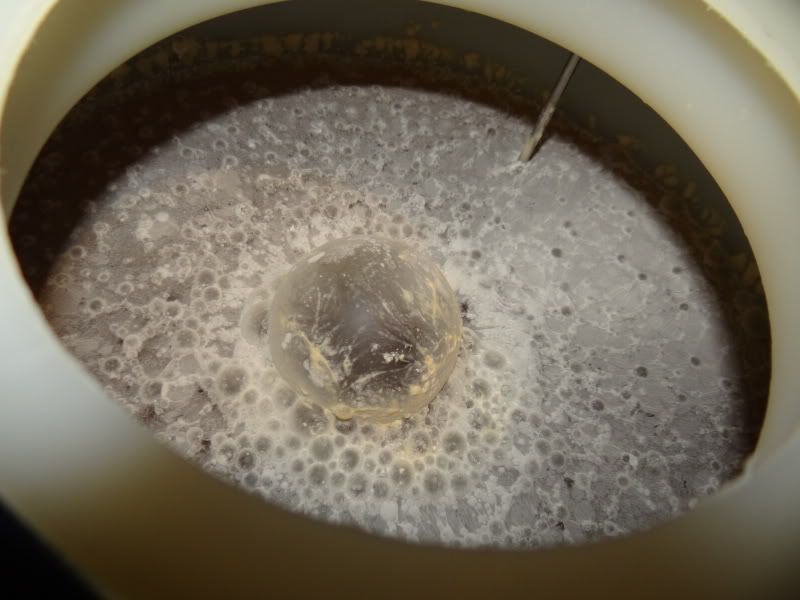
Thought I would post a quick update on the Blonde Ale that I turned some Brett lose on, mainly I just want to post some pix of the pellicle from inside the conical cuz it looks cool...

Thursday, April 5, 2012
Infecting My Infection Experiment
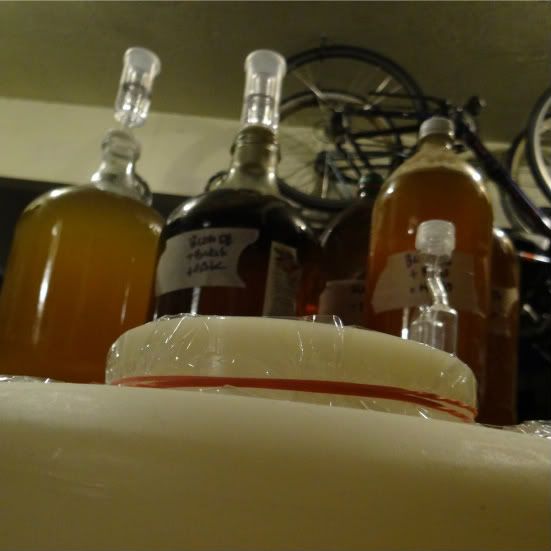
On the conical, I diverted 1 gallon to a jug that housed a Brett starter to funk up, and I hit the remainder with 1/4 cup starter from Russian River Consecration and 1/4 cup of my Lambic along with 8 pieces of French Oak. After a few days it was tasting quite oxidized, so I moved it out of the conical into smaller containers. I put all the oak into one jug so it will be over oaked and used to blend into the final mix. The rest was put into 2L bottles with a small addition of sugar.
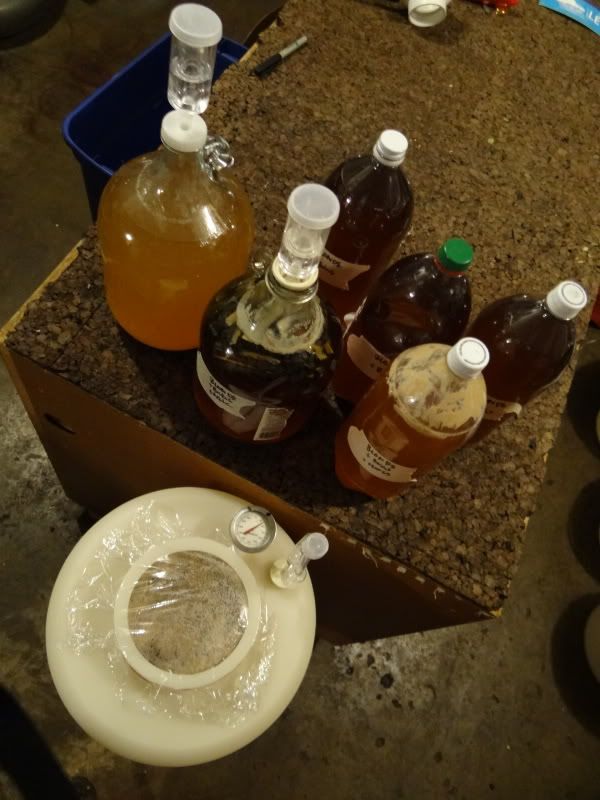
The plan is to let the Better Bottle version now in the conical funk up with Brett for a few months while the original conical version sours in the 2L bottles. After 3 months or so, I will drain off a couple gallons of the Bretted conical into 2L bottles and add a 1 gallon starter of Lacto and honey, as well as a couple of the 2L soured bottles to get the souring bugs going in the Brett only version. After some time passes I will pull some more form the conical and add the remaining 2L bottles of soured Blonde as well as the oaked sour Blonde to the mix. Come the end of summer, I will have 2 gallons of Blonde Ale on Brett, and about 8 gallons of soured, oaked, wild Blonde which I will split 3 gallons onto cherries, 3 gallons onto apricots, and keep 2 gallons straight giving me a total of about 10+ gallons. We will see how time plays this one out.
Thursday, March 22, 2012
Wet Cardboard Stinks!
After all the effort to brew a clean beer after all the infections, after brewing up a new recipe, after finding that the conical was still infected, after deciding to sour the whole batch and fermenter for good, after working up a great plan, wet cardboard! The conical is opaque so I can't see what is going on inside. Last night I popped the top to see if any progress had been made in 5 days (no, it hadn't), to find an odd smell. I flipped a couple of the oak cubes over since they had some yeast slurry on top of them, and when I pulled my hand back it hit me... oxidized! The conical also holds about 8.5 gallons, so 3 gallons of beer and 5.5 gallons of head space in a plastic conical is not a good thing. I pulled a sample and the taste is the same, wet cardboard. I grabbed as many 2L soda bottles (PET just like Better Bottles) as I could and Oxicleaned them quick, then ran off the beer into them and sealed them up in an attempt to save it from a total bust, we'll see if that worked in about 5 months when I reopen them for gravity and sampling. If not, then I can use them to inoculate other sours. If so, we proceed as planned. I am hoping for the latter.
BTW, the smell of oxidized beer does not wash off easily, nor does it make for a good night's rest when you put your hand near your face.
Tuesday, March 20, 2012
Yogurt... In My Beer?
 So much cleaning, so much sanitizing, so much stressing about whether I would ever be able to brew a clean beer again, and then the inevitable happens... another infected batch. I had stripped apart my conical, soaked it in PBW and hot water for over a day, and then left it in bleach for nearly a week. After brewing up 8 gallons of Blonde Ale to split between the conical and my Better Bottle (that had housed the infection as well) as a test to see if I had rid myself of it, I let them both ferment for a week. I pulled samples of both of them to taste, smell, and check the gravity. What I found from that conical was so much different than the Better Bottle. Dull, lifeless, dirty fruit, watery, and 3 points lower, diagnosis: INFECTED! With that, I resigned my efforts to salvage the fermenter, after all I had done, it was to no avail, and thus, a new fermenter for brewing up sours was born. And with all my renewed passions towards sours, it happened at just the right time. I was already planning on souring half the batch anyways, this just made it easier.
I pulled a gallon of the beer from the ball valve that went straight into a glass jug that had housed my Brett starter before it went into the leftover wort from this brew session, and had yet to be cleaned. Given a few months, the Brett should build up a nice pellicle and funk it up quite a bit. In the conical, I added a 1/4 cup of a starter I had built up from the dregs of Russian River's Consecration last summer, as well as a 1/4 cup of the Lambic I brewed last September using yeast I cultured from blackberries growing wild in my neighbor's backyard. I tossed in about 8 cubes of French Oak that were previously used by a winery in Lodi, CA to revive an old barrel as well. I also have a starter from RR Supplication that I won't be adding, at least not right now, because there is a lot of head space in that vessel right now and that culture has some definite acetobacter from when I used it in a bucket on another brew.
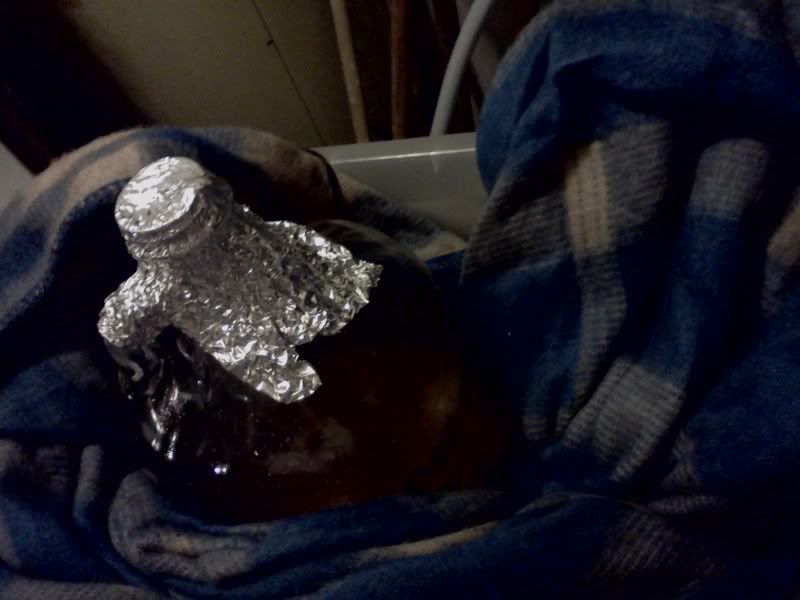
Just for the fun of it, I also made a 1L starter with 750ml water and 250ml Apple Juice, and 100g DME, that I cooled to 115*F, and pitched in 1/3 a serving Zoe Non-Fat Plain Greek Yogurt, which I inserted my temp control probe into and set it to 115*F wrapped in the heating blanket I received from a friend. 3 days later, the temp is constant at about 39*C (~100*F). When I poured a sample it fizzed like Alkaseltzer, which is good, that means carbonation, which means that something is going on. A sniff gives hints of yogurt, clean, nothing off in the aroma. A taste gives off sour apples, and a light yogurt twang. I effectively cultured Lacto from Greek Yogurt! After a few more days, I added 3/4 gallons of water mixed with 1.25# Clover Honey to bring it up to 4L, and give it a week or so at 100*F. Once this gallon of Lacto fermented Mead is ready to go, I will add it to the main Blonde Ale in the conical, along with another 1.25# of Clover Honey in a gallon of water, and let her ride for a good 6-8 months. Then I will add back in the gallon of Brett only portion, and hit it with 2-3# of fresh Apricots this Summer. This will bring the total volume of beer up to 6 gallons, with a new OG of 1.041 (1.037 prior to honey), and a FG of near 1.002 (or less) for a 5% ABV oak aged, wild Honey Blonde Ale.
Here's to innovation and infections!
Friday, March 9, 2012
If It's Infected, Why Not Infect It?
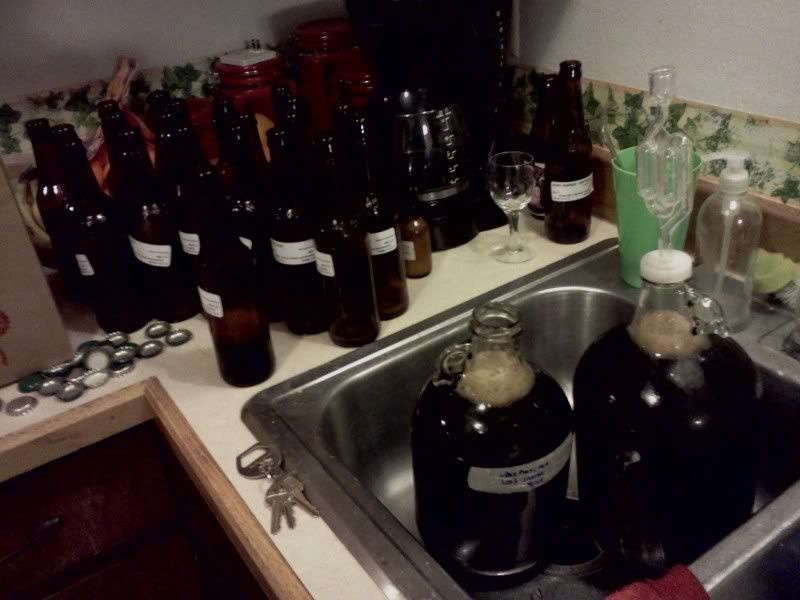 I've been thinking a lot about sours and wild brews lately, much of this is from the infections in 8 batches and the despair that I may not be able to brew clean beers again. Then a shipment of Cantillon came in and I was able to get a bottle of 1900 and Rose de Gambrinus and a renewed desire to brew sours on purpose arose. I have the American Blonde going in my fermenters right now, and was able to get an extra 2.5 gallons of wort out of it which got straight Brett B from a starter I had made from Orval (huge pelicle right now). I am planning on diverting 3-4 gallons of the Blonde to another fermenter for souring upon bottling, some with oak, some with Apricots, all with a blend of bugs. This new joy for sours got me thinking... I have a case of infected stout that I am not going to drink... why not sour it all? So I did. Last night I popped the top on the whole case of gushers and poured them into 2 - 1 gallon glass jugs. The foaming was outrageous; it took 3 shots of foam control in each jug to get them full. Once I got them filled I hit them each with a bug blend I have of Lacto, Pedio, and Bretts. One of the jugs overflowed when I hit it with the solution. Both jugs were still throwing off tons of CO2 10 hours later (not too worried about oxidizing these since the airlocks are more active then the fermenting Blondes). I'll give them a few months to go wild and see what comes of it. If they turn out to be drain pours then I've lost nothing but part of an evening and a few drops of foam control. If they turn out to be awesome wilds, then great, glad I did it and saved a batch of beer that was just going to get poured out.
Thursday, February 16, 2012
Beyond Just Bottles
 As previously posted, I had a bad score from my Brown Ale at a BJCP home brew competetion that showed signs of infection, and after some research and questions about cleaning and cleaning products, and sanitization, I seemed to be getting some headway... or I thought. I was under the impression that this was a bottle here, and bottle there, and had
  established what I was going to do to fix it...that was until last night. I opened another Brown Ale to see if it would have issues, and was met with Old Faithful. I grabbed that last 5 bottles and one, after the other, nothing but gushers. Alarmed doesn't begin to describe it; neither does rage, but that wassn't the end of it. I grabbed one of the Ambers that I had made 2 weeks after the Brown, that consequently I had repitched the yeast on. No gushing, but the flavor is lacking all the crystal malt character and it is watery. Open the 90- (repitched the yeast into this as well) from the partigyle I had done: GUSHER! Run to the cellar and grab the Wee Heavy from that same partigyle (which got the same repitch as the 90-): GUSHER! Grabbed the Session Stout with Orange Zest and Cinammon (repitched from 90-): GUSHER! This beer had been entered into the same competion and received remarks about over carbonation and lack of flavor. This beer was also a partigyle with my 10.6% Imperial Stout that also received the same yeast; it is carbing up right now, and have no clue about how far the infection has gotten on it, but over the course of the month it aged on cherries the FG dropped from 1.028 to 10.24. I will be crash cooling this one and drinking quicker than expected.
I thought it was all about the bottles, but with the rapid advance of the infection in all the batches it appears to be the repitching of the yeast. The Brown took 5 months to show signs of infection. The Amber 4.5, and is not fully there yet (only a 6 pack left). The 90- and Wee Heavy 3 months, the Stout, less than 2. I am still going to have to get all new bottling equipment as well since all 5 batches went through it all and I'd rather not risk the infection having taken hold of in my nozzle, tubing, wand, bucket, etc., and end up in my other beers as well. This is causing some paranioa as well; my 8 gallons of ESB had all new yeast, and I under primed due to a mishap with the app I use, and thought it would never carbonate. But now it has a decent amount of carbonation. Could just be the time and temp finally giving it what it needed. Could be the same infection (they have the same "oil slick" on the top of the beer as all these others had, could be residual cleaner, could be infected). I am going to get all the ESB in the fridge and drink quick. I will leave out a few bottles for a couple months and see if they turn into gushers as well just so I can know for sure. If the Saison gets infected, I am not too concerned, but still would like it to stay clean. I also am now concerned about the West Yorkshire and 3726 Farmhouse Ale yeasts I used, since I washed them and kept them, but I used the same mason jar lids w/ rubber seals that I used for storing the 1056 that infected all the others, and I didn't boil my jars or lids, just StarSan.
Time to go back to the basics again. Gonna drain-pour multiple batches this weekend, have to buy new Bottling Bucket, spigot, tubing, wand, and I have an email out to the Mad Fermentationist about the best way to kill any bacteria in my Better Bottles since he moves from wild to clean to wild to clean in his with no ill effects.
Wednesday, February 15, 2012
Beating the Bottle Bugs
 One thing that came of my debacle was a reevaluation of my cleaning and sanitizing procedures. I got a fairly large forum discussion going back and forth over on Tasty Brew. What has seemed to come of it is that my cleaning and sanitizing is fairly tight, but every-so-often I miss a few bottles. This problem could be stemming from micro scratches inside the bottles that are harboring the bacteria that ravage my beer post packaging. I could always throw these bottles away when I end up with a gusher or two. Another option allows me to tighten up my process to have the best beer packaging available.
Cleaning: I told the guys at the LHBS that I wash with Sun Oxygen Cleaner and they stated that this was bad. They told me that it had detergents in it that would coat the walls of my equipment and bottles, that it was difficult to wash off, and that it would de-activate StarSan. I started the forum thread and did some reading and snooping. According to John Palmer, a very good cleaner for your brewery is a Sodium Percarbonate cleaner like PBW and One-Step. Turns out that the Sun Oxygen Cleaner that I use is simply Sodium Percarbonate, just like the expensive stuff they were trying to sell me. According to the forum thread, I wasn't rinsing them well enough, and the Sun MSDS sheet does state that the Sun Oxygen Cleaner doesn't work correctly with acids. To properly rinse the cleaner from the bottles (or any equipment) it should get a good 3-5 rinses with hot water. I would fill the sink with warm-hot water and submerge the bottle once, drain, then sanitize. I wasn't rinsing the first bottles thoroughly, and then I was diluting the rinse water each time as well. To rectify this issue I am going to purchase a jet type bottle washer that attaches to the sink. You turn on the hot water, turn the bottle over, press it down over the nozzle, and it sprays the hot water all over the inside. Repeat a few times and then sanitize. Another cool thing about a hot water Oxy soak is that it removes labels easily, and typically breaks up any gunk inside the bottles (still give it a good scrub with a bottle brush to be sure).
Sanitizing: This is where you take the previously cleaned (all debris, gunk, etc, removed) bottles and kill off most (if not all) of the bacteria and wild yeast that might be in/on them. Options for effectively sanitizing the bottles include baking, boiling, and steaming them. Baking will effectively sterilize the bottles killing any and everything in them. It will also degrade the stability of the glass which may lead to bottle bombs, or broken necks in the future. Boiling is very effective, yet how do you fit ~ 60 bottles into a pot of water? And even if you can get them in, how do you avoid the current of the boil crashing the bottles into the wall or each other? The third option is using the dishwasher. In this method, you remove all dishes from the dishwasher and give it a good cleaning inside (wipe down the walls, make sure there are no food particles on the bottom). Some may want to open up the insides and give it a through cleaning (be prepared, I hear this is putridly disgusting). Once it is clean, fill it with bottles, and run it with out any detergents and have it set to high heat and heated dry/sanitize cycle. Once this is done, your bottles are clean, sanitary, and on a sanitized shelf for bottling. If you bottle from the dishwasher (as I do) then any beer that spills on the opened door is just dumped into the dishwasher once you are done, and goes down the drain. Of course with as anal as I am now with everything that has happened, I will most likely take these bottles and hit them with StarSan, then place them back into the dishwasher to double sanitize.
Wednesday, October 19, 2011
Spontaneous Fermentation Update
The recipe:
6.25# Pilsner Malt (54%)
2.25# Vienna Malt (20%)
2.00# Flaked Wheat (17%)
1.00# Caravienne (9%)
90 minute boil
FW Hops 0.4oz Styrian Bobek 3.8AA pellets
15 min 0.6oz Styrian Bobek 3.8AA pellets
10 min 1.50z Cake Flour
5 min 1tsp Coriander, Crushed
Mashed 60 mins @ 152*F
Sparged w/ Boiling water
5.25 gals
OG 1.057
FG 1.002
IBU 10
ABV 7.2%
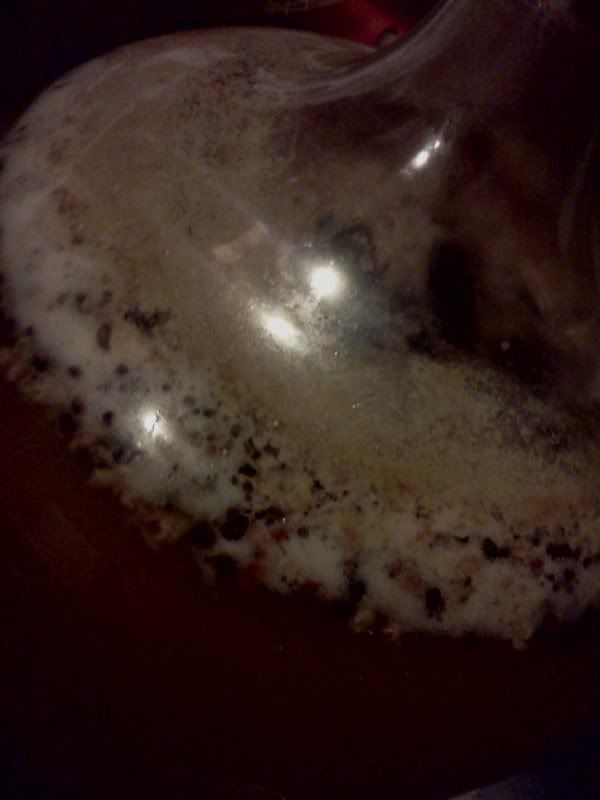
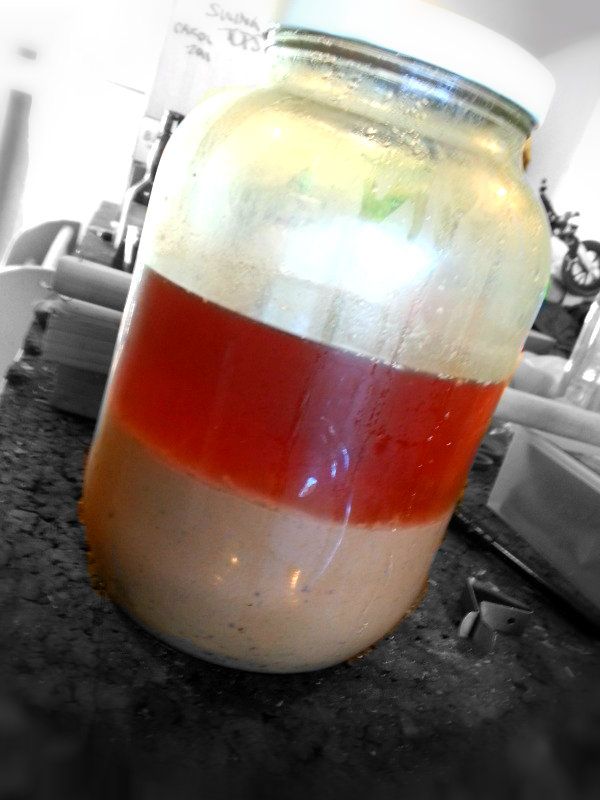
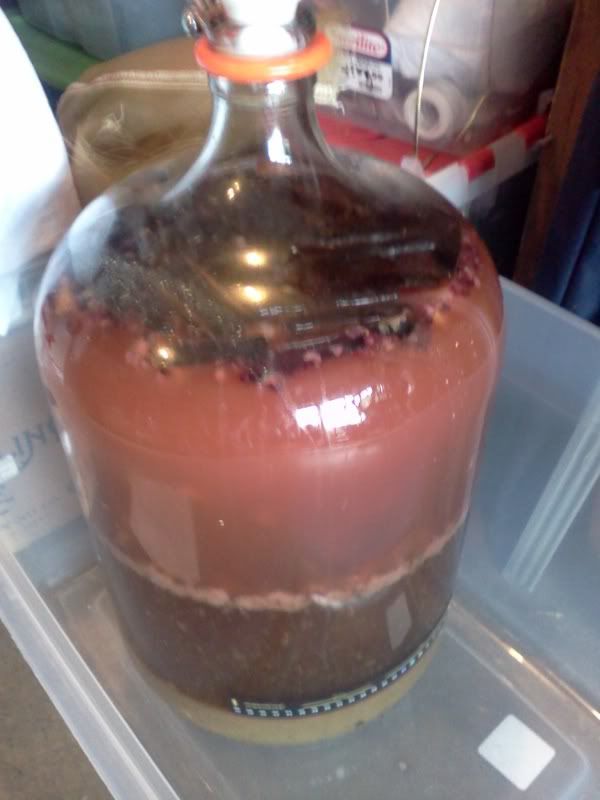
I mashed at 152*F, I was shooting for 154, but added too much cold water when I was too hot, and it cooled it down too much. I sparged with boiling water to try to extract as much sugar as possible and even some tannins as well. At the end of the 90 minute boil I added some cake flour for extra dextrins and starches for the Brett to chew on over the long fermentation. I cooled it as usual and ran it into the fermenter. I added the 2 starters to it whole, all the wort, fruit, bacteria, yeast, a couple ants, everything. I didn't aerate it since oxygen feeds bad bacteria, and inhibits Lacto growth. It looked kind of stratified until the next day as the different parts were layered, wort, trub, break material, fruit, starter, etc.
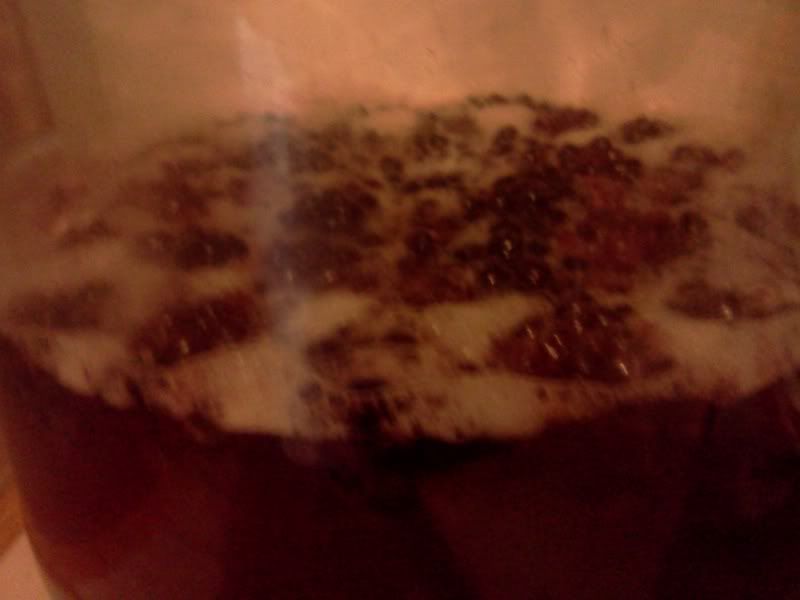
After a few days I noticed some odd activity. There was no krausen, but I had used S-Foam, and foam inhibitor, so it is quite possible that it was fermenting and not putting up a krausen. I did notice lots of little tiny bubbles shooting up and feeding a fluffy foam at the top though, and I assume this was from the Lacto working since it releases CO2. Another day later and I saw the wort churning away like any other beer fermentation, so things were going good.
I let it go for a few weeks with out tasting it, and finally on week 3 I gave it a taste. Nice, light, clean tartness, clean fermentation, no off flavors, mild funkiness, slightly fruity, not much oak character, gravity was 1.005. Quite happy with it. I tasted it again 1 week later and the oak is starting to show some; I will be watching this since I don't want it to be too oaky. If it gets where I want it I am going to rack the beer off, remove the oak, and add the beer back to the trub, yeast, and fruit for longer conditioning and funkdifying. So far I am very pleased. I even used the yeast to ferment a cider.
NOTE: This beer took 1st place in Sour Beers and won BEST OF SHOW in February 2014 at the KLCC BJCP comp.
NOTE: This beer took 1st place in Sour Beers and won BEST OF SHOW in February 2014 at the KLCC BJCP comp.
Subscribe to:
Posts (Atom)