Showing posts with label Conical. Show all posts

Monday, June 11, 2012

And Another One, and Another... Gushers Update


Seems as though the infection spread further and goes back farther than I had originally thought.  But this does help to close in on the issue.  I had brewed 2 ESBs to do a side-by-side comparison on two yeasts.  The one that happened to be in the fermenter that had housed the infected batches was very slow to start fermenting and had lots of phenols once bottled.  It seemed to have better carbonation than the other version as well.  I had originally thought that the phenols were from a stressed fermentation since the yeast pitch came from a local brew-pub, was from an Imperial IPA, and was mostly hop sludge.  Turns out, after 4 months at room temp, we have gushers again.  Looks as though the gusher bacteria took hold while waiting for the yeast to grow and work.  

I also found one last bottle of Free Bag O Malt Mild, the first brew from the conical which happened to be in the fridge since bottling back in September 2011.  Gusher.  I think my hunch of the bacteria inhabiting the used conical is more than a hunch.  The second batch in that fermenter was only in it for 1 week, and it had some fairly powerful bubbling when I popped the last one of those this weekend too, never gushed though.  So first batch in conical, gusher.  Second, over carbed.  Third, gusher.  Fourth and the one from my other fermenter that got a re-pitch form conical #3 batch, gushers.  Another fermenter repitched, gusher (5th from conical seems to be okay even though it has the same repitch as the other fermenter, yet it is a 10.6% beer).  Yet another batch from a different fermenter that had housed 2 infected repitched batches, gusher.  

Needless to say, I pulled the American Blonde that was fermented in that Better Bottle from the fridge to leave in the garage for a few weeks at 70+ degrees to see if it gushes as well.

Wednesday, April 25, 2012

UPDATE: Brett Blonde

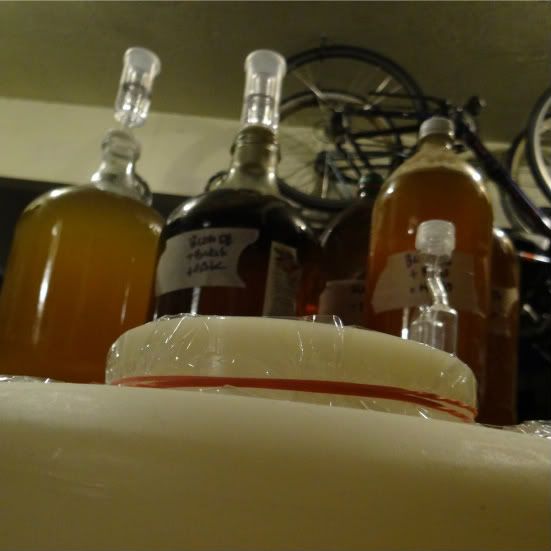
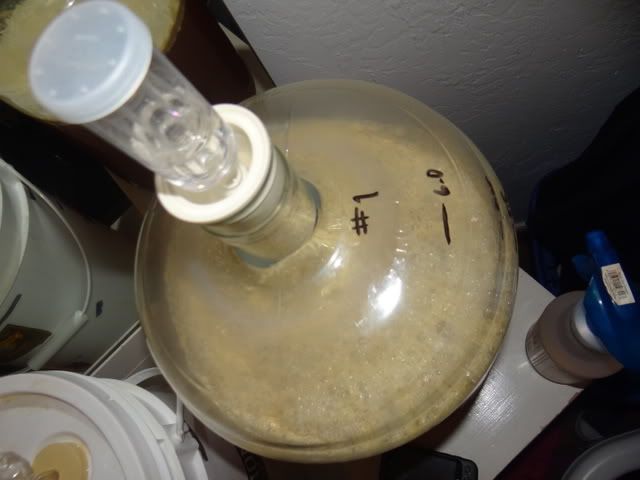
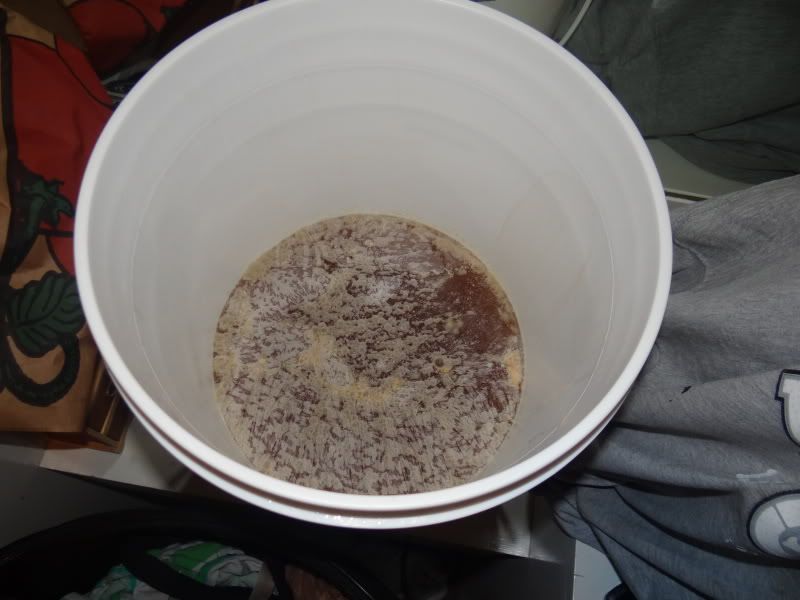
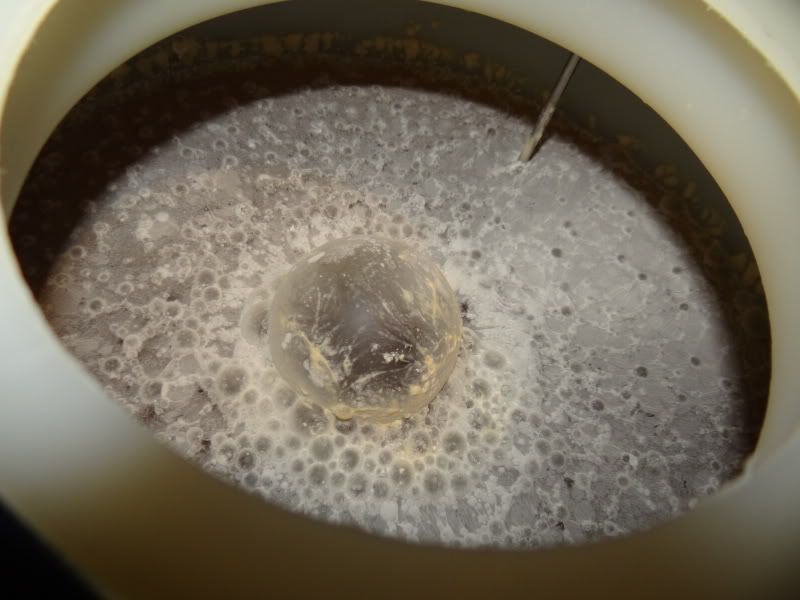
Thought I would post a quick update on the Blonde Ale that I turned some Brett lose on, mainly I just want to post some pix of the pellicle from inside the conical cuz it looks cool...


Thursday, April 5, 2012

Infecting My Infection Experiment

A few weeks ago I brewed up a basic American Blonde recipe to test my fermenters to see if I had effectively killed off the infection that may have been housed in them from previous batches.  The conical version of the beer seemed to be infected from the start so I decided to sour up the whole lot of it.  After checking the final gravity on the Better Bottle version and tasting it, I decided that I didn't have to have 5 gallons of this one bottled and could go for a half batch or so.  It seems a little thin with a FG of 1.005.  The flavors are nice, but the body is a little off.  I shouldn't have expected much different since I pulled 10.5 gals (post boil) from 12.5# of grain, and with such a low OG (1.037) even taking up the mash temp to 153*F wasn't going to stop it from finishing low.  Thus the decision to purposely infect the infection experiment batch.

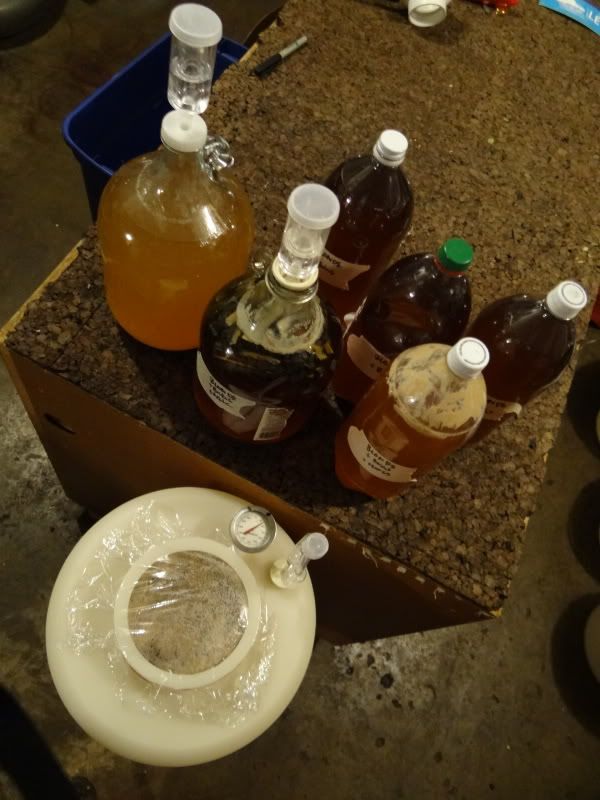
On the conical, I diverted 1 gallon to a jug that housed a Brett starter to funk up, and I hit the remainder with 1/4 cup starter from Russian River Consecration and 1/4 cup of my Lambic along with 8 pieces of French Oak.  After a few days it was tasting quite oxidized, so I moved it out of the conical into smaller containers.  I put all the oak into one jug so it will be over oaked and used to blend into the final mix.  The rest was put into 2L bottles with a small addition of sugar.

I bottled 18 bottles worth from the Better Bottle using carb tabs just so I can know exactly how the final batch actually turned out.  The rest I transferred into the conical where I added the entire 2.5 gallons of this wort fermented on all Brett, the gallon of Bretted conical beer, and added 1.25# Clover Honey for added sugars.  I put a piece of saran wrap over the top so that I can easily look inside at what is going on with out allowing oxygen in every time I take a peek.  The saran wrap is kind of fogging up from the honey fermenting, which started out as a ring of foam as is began to dissolve from the bottom of the conical and start to ferment and slowly developed into a full krausen by 2 days later.

The plan is to let the Better Bottle version now in the conical funk up with Brett for a few months while the original conical version sours in the 2L bottles.  After 3 months or so, I will drain off a couple gallons of the Bretted conical into 2L bottles and add a 1 gallon starter of Lacto and honey, as well as a couple of the 2L soured bottles to get the souring bugs going in the Brett only version.  After some time passes I will pull some more form the conical and add the remaining 2L bottles of soured Blonde as well as the oaked sour Blonde to the mix.  Come the end of summer, I will have 2 gallons of Blonde Ale on Brett, and about 8 gallons of soured, oaked, wild Blonde which I will split 3 gallons onto cherries, 3 gallons onto apricots, and keep 2 gallons straight giving me a total of about 10+ gallons.  We will see how time plays this one out. 

Monday, April 2, 2012

The Becca: Imperial Chocolate Stout w/ Cherries & Chipotle

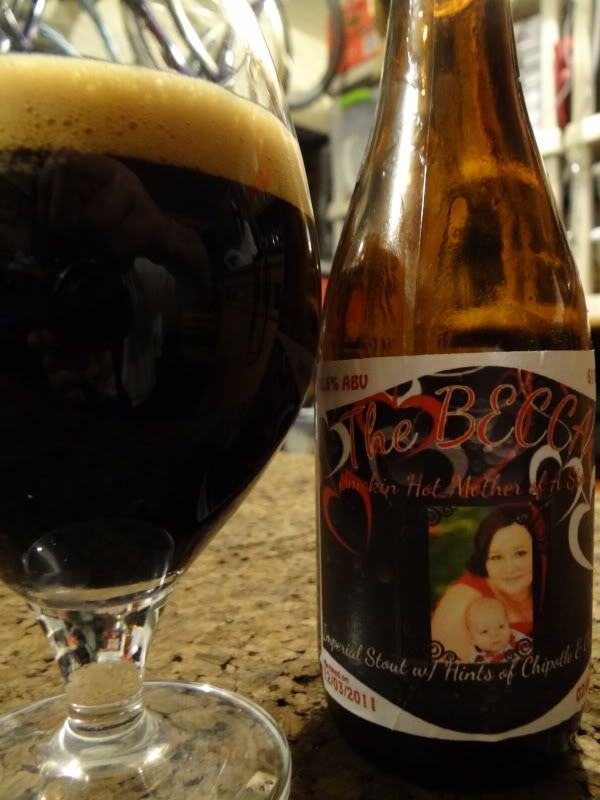
The Becca: Smokin' Hot Mother of A Stout.  I got the idea to brew a beer to name after my wife, a complex, deep, rich beer to ponder, as the back of the label reads:

Gaze upon her beauty ever so longingly, be captivated by her sparkle, stand in awe of her mystery.  You would not think that she had the fortitude to withstand the years, yet with a strength that causes many to wonder at her power.  So dark that you would think her bracing, and with a gracious smoothness that drives one to ponder her infinite depths, the complexity and richness of who she is --- truly a sweet heart.

Great Western Pale Malt, Crisp Pale Chocolate, Black Patent, C75, Carafa III, C136/165, Cherry Wood Smoke Malt, Zeus hops, Chipotle pepper, 3.75# Sweet Cherries, 61 IBUs, 10.6% ABV.


Appearance:  Pours like oil, jet black, 1 finger dense brownish tan head that fades slow to a thick cap, leaving behind spotty lacing and nice legs.  The head has a slight rose-ish tint to it on the edges from the cherries.

Aroma:  Smells of dark chocolate, espresso, cherry, big sweet caramel, plums, burnt raisins, toast, deep dark fruits, baking cocoa, hints of smoke and spices, touch of alcohol as it warms.

Taste:  Flavors pop with chocolate cake, cherries, plums, burnt toast, slightly spicy, hint of smoke, bready, touch of coffee beans, big caramel presence.  Drinks like a black barley wine with hints of cocoa and smoke, roast is light and could stand to show more presence.

Mouthfeel:  A warming finish but not boozy, big, chewy, sweet yet semi dry finish, slick, light carbonation, coats the tongue and throat and leaves them covered.  Bitterness is in the background and balances the beer to keep it from being cloying, but doesn’t assault you.

Overall:  Very impressive Imperial Stout, and way too drinkable for 10.6% at only 4 months.  Deep, black, thick, sweet yet not cloying, mild roastiness, big fruits, chocolate.  The spiciness and smokiness of the Chipotle are hinting at their presence, as is the Carafa III bringing in a touch of coffee.  The cherry lets you know that it is there, but you wonder if it is malt & yeast or fruit.  It could stand to be a little more bitter to help balance it out, and a touch of roast barley or more black malt for a little more roast character and to help dry the finish out and leave you wanting more.  Looking forward to how this beer ages (especially since it had the last pitch of the dreaded infected batches).


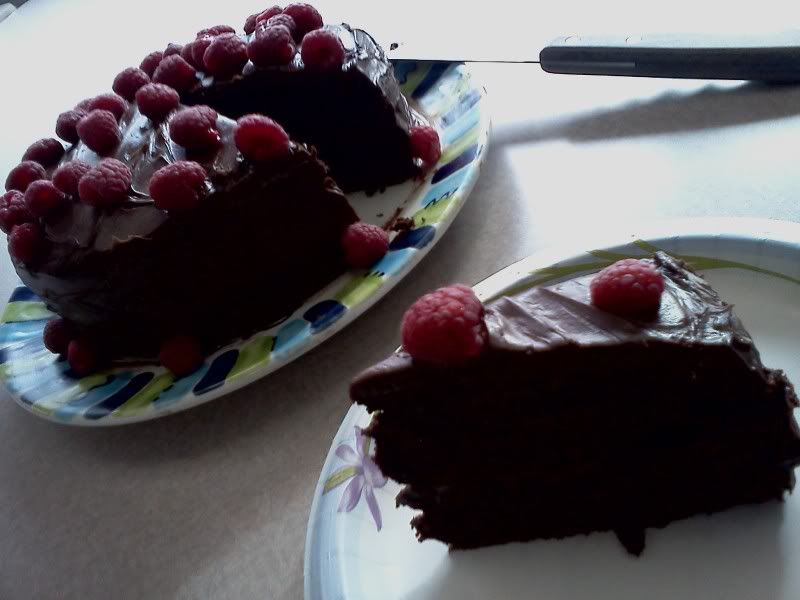
And as an added bonus, it makes a killer addition to chocolate cake!


Thursday, March 22, 2012

Wet Cardboard Stinks!

After all the effort to brew a clean beer after all the infections, after brewing up a new recipe, after finding that the conical was still infected, after deciding to sour the whole batch and fermenter for good, after working up a great plan, wet cardboard! The conical is opaque so I can't see what is going on inside. Last night I popped the top to see if any progress had been made in 5 days (no, it hadn't), to find an odd smell. I flipped a couple of the oak cubes over since they had some yeast slurry on top of them, and when I pulled my hand back it hit me... oxidized! The conical also holds about 8.5 gallons, so 3 gallons of beer and 5.5 gallons of head space in a plastic conical is not a good thing. I pulled a sample and the taste is the same, wet cardboard. I grabbed as many 2L soda bottles (PET just like Better Bottles) as I could and Oxicleaned them quick, then ran off the beer into them and sealed them up in an attempt to save it from a total bust, we'll see if that worked in about 5 months when I reopen them for gravity and sampling. If not, then I can use them to inoculate other sours. If so, we proceed as planned. I am hoping for the latter.

BTW, the smell of oxidized beer does not wash off easily, nor does it make for a good night's rest when you put your hand near your face.

Wednesday, March 7, 2012

Laminated Envelope

After all of the infections in my past 8 batches, then cleaning and sanitizing all the equipment, it was finally time to test it. I made some new adjustments to my brew house to help facilitate the brewday as well. I split my cold and hot water lines for my laundry and added Fresh Water hoses to it so I have water in the brew house now (no more running back and forth to the bathroom for strike and sparge water, or cleaning). I also got some plastic 4.5 cup measuring cups for hops. While my strike water was heating, I thought it best to calibrate my thermometer only to find it was 7*F off, meaning that on the past few batches when I thought I was mashing at 147*F, I was really at 140*F... thus 83% attenuation on my Bitters with yeast that stops at 72%. This also made my mash hit 159*F instead of 153*F, so I hit it with cold water until it evened out at 153*F.

After I ran off my first runnings, I hit it with my sparge water and gave it a good mix. Started to run off the second runnings and noticed that it was quite slow from 7.5-8 gallons, then no movement at all... my very first stuck sparge (23 batches). I gave it a good stir, recirculated, and ran off the remainder to 10 gallons @ 1.040. 1.040 was supposed to be my OG post boil. I hit 90% efficiency. Had to think on the fly for this one. I didn't want a 1.050 Blonde Ale, so I topped it off with cold water to hit 12 gallons preboil @ 1.033, and added another 0.10 oz of Zeus for the adjusted bittering. Boiled it down to 10.5 gallons in an hour for an OG of 1.037 (should have boiled another 15-20 minutes to get it closer to my desired OG of 1.040). My Immersion Chiller - designed for 5 gallon batches - took the 10.5 gallons from boiling to 90*F in about 22 minutes, not bad (another 15 minutes to get it to 65*F).

After letting it settle, and sanitizing my Better Bottle, conical, and a 6.5 gallon plastic bucket, I started running it off into the Better Bottle (measurements are fully calibrated on it). At about 1.75 gallons, I stopped the flow and dumped it from the BB to the bucket, then filled the BB to 4 gallons and dumped it into the conical (which was severely off on its measurements). Then I sent 4 gallons to the BB and the last of it to the bucket (2.5 gallons total). I aerated the BB and conical and pitched the 1.5L West Yorkshire starter into the two batches. I pitched a starter of Brett I made from Orval previously into the bucket for a Brett Blonde with the extra wort (didn't want to pitch the yeast for 8 gallons into 10.5).

The Blondes were rocking within 16 hours, and full bore by 30 hours, but the Brett Blonde was still a no-go at 42 hours, so I dumped the rest of the Orval starter into it before work and came home to a nice pelicle. After another 36 hours the pelicle is full bore and bubbled up nicely. Another 24 hours later and the Brett Blonde has a krausen. Wort stability test was still showing no activity at one week, which is awesome, I opened it and it is pure fresh wort.

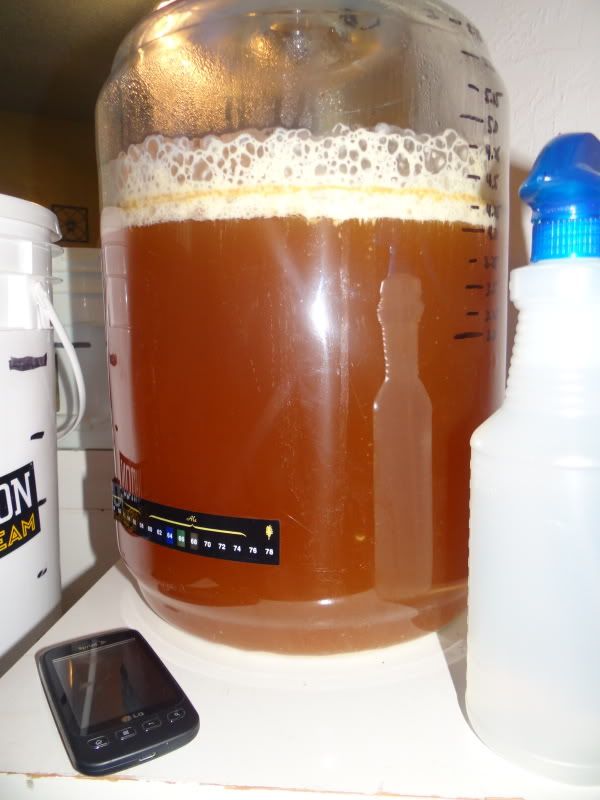
After one week, I took samples and readings on all of them. The Better Bottle smells of peaches, melons, and a touch of sweet malt at 1.010. The conical is at 1.007, the aroma is lightly phenolic and has a light dirty fruit smell... I am thinking the conical is infected and will now house sours only which sucks since it would be perfect for lagers, yet I want to do more sours so that works too. The Brett Blonde is acidic, light, funky, a little fruity, and slightly oxidized (I dumped the whole 2L 8 month old starter into 2.5 gallons, to be expected), and it is @ 1.007 as well.

_______________________

American Blonde Ale
10.5 gallons
20 IBUS
4 SRM
3.5 ABV
_______________________

11# Pale Malt
1# Carafoam
0.5# Honey Malt
45 minute mash @ 153*F
90% Efficiency
_______________________

60 minute boil
60 mins 0.20 oz Zeus 15.4% AA
25 mins 1.00 oz Amarillo 10.4% AA
0 mins 1.00 oz Amarillo 10.4% AA
_______________________


1/4 tsp Gypsum - Mash
3/8 tsp Calcium Chloride - Mash
1/4 tsp Gypsum - Boil
1/2 tsp Calcium Chloride - Boil
1/4 tsp Yeast Nutrient 12 mins
1 tab     Whirfloc 12 mins
_______________________

Chill to 62*F
Pitch 1.5L Starter WY 1469 West Yorkshire
Split to 3 fermenters
Ferment 68*F for 7 days
Ambient for 21 days
Bottled 18 - 12 oz bottles w/ 4 carb tabs each from Better Bottle only
Soured all remaining beer
_______________________

OG 1.037
FG 1.010


Just for fun... the name of the beer came from an infamous day for a co-worker that she will never live down. Back when our new branch was just opening and didn't have their own laminating machine, they would send any items for laminating to our main branch. The branch sent a couple new membership cards over to have laminated and placed into an envelope that was ready to mail to the members. The sticky note said "Please laminate and mail to the members" meaning, laminate the cards, place in envelope, and mail. The blonde of all blondes placed the cards into the envelope, then laminated the envelope and sent it back to the branch with a big question mark. Thus, an apt name for a Blond Ale... Laminated Envelope.

Friday, February 24, 2012

Here's To Hoping It's Gone

Over the 3 day weekend I took the time to thoroughly clean and sanitize some of my equipment. As I was able to deduce that the infection spread through 1 yeast into 2 fermenters, I knew what I needed to care for. I started by giving all 3 fermenters a 17 hour soak in hot PBW over night. I gave it the recommended ½ cup dosage for the 15-25 minutes, and left it for 17 hours. I came to find out that I actually didn’t need to use that much if I was doing an elongated soaking, but at least this way I know they are clean. After this I filled a bucket with the PBW solution from one of the Better Bottles, removed the brass ball valve from my conical (it smelled like mushrooms – not cool), and placed the conical into the bucket so that the threads could get a good soak. At this point I filled the Better Bottles with cold water and 3 cap fulls of bleach. After a few hours I removed the bleach water and refilled the Better Bottles with PBW solution to help clean out any bleach. I then rinsed each one 5 times with hot water, and had my wife smell test them for any bleach. I also added the bleach to the bucket that previously contained the PBW and soaked the bottom and threads of the conical overnight. The next morning I put my bottling bucket spigot on the conical (same size threading) and filled it up with the bleach water as well (topped off with more cold water and extra bleach), and that has been soaking for 5 days. Tonight I will give it a thorough rinse with PBW and hot water and then let it dry out.


Next week I have an extra day off after taking the youth group to the coast for a weekend retreat, and I am going to brew up a batch of beer to test the Better Bottle and Conical. After talking to Michael Tonsmeire (Mad Fermentationist), I decided to do an American Blonde Ale since this style will show any signs of infection, and will probably still taste good if it does get infected. I worked up a recipe for it and will finally get to use the Amarillo hops I have in the freezer. Typically an American Blonde only has about 0.5oz flavor and 0.5oz aroma hops, but I am brewing an 8 gallon batch as opposed to 5, and I am going to (if it stays clean) enter it in a Club Only Competition in May and still want the hops to be around for it, so I am going to use 1oz each for flavor and aroma. I am putting this against a malt back drop of Pale Malt, Carafoam, and Honey Malt so it will have a nice honey sweet flavor, body, and retain a light, smooth, dry finish. I am choosing to use the WY 1469 West Yorkshire strain that I used to brew my ESB since I really liked the stone fruit aroma, and think it would compliment this beer well. Only issue with this yeast is that it doesn’t flocc out well, so it will get a little longer in the fridge before I transfer and bottle. For bottling, I am going to use a brand new bottling rig for the Better Bottle version, and will bottle straight from the conical for the other to keep them as separate as possible and to isolate any possible place that an infection may still be harbored. I am going to purposefully divert a few gallons of this brew to my gallon jugs where I will intentionally sour, wild, and oak it just because I can, and I don’t want to actually bottle another 8 gallons of the same beer like I did on the ESBs, and of course, I like souring stuff (intentionally). I will of course keep the blog up to date as that brew progresses.

Wednesday, October 12, 2011

Broke Down Brown

Seeing as the leaves are changing, the sun is mostly gone, the days are shorter, the skies are gloomy, the temps have dropped, and everything is wet here in Eugene, I took a look at my brews. I have a Mild in the bottles, as well as a Fresh Hop IPA. I have a partigyle Wee Heavy & 70- Scottish Ale planned for early November, and an Imperial Stout / Oatmeal Chocolate Stout partigyle planned for early December. So I have 2 beers ready that need to be consumed quickly, and the next brews won't be ready to drink until mid to late December; I thought it would be nice to have a nice, dark, smooth, malty beer to snuggle up to on the cold, gloomy fall evenings. I wrote up a recipe for a Brown Ale with American Two-Row, Abbey Malt for maltiness, lots of Pale Chocolate Malt, a healthy dose of C60, and some Flaked Barley to give it a nice smooth mouth feel. Gave it generous additions of Nugget, Zues, and Amarillo hops, and its set for some dryhopping this weekend. But then... where did the name come from?

I had my buddy over to help me brew, and we did it after work on Friday (late start). I worked up the water additions and everything on this one. We let the strike water heat while we ate dinner, then doughed in... wait a second... I forgot the additives I spent 3 hours figuring out! Go to measure them out... wait a second... my scale just jumped from 0 grams to 4 grams... it's not measuring accurately! Pinch of this, pinch of that... fingers crossed!

Set the Brew Timer on my smart phone... wait a second... it keeps stalling, the timers went off as they should, but I had no way of knowing how long had passed, nor how long was left!

I added the sparge water at almost boiling to the mash to try to get up the temp for the sugars to move more fluidly... dumb mistake... now this is a no-sparge!

Collected our wort and fired up the burner... just about 195*F I notice there is no longer a flickering under the pot... wait a second... out of propane!

Hooked up the second tank and commenced to boil. Added all my hops, everything is going good. My buddy, a new father, had to take off while we were chilling, so I was going to drain the kettle myself, no problem since I usually brew solo anyways. Everything is sanitized, draining from the Keggle into the conical perfectly. Check my OG, 1.061, just right! Clean up my stuff and then look at the fermenter... wait a second... the volume is at 4 gals and not moving anymore! 2 gals short!

Look inside the keggle and... wait a second... the pick up tube stopped working! Tried to get it working to no avail. Sanitized my hands and un hooked it, tipped it up, still nothing. Sanitized a strainer and removed the hops. Still nothing. Sanitized a mason jar and drained it by hand, one scoop at a time. Got to 5.2 gals @ 1.061... wait a second... that's only 62% Efficiency!

I ended up boiling a pot of water, and after cooling, added it to the conical to bring the volume up, the gravity and the IBUs down.

Needless to say, I think you know why the name is Broked Down Brown!

Monday, September 26, 2011

Primary Fermenter Turned Bottler

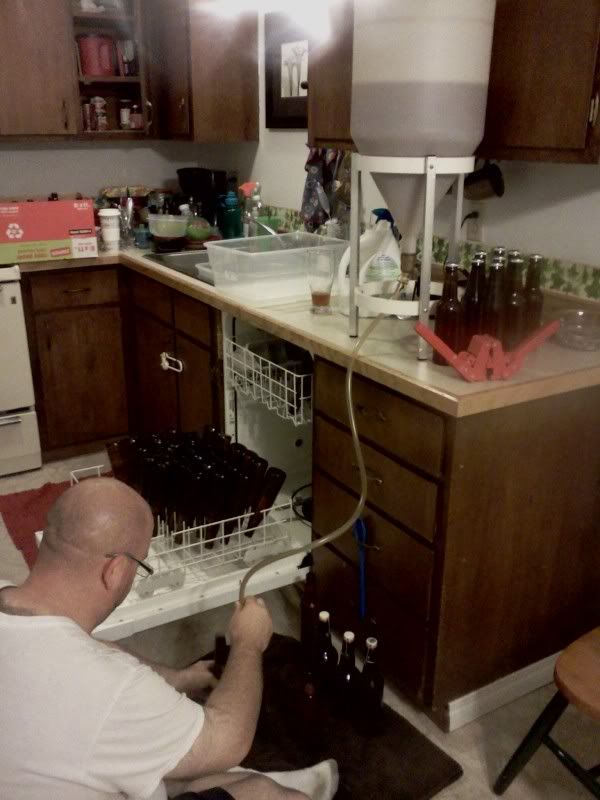
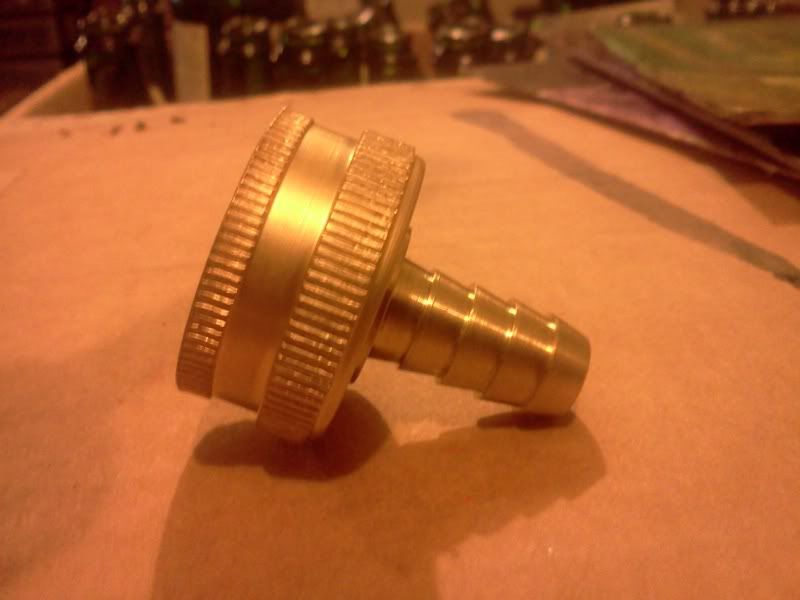
In previous posts I have talked about the "new" conical that I scored from the guys @ VV&B, and some tweaks I had made to it. This weekend I took a stab at using another function that I equipped my conical to do. When I was piecing together the parts to fit the conical with, I bought a 3/4" female hose thread to 3/8" barb adapter to attach to the ball valve for transferring the beer since the ball valve would allow too much beer to flow at once, and it would just spew it causing tons of splashing and aeration. Another possibility for this use is to attach a bottling wand to the transfer hose, and bottle directly from the primary conical fermenter.

After opening the ball valve and removing the trub and yeast collected at the bottom of the cone (3 pint glasses worth), I added my priming solution directly to the fermenter and mixed it in well with a sanitized slotted spoon. We (my wonderful wife always helps bottle, and I am grateful for it since she is amazing with the capper, and I am not) then began bottling directly from the fermenter. The first bottle was a flop as it had quite a bit of yeast in it, but from that point on, it was smooth sailing. And in the end, I only had to clean the fermenter which I would have to do anyways, no extra equipment... no bottling bucket to clean. We will see soon how well it worked once I can taste a bottle of my Fresh Hop IPA, and see how much yeast sediment is in the bottles, and how it carbonated. So far it looks about normal in the bottles.

Friday, September 23, 2011

Conical Update

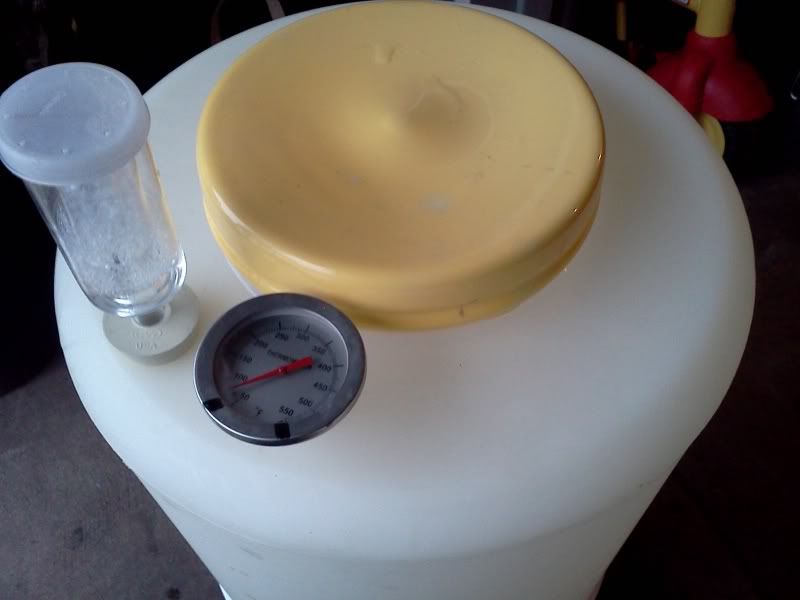
A few weeks ago I got a conical fermenter and assembled it to brew my Mild. It worked fairly well except that there was no way of knowing the temperature of the fermentation with out removing the airlock to insert a thermometer, which defeats the purpose of a conical to keep oxygen out of the beer. This past weekend I brewed a fresh hop beer with 1# of wet Simcoe hops, and 1# of wet Citra hops in the last 15 minutes of the boil. While that was cooling I cut a hole in the top of the conical to fit a small rubber bung, and forced (quite difficultly) a thermometer through the bung into the fermenter. This will give me the ability to know the exact fermentation temperature of the beer inside the fermenter. Now I just need to get a different thermometer since my spare only reads in 5 degree increments as opposed to 2 degrees like my other one, meaning that 71F and 74F look almost the same, yet are worlds apart in the world of ale fermentation. Next up is a sample port so I can keep the system fully closed until packaging or secondary additions, and then a stationary insulated chamber for temperature control.

Monday, August 29, 2011

Conical Fermenter

Oxygen wreaks havoc on a finished beer. It will stale the beer and make it taste like wet cardboard. When using a typical carboy, bucket, or Better Bottle (PET plastic carboy), you have to rack (transfer via syphon) the beer out of the container into a new one to remove the trub (the globs of matter from the boil), hops, or yeast. Some beers need longer bulk storage to age and it is best to do this off of the yeast; once the yeast are done fermenting if they stay in the beer and under pressure at room temp they can die and autolyse spewing their innards into the beer wrecking it. It is also advantageous to remove the beer from the yeast when you Dry Hop (add hops to the fermented beer for fresh aroma); yeast still in suspension can grab some of the oils from the hops and take them out of the beer causing the Dry Hops to lose some of the desired effect on the beer, and the same goes for adding fruit or spices. Whenever you transfer the beer from one vessel to another you expose the beer to oxygen (the second container is full of it). Then, when you transfer from the secondary to a bottling bucket you expose it again.

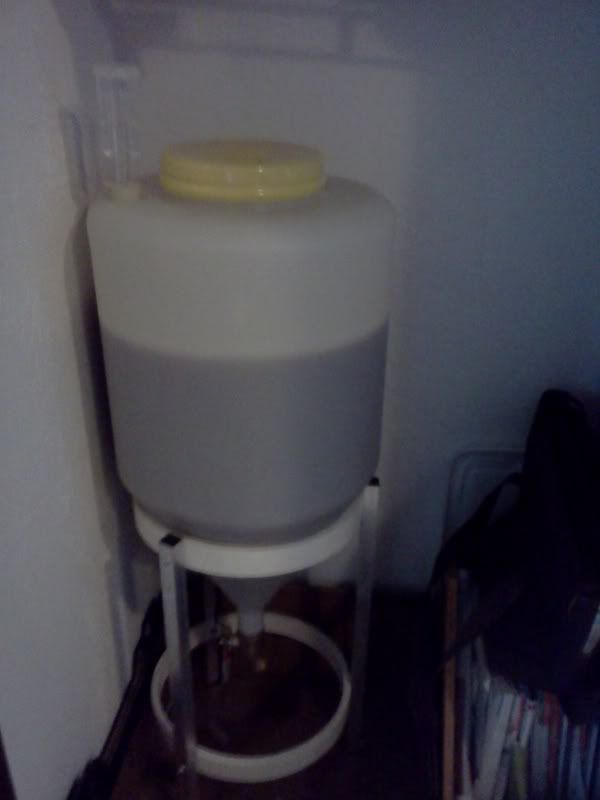
A conical is another type of fermenting vessel that is typically used in the brewing industry for different reasons. One huge advantage of a conical is that when it is fit with a port at the bottom you can keep the fermenter as a closed system, avoiding the oxidation you just read about above. In a (sanitized) conical, you add the wort after chilling, pitch your yeast, and "seal" the vessel. During fermentation the yeast produce CO2 which escapes the system via a blow off tube or air lock, and it pushes any oxygen in the vessel out with it. Once fermentation is finished the vessel has no oxygen in it to damage the beer. To remove the trub, hops, and/or yeast, you open the port at the bottom of the vessel allowing it to flow out, and then reseal the port once it is cleared. The vessel is still oxygen free, and it is now free of the yeast and trub as well. At this point you can add your fruits, hops, spices, etc. to the vessel through an opening in the top and then reseal it; the CO2 layer on top will help to protect from too much oxygen getting in when you open it (much more than moving an entire 5 gallons into a 5 gallon container of air).

Once your beer is done and ready to package, you can drain it from the bottom of the conical into a keg, or bottling bucket, or, as I hope to do, add the priming sugar to the beer in the vessel, gently stir, and then attach a bottling wand to the port and bottle from the fermenter itself.

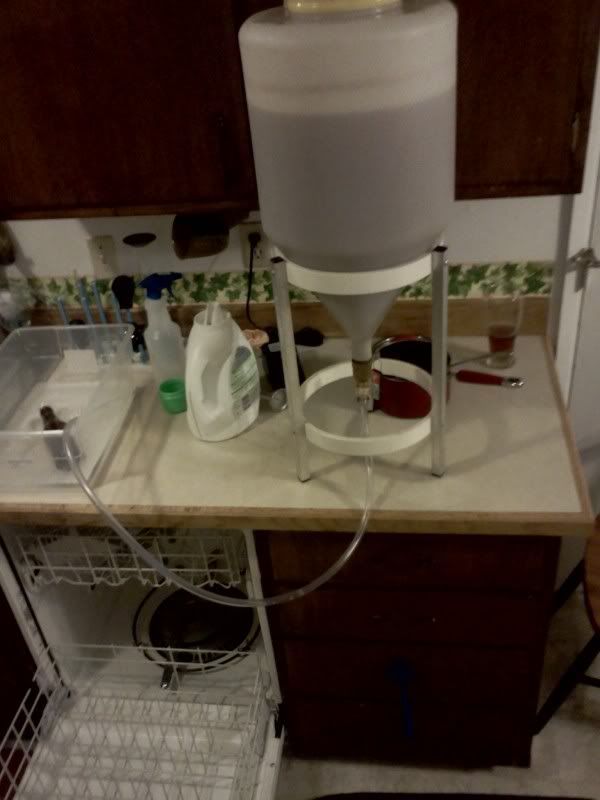
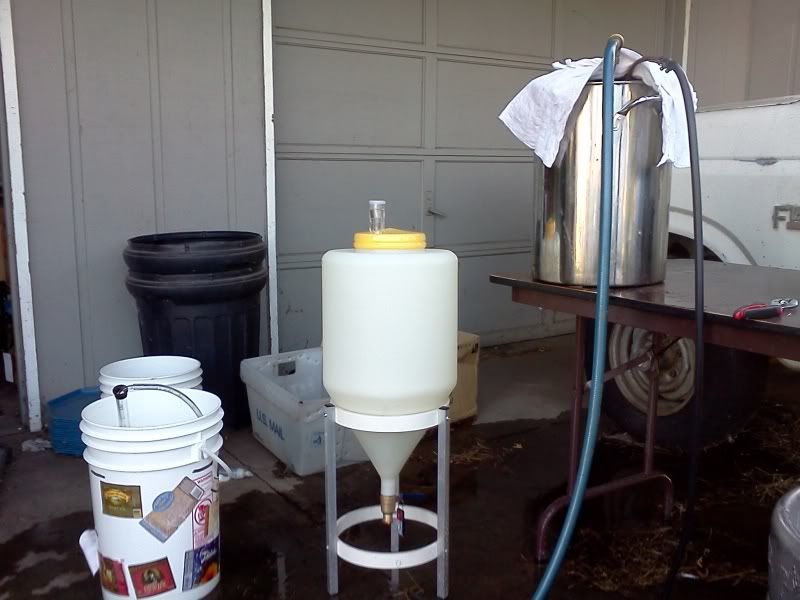
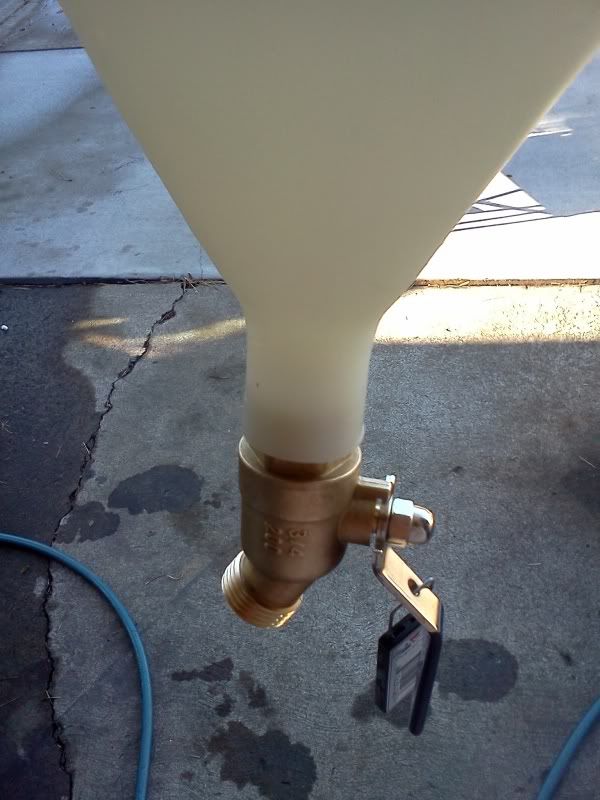
All this to say, I scored a conical from the home brew shop last week, and it is currently holding the Mild I brewed over the weekend. The conical was just the vessel itself, and I had to buy the fittings for it. I went to Lowes and bought a brass ball valve hose bib for $9, and then also bought a 3/4" female threaded hose end to 3/8" barb adapter so I can attach it for bottling or transferring the beer. For running off the trub and yeast the ball valve is good as it has a wider opening (1/2") so nothing will clog. But I don't want the beer flowing at that unimpeded rate (causing excessive splashing, thus defeating the purpose of avoiding oxygen), nor do I want it passing through a tube the size garden hose, which is why I have the adapter, I can now control the flow through the ball valve and the narrower tubing.

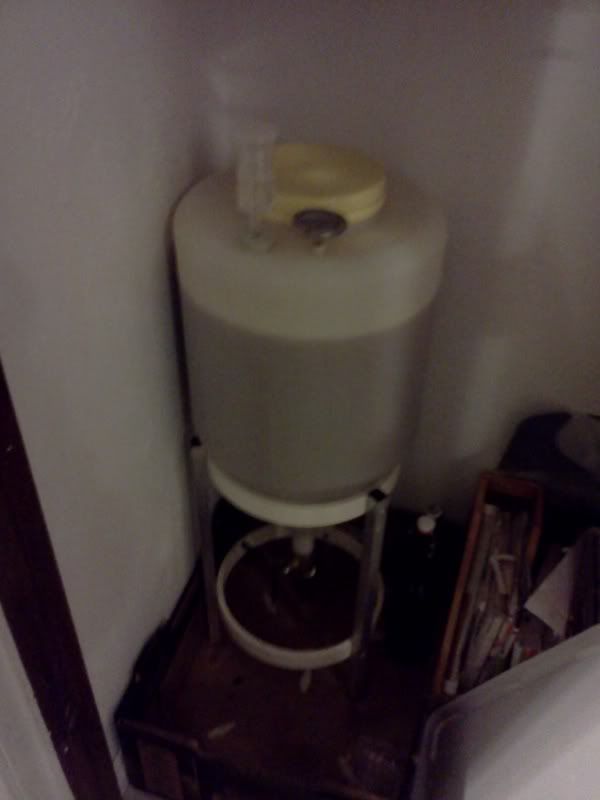
One problem I have found is that the thicker wall of the plastic conical makes it harder to know what temperature the fermenting beer is at. At this point I have been removing the airlock and inserting a thermometer a few times a day. To solve this problem I am going to drill a hole in the top of the vessel (between beers of course), insert a small rubber bung and pierce a thermometer through it into the wort so I can have a constant reading on the actual fermentation temperature. I also need to find some way to control the temp on it since I can't put it into a water bath and add ice as I could with my Better Bottle, bucket, or carboy, which may cause a few problems with this beer since it got up to 75*F and the yeast is only supposed to go to 72*F. I would also like to add a sampling port to the side of the conical so I can take taste tests or gravity readings without opening the vessel to air. I am also looking for a tallish cupboard that I can drill a hole in the top of to hold the fermenter, this will allow me to keep it higher and more stable (away from my son who would love to play with it), and to put another vessel under it if needed (bottling bucket, glass carboy for souring, bottles, etc), and if i get a double level cupboard I can attempt to temp control the fermenter.