
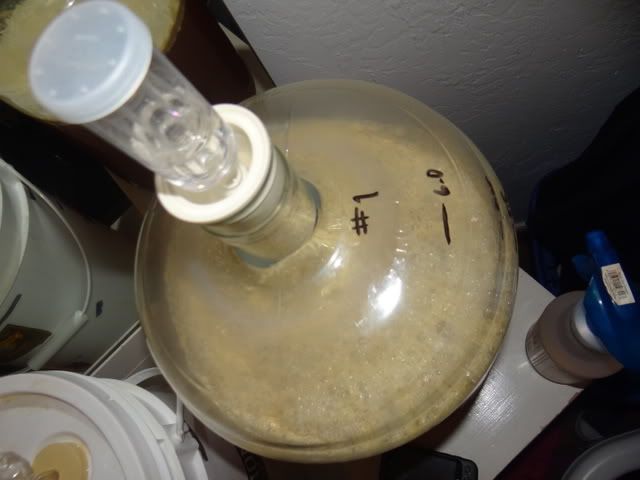
 After all of the infections in my past 8 batches, then cleaning and sanitizing all the equipment, it was finally time to test it. I made some new adjustments to my brew house to help facilitate the brewday as well. I split my cold and hot water lines for my laundry and added Fresh Water hoses to it so I have water in the brew house now (no more running back and forth to the bathroom for strike and sparge water, or cleaning). I also got some plastic 4.5 cup measuring cups for hops. While my strike water was heating, I thought it best to calibrate my thermometer only to find it was 7*F off, meaning that on the past few batches when I thought I was mashing at 147*F, I was really at 140*F... thus 83% attenuation on my Bitters with yeast that stops at 72%. This also made my mash hit 159*F instead of 153*F, so I hit it with cold water until it evened out at 153*F.
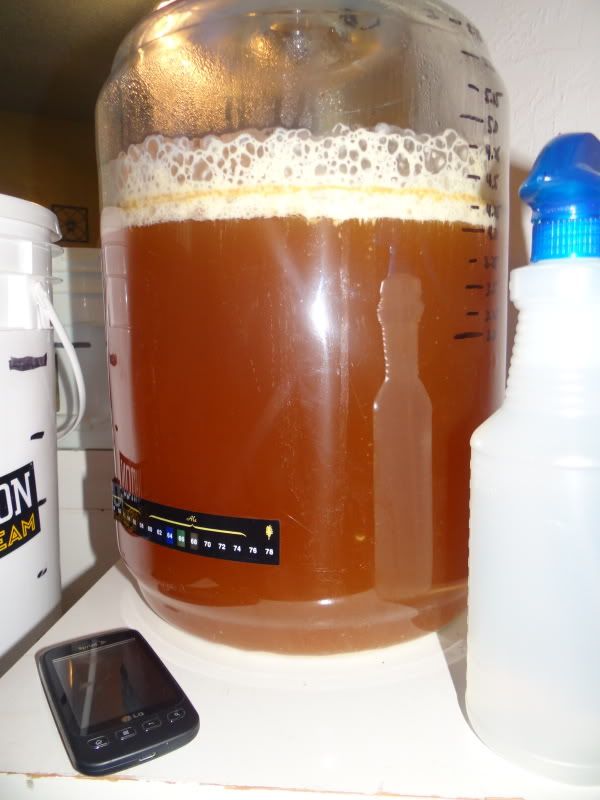 After I ran off my first runnings, I hit it with my sparge water and gave it a good mix. Started to run off the second runnings and noticed that it was quite slow from 7.5-8 gallons, then no movement at all... my very first stuck sparge (23 batches). I gave it a good stir, recirculated, and ran off the remainder to 10 gallons @ 1.040. 1.040 was supposed to be my OG post boil. I hit 90% efficiency. Had to think on the fly for this one. I didn't want a 1.050 Blonde Ale, so I topped it off with cold water to hit 12 gallons preboil @ 1.033, and added another 0.10 oz of Zeus for the adjusted bittering. Boiled it down to 10.5 gallons in an hour for an OG of 1.037 (should have boiled another 15-20 minutes to get it closer to my desired OG of 1.040). My Immersion Chiller - designed for 5 gallon batches - took the 10.5 gallons from boiling to 90*F in about 22 minutes, not bad (another 15 minutes to get it to 65*F).
After letting it settle, and sanitizing my Better Bottle, conical, and a 6.5 gallon plastic bucket, I started running it off into the Better Bottle (measurements are fully calibrated on it). At  about 1.75 gallons, I stopped the flow and dumped it from the BB to the bucket, then filled the BB to 4 gallons and dumped it into the conical (which was severely off on its measurements). Then I sent 4 gallons to the BB and the last of it to the bucket (2.5 gallons total). I aerated the BB and conical and pitched the 1.5L West Yorkshire starter into the two batches. I pitched a starter of Brett I made from Orval previously into the bucket for a Brett Blonde with the extra wort (didn't want to pitch the yeast for 8 gallons into 10.5).
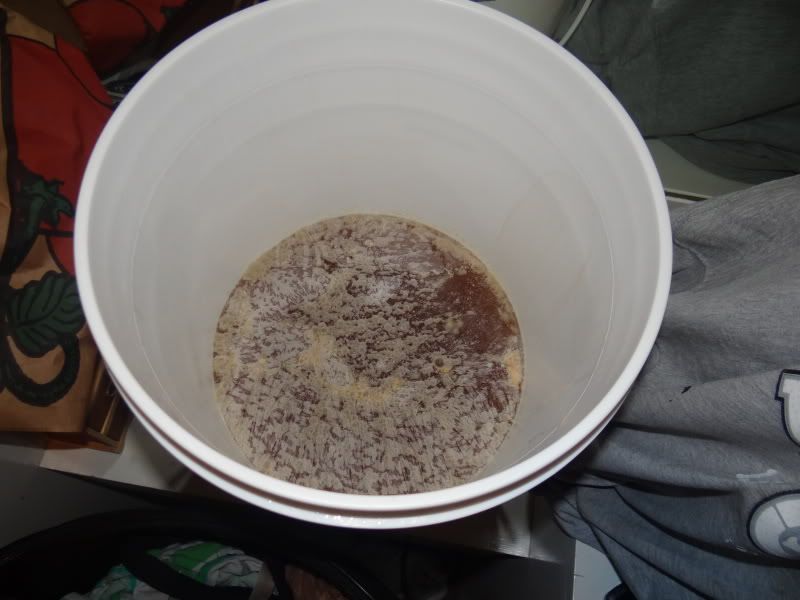 about 1.75 gallons, I stopped the flow and dumped it from the BB to the bucket, then filled the BB to 4 gallons and dumped it into the conical (which was severely off on its measurements). Then I sent 4 gallons to the BB and the last of it to the bucket (2.5 gallons total). I aerated the BB and conical and pitched the 1.5L West Yorkshire starter into the two batches. I pitched a starter of Brett I made from Orval previously into the bucket for a Brett Blonde with the extra wort (didn't want to pitch the yeast for 8 gallons into 10.5).
The Blondes were rocking within 16 hours, and full bore by 30 hours, but the Brett Blonde was still a no-go at 42 hours, so I dumped the rest of the Orval starter into it before work and came home to a nice pelicle. After another 36 hours the pelicle is full bore and bubbled up nicely. Another 24 hours later and the Brett Blonde has a krausen. Wort stability test was still showing no activity at one week, which is awesome, I opened it and it is pure fresh wort.
After one week, I took samples and readings on all of them. The Better Bottle smells of peaches, melons, and a touch of sweet malt at 1.010. The conical is at 1.007, the aroma is lightly phenolic and has a light dirty fruit smell... I am thinking the conical is infected and will now house sours only which sucks since it would be perfect for lagers, yet I want to do more sours so that works too. The Brett Blonde is acidic, light, funky, a little fruity, and slightly oxidized (I dumped the whole 2L 8 month old starter into 2.5 gallons, to be expected), and it is @ 1.007 as well.
_______________________
American Blonde Ale
10.5 gallons
20 IBUS
4 SRM
3.5 ABV
_______________________
11# Pale Malt
1# Carafoam
0.5# Honey Malt
45 minute mash @ 153*F
90% Efficiency
_______________________
60 minute boil
60 mins 0.20 oz Zeus 15.4% AA
25 mins 1.00 oz Amarillo 10.4% AA
0 mins 1.00 oz Amarillo 10.4% AA
_______________________
1/4 tsp Gypsum - Mash
3/8 tsp Calcium Chloride - Mash
1/4 tsp Gypsum - Boil
1/2 tsp Calcium Chloride - Boil
1/4 tsp Yeast Nutrient 12 mins
1 tab Whirfloc 12 mins
_______________________
Chill to 62*F
Pitch 1.5L Starter WY 1469 West Yorkshire
Split to 3 fermenters
Ferment 68*F for 7 days
Ambient for 21 days
Bottled 18 - 12 oz bottles w/ 4 carb tabs each from Better Bottle only
Soured all remaining beer
_______________________
OG 1.037
FG 1.010
3.5 ABV
_______________________
11# Pale Malt
1# Carafoam
0.5# Honey Malt
45 minute mash @ 153*F
90% Efficiency
_______________________
60 minute boil
60 mins 0.20 oz Zeus 15.4% AA
25 mins 1.00 oz Amarillo 10.4% AA
0 mins 1.00 oz Amarillo 10.4% AA
_______________________
1/4 tsp Gypsum - Mash
3/8 tsp Calcium Chloride - Mash
1/4 tsp Gypsum - Boil
1/2 tsp Calcium Chloride - Boil
1/4 tsp Yeast Nutrient 12 mins
1 tab Whirfloc 12 mins
_______________________
Chill to 62*F
Pitch 1.5L Starter WY 1469 West Yorkshire
Split to 3 fermenters
Ferment 68*F for 7 days
Ambient for 21 days
Bottled 18 - 12 oz bottles w/ 4 carb tabs each from Better Bottle only
Soured all remaining beer
_______________________
OG 1.037
FG 1.010
Just for fun... the name of the beer came from an infamous day for a co-worker that she will never live down. Back when our new branch was just opening and didn't have their own laminating machine, they would send any items for laminating to our main branch. The branch sent a couple new membership cards over to have laminated and placed into an envelope that was ready to mail to the members. The sticky note said "Please laminate and mail to the members" meaning, laminate the cards, place in envelope, and mail. The blonde of all blondes placed the cards into the envelope, then laminated the envelope and sent it back to the branch with a big question mark. Thus, an apt name for a Blond Ale... Laminated Envelope.


