Showing posts with label dry hops. Show all posts

Monday, July 30, 2012

Review: BANGARANG - Thud Butt

I wanted a Hop Bomb that would make you BANGARANG!, and I got one, and I have the lost volume to prove it too.  I underestimated the impact that the dry hops would have on the final volume, as well as the difficulty of getting 5 oz of hops into the Better Bottle, and out again.  The bitterness is low for the style and needs to be adjusted.  I attribute this to using the home grown hops since I was guessing at AA% for the bulk of the hops in this brew.  A little more gypsum wouldn't hurt either.  There is a sweetness that is not malt derived that came from all the hops, it might be best to cut back on the additions next time.  The color is also darker than I wanted.  Other than these few details the beer tastes great.  Super dank and hoppy with big citrus and a supporting malt backbone that finishes dry.  Alcohol is present yet clean.  I will be sad when this beast is gone.

Look: Pours a rich, hazy amber w/ a thick, dense, long lasting beige head that leaves thick lacing throughout. Sparkles.

Aroma:  Smells of big resiny hops, grapefruit peel, citrus, orange zest, dank, tropical fruits, pepper, spicy hops, sweet toffee and light caramel, spicy & floral alcohol, raisins.

Taste:  Taste mirrors the nose.  Dank hops, resin, chocolate, citrus peels, spicy alcohol w/ hints of rose, big hops, passion fruit, spicy hops/pepper, raisins, lightly burnt sugar.  Sweet hops.  No off flavors.  Nos solventy alcohol.

Mouthfeel:  Sweet, creamy, full body, spicy alcohol warms the throat, semi-dry finish, drinkable.  Bitterness comes in the finish and, with the carbonation and low FG cleans the palate, but the bitterness is fairly low for the style, more English IPA then American.

Overall:  Big Hops!  Hops shine in the flavor and aroma, though not in the finish.  Malt plays a great supporting role.  Hops give a heavy resin and sweetness.  Color is a little dark.  With a few adjustments this beer will be all the glory it was supposed to be, but it definitely makes you BANGARANG!

Friday, June 15, 2012

Recipe: Thud Butt - Double IPA -- BANGARANG SERIES


BANGARANG... The term used by the Lost Boys in the movie Hook as a statement of enjoyment, agreement, and delight.  It could be a battle cry or an adjective.  One thing was for sure, if you liked it, it was Bangarang!  Thus starts a new series of recipes, the Bangarang Series, featuring beers that make you wanna Bangarang!  And this beer definitely fits the bill' named after Thud Butt, a big, bold, gentle yet powerful character, the name is an apt fit for a 9.2% ABV, 92 IBU, Double IPA that finishes dry with a noticeable alcohol, yet not solventy, and a huge hop punch.

On to the beer; recently a fellow brewer hooked me up with rhyzomes for my hop yard - 7 varietals (of his nearly 20).  While I was there we were chatting about the types of beers I brew and how the hops will compliment my brewing.  I told him that I'd love to brew IPAs but the cost of hops can just be outrageous which is why I was planting a few big IPA hops (Cascade, Chinook, Blisk).  He was extremely generous and, unprompted, dug into his hop locker and filled a grocery sack with nearly 2# of hops.  Some were the odd varieties that I got to plant so that I can get a feel for their character.  The bulk were Cascades, along with some Zeus as well.  While I was still at his place I brought up Zeus as a bittering hop and he said that it is a great flavor and aroma hop and poured me a sample of a double IPA with Cascade and Zeus.  I was hooked.  And, well, since I had those hops now, and quite a bit at that, I decided to brew one up myself.  I also tossed in some Galaxy as well since I've heard some great things about them and happen to have a few ounces.  I'm targeting a big back bone that still has some maltiness as well as some character, but remains very fermentable, thus dry and drinkable.  I've got some Munich in there for a good maltiness, as well as some Caramalt 10/15L for a light graham cracker note, and some CaraFoam for a little bit of body with the 12% Sugar.   Lots of late hopping for aroma and flavor, and dry hopped to boot, 1# total.

___________________________________


Stats
5.70 gallon batch
OG 1.084
FG 1.014
ABV 9.2%
IBUs 92
SRM 16
84% Efficiency
___________________________________

Fermentables
9.5# Pale Malt
3.0# Munich 10L
0.75# Carafoam
0.75# Caramalt 10/15L
0.06# Carafa III (Color)
2.0 # Table Sugar
1/2 tsp Gypsum
3/8 tsp Calcium Chloride
60 min single infusion @ 153*F
___________________________________

Boil (60 min):
FW 1.00 oz Zeus 15.4 AA%
15 1.00 oz Galaxy  13 AA%
15 1.00 oz Cascade ~ 6.6 AA%
KO w/ 15 min WP 1.00 oz Galaxy  13 AA%
KO w/ 15 min WP 1.00 oz Zeus ~ 16 AA%
KO w/ 15 min WP 1.00 oz Cascade ~ 6.6 AA%
Post KO @ 130*F  1.00 oz Galaxy  13 AA%
Post KO @ 130*F 1.00 oz Cascade  ~ 6.6 AA%
Post KO @ 130*F  2.00 oz Zeus  ~ 16 AA%
DH 9 days 2.00 oz Zeus
DH 9 days 1.00 oz Galaxy
DH 9 days 2.00 oz Cascade
___________________________________

Kettle Additions:
5/8 tsp Gypsum
3/8 tsp Calcium Chloride
1/4 tsp Yeast Nutrient
1 tab Whirfloc
___________________________________

Fermentation:
1056 American Ale - Pint of Slurry from Oakshire
65*F 3 days
68*F 2 days
71*F 7 days
45*F 2 days (to clear)
________________________________________________

Put the FW hops into the kettle directly instead of in a bag and had to fish them out and put them into a hop sack.  I missed a few which caused the pick-up tube to clog after the boil.  My refractometer went on the fritz, and kept jumping around on the reading so I had to crash cool a sample and use the hydrometer.  Ended up overcooling the wort before my post chill hops (was aiming for 150*F and cooled to 130*F).  The hydro sample was super sweet and bitter, smelled and tasted great.  Had to rack via auto-siphon due to clog.  Aerated for ~15-20 minutes, pitched a pint of slurry.  Fermentation was rocking by 5 hours.  Woke up the next morning to find my stopper missing and a thick krausen and sludge around the neck of the carboy... had my first blow-off.  Cleaned it up (before taking a picture of course), sanitized my siphon and a glass gallon jug and transferred 1/2 gallon to increase the head space.  Temp got up to 70*F for a few hours maybe when the temp probe popped loose from the side.   Seems like a lot of issues, but a good brew.

Day 3 took sample, tastes and smells great, down to 1.034, ramped up temp to 68*F to encourage continued ferm as it appears to have slowed.

Day 5 took another sample, down to 1.021.  Ramped up to 71*F to finish strong.

Day 7 took a sample, down to 1.014, remains the same as of day 10.

Day 10 dropped to 45*F until bottling.

Day 12 removed from fridge and shoved (difficultly) full of hops & marbles

Day 14 moved back to ferm fridge at 40*F for cooler/longer DH

Day 21 bottled to 2.3 vols CO2.

Monday, May 14, 2012

3 Beers, 1 Mash, Good Deal...


It might just become a yearly brew for me… A triple beer mash that is.  Last year I did a Bavarian Hefeweisse, an American Wheat IPA w/ pineapple, and a Session Sour from a single mash.  This year I did a single mash for 3 more beers.  This year the Hefe was switched out for a Witbier, the Wheat IPA for a clone of 3 Floyds Gumballhead, and the sour mashed Session Sour for a sour mashed “Saison” with oak and Pinot Noir juice.  Made for a great brew day, and hopefully, despite a few hiccups, some great beers.

Single Mash:
11# Flaked Wheat
9.6# Great Western Pale Malt
3# Rice Hulls (for good measure)
5/8 tsp Gypsum
3/8 tsp Calcium Chloride
Single Infusion: 151*F for 60 minutes
Ran off 13.5 gallons.
Split into 2 - 6.75 gallon batches
____________________________________________________________

Witte Comeback:
45 minute boil
FW 0.30oz Sterling AA% Unkown (home grown 7.5% estimated)
15   0.70oz Sterling AA% Unkown (home grown 7.5% estimated)
KO 1.00oz Sterling AA% Unkown (home grown 7.5% estimated)
10 mins 0.80# Flaked Wheat added to boil
KO zest of 2 Cara Cara Oranges, 0.12oz Coriander, 0.12oz Pink Peppercorn, 0.12oz Green Peppercorn (didn’t buy enough spices and missed each addition by half… oops)
Tea of: zest of 1 Cara Cara Orange, 0.20oz Coriander, .12oz Pink Peppercorn, 0.10oz Chamomile steeped 5 mins @ 190*F added to fermenter (1.5 cups)
 ____________________________________________________________

5.0 gallons 3726 Farmhouse Ale yeast slurry
0.5 gallons 3726 Farmhouse Ale + souring bugs/Brett
Fermented @ 83*F 2 days, 78*F for 3 weeks
Blended at bottling
____________________________________________________________

5.5 gallons
OG 1.050
FG 1.005
15 IBUs
4 SRM
5.9% ABV
____________________________________________________________

Gumballhead:
0.75# Caravienne steeped 35 minutes @ 150*F
45 minute boil
FW 0.50 oz Amarillo 9.3 AA%
45   0.30 oz Amarillo 9.3 AA%
15   0.50 oz Amarillo 9.3 AA%
5     1.30 oz Amarillo 9.3 AA%
KO 1.00 oz Amarillo 9.3 AA%
DH  1.40 oz Amarillo 9.3 AA%
____________________________________________________________

1056 American Ale pitch f/ Oakshire
Fermented @ 66*F for 2 weeks
DH @ 66*F for 4 days
____________________________________________________________

***Hit the 1.055 gravity perfect @ 5.0 gals but forgot to drain ½ gallon of StarSan from Better Bottle before racking so ended up with 5.5 gallons @ 1.050.  Added 1# sugar boiled in 1 pint water to the fermenter on day 2 to boost gravity back up making it 1.057, and FG hit low @ 1.007 making for a 6.6% ABV beer instead of 5.5%***
____________________________________________________________

5.5 gallons
1.057 OG
1.007 FG
34 IBUs
5 SRM
6.6% ABV
____________________________________________________________

Vino Cilurzo (Sour w/ Pinot Juice):
Last runnings from mash 6 gallons @ 1.011 soured with 0.10oz of Pale Malt in bucket @ 98*F for 50 hours, smell of yogurt, not much sour, light twang, somewhat astringent.  Went to boil and my burner caught on fire resulting in no boil.  Racked back into the same bucket less grains.  Pulled 1 quart of wort and brought to just under a boil on the stove.  Added hops and steeped for 5 minutes.  Strained into bucket.  Pitched ¼ cup slurry of 3726 Farmhouse + souring bugs/Brett slurry.  Added 3 pieces of French Oak blocks.  Didn’t take OG, estimated @ 1.030.  On day 2 added 3000ml of Pinot Noir concentrate that I scored for free when it was broken in transit to Falling Sky, estimated new OG 1.050.  Smelled of sulfur so I added 3726 Farmhouse slurry for more yeast activity and also added yeast nutrient per recommendations from a fellow brewer.  As of 4 weeks the sulfur smell is gone and a pellicle has formed.  Looking forward to how this one turns out... it will be bottled in early July since I need the bucket for my Flander's Red, and I don't have another fermenter (unless I pull it off to 1 gallon jugs).  At this point FG is 1.010.
____________________________________________________________

1.00 oz Cascade (home grown)
1.00 oz Challenger (home grown)
____________________________________________________________

~ 6.5 gallons
~ 1.050 OG
~ 1.002 FG (unkown, assuming low FG with bugs, Brett, juice)
~5 IBUs
~ 6% ABV

Wednesday, October 12, 2011

Broke Down Brown

Seeing as the leaves are changing, the sun is mostly gone, the days are shorter, the skies are gloomy, the temps have dropped, and everything is wet here in Eugene, I took a look at my brews. I have a Mild in the bottles, as well as a Fresh Hop IPA. I have a partigyle Wee Heavy & 70- Scottish Ale planned for early November, and an Imperial Stout / Oatmeal Chocolate Stout partigyle planned for early December. So I have 2 beers ready that need to be consumed quickly, and the next brews won't be ready to drink until mid to late December; I thought it would be nice to have a nice, dark, smooth, malty beer to snuggle up to on the cold, gloomy fall evenings. I wrote up a recipe for a Brown Ale with American Two-Row, Abbey Malt for maltiness, lots of Pale Chocolate Malt, a healthy dose of C60, and some Flaked Barley to give it a nice smooth mouth feel. Gave it generous additions of Nugget, Zues, and Amarillo hops, and its set for some dryhopping this weekend. But then... where did the name come from?

I had my buddy over to help me brew, and we did it after work on Friday (late start). I worked up the water additions and everything on this one. We let the strike water heat while we ate dinner, then doughed in... wait a second... I forgot the additives I spent 3 hours figuring out! Go to measure them out... wait a second... my scale just jumped from 0 grams to 4 grams... it's not measuring accurately! Pinch of this, pinch of that... fingers crossed!

Set the Brew Timer on my smart phone... wait a second... it keeps stalling, the timers went off as they should, but I had no way of knowing how long had passed, nor how long was left!

I added the sparge water at almost boiling to the mash to try to get up the temp for the sugars to move more fluidly... dumb mistake... now this is a no-sparge!

Collected our wort and fired up the burner... just about 195*F I notice there is no longer a flickering under the pot... wait a second... out of propane!

Hooked up the second tank and commenced to boil. Added all my hops, everything is going good. My buddy, a new father, had to take off while we were chilling, so I was going to drain the kettle myself, no problem since I usually brew solo anyways. Everything is sanitized, draining from the Keggle into the conical perfectly. Check my OG, 1.061, just right! Clean up my stuff and then look at the fermenter... wait a second... the volume is at 4 gals and not moving anymore! 2 gals short!

Look inside the keggle and... wait a second... the pick up tube stopped working! Tried to get it working to no avail. Sanitized my hands and un hooked it, tipped it up, still nothing. Sanitized a strainer and removed the hops. Still nothing. Sanitized a mason jar and drained it by hand, one scoop at a time. Got to 5.2 gals @ 1.061... wait a second... that's only 62% Efficiency!

I ended up boiling a pot of water, and after cooling, added it to the conical to bring the volume up, the gravity and the IBUs down.

Needless to say, I think you know why the name is Broked Down Brown!

Friday, September 23, 2011

How Did That Happen?

Thought this was kinda interesting... I brewed 3 beers from one mash awhile back, and this is one of the first times that I had them poured side by side. The two beers in the picture are almost the same OG and FG, both had 90 minute boils. The only difference is hops, yeast, and fermentation. The one on the left is my Bavarian Hefe that was fermented open with Sierra Nevada's Kellerwiesse yeast. The one on the right has 7oz of Falconer's Flight hops, fermented w/ American Ale 1056, and has a pineapple in the secondary with the dry hops. It is quite astounding the difference in color on these two beers. Granted, the Hefe has yeast in the glass, and the Wheat has lots of hops (for the style at least) and pineapple (juice included). Hard to believe they both came from the same mash. I might have one Hefe left to do a 3 way comparison with the "Berliner Wiesse" that was made from the last runnings, which will inevitably be lighter seeing as it was a thinner wort to begin with and almost 1/2 the OG.

Monday, August 29, 2011

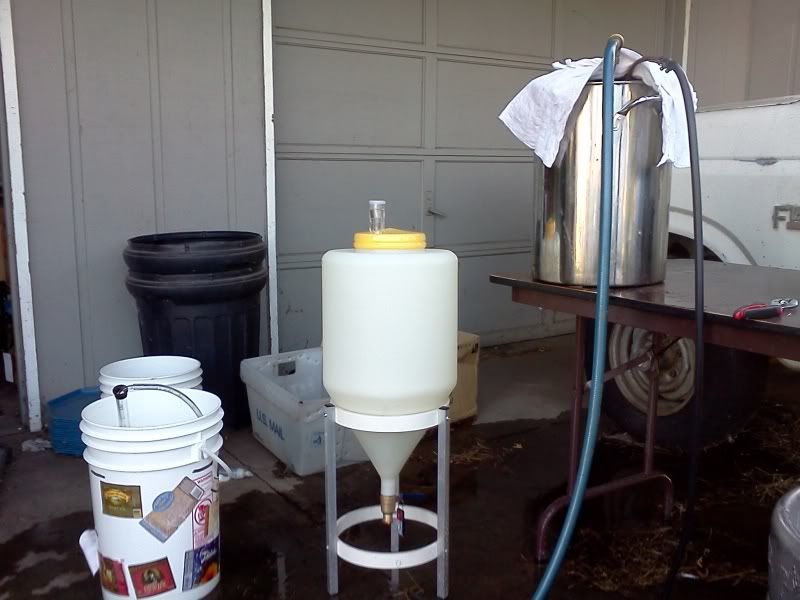
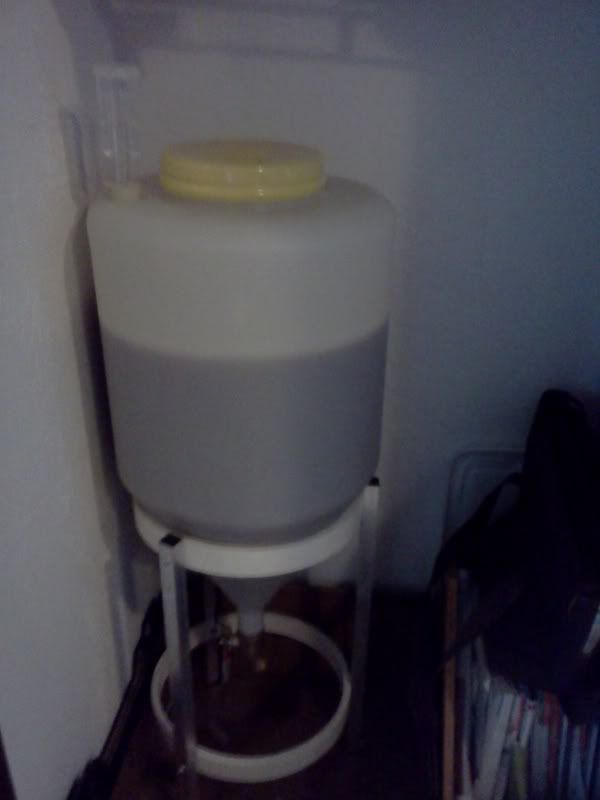
Conical Fermenter

Oxygen wreaks havoc on a finished beer. It will stale the beer and make it taste like wet cardboard. When using a typical carboy, bucket, or Better Bottle (PET plastic carboy), you have to rack (transfer via syphon) the beer out of the container into a new one to remove the trub (the globs of matter from the boil), hops, or yeast. Some beers need longer bulk storage to age and it is best to do this off of the yeast; once the yeast are done fermenting if they stay in the beer and under pressure at room temp they can die and autolyse spewing their innards into the beer wrecking it. It is also advantageous to remove the beer from the yeast when you Dry Hop (add hops to the fermented beer for fresh aroma); yeast still in suspension can grab some of the oils from the hops and take them out of the beer causing the Dry Hops to lose some of the desired effect on the beer, and the same goes for adding fruit or spices. Whenever you transfer the beer from one vessel to another you expose the beer to oxygen (the second container is full of it). Then, when you transfer from the secondary to a bottling bucket you expose it again.

A conical is another type of fermenting vessel that is typically used in the brewing industry for different reasons. One huge advantage of a conical is that when it is fit with a port at the bottom you can keep the fermenter as a closed system, avoiding the oxidation you just read about above. In a (sanitized) conical, you add the wort after chilling, pitch your yeast, and "seal" the vessel. During fermentation the yeast produce CO2 which escapes the system via a blow off tube or air lock, and it pushes any oxygen in the vessel out with it. Once fermentation is finished the vessel has no oxygen in it to damage the beer. To remove the trub, hops, and/or yeast, you open the port at the bottom of the vessel allowing it to flow out, and then reseal the port once it is cleared. The vessel is still oxygen free, and it is now free of the yeast and trub as well. At this point you can add your fruits, hops, spices, etc. to the vessel through an opening in the top and then reseal it; the CO2 layer on top will help to protect from too much oxygen getting in when you open it (much more than moving an entire 5 gallons into a 5 gallon container of air).

Once your beer is done and ready to package, you can drain it from the bottom of the conical into a keg, or bottling bucket, or, as I hope to do, add the priming sugar to the beer in the vessel, gently stir, and then attach a bottling wand to the port and bottle from the fermenter itself.

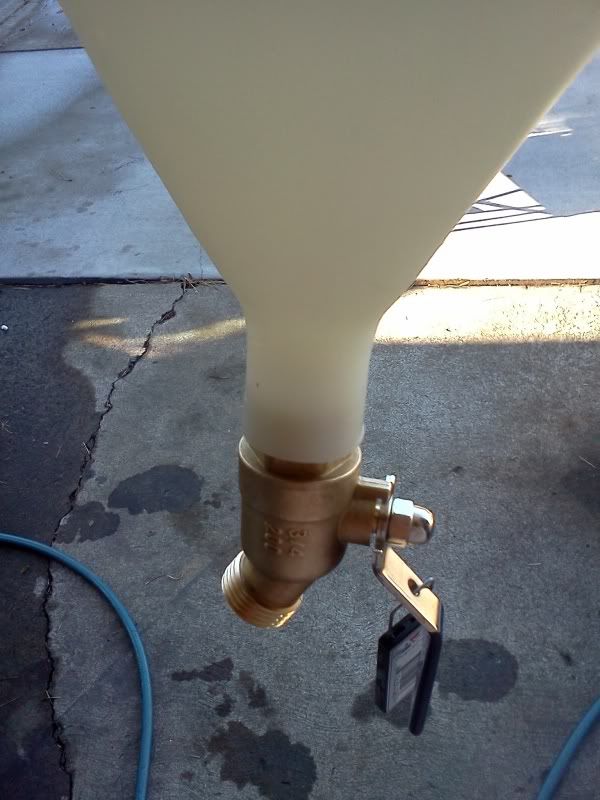
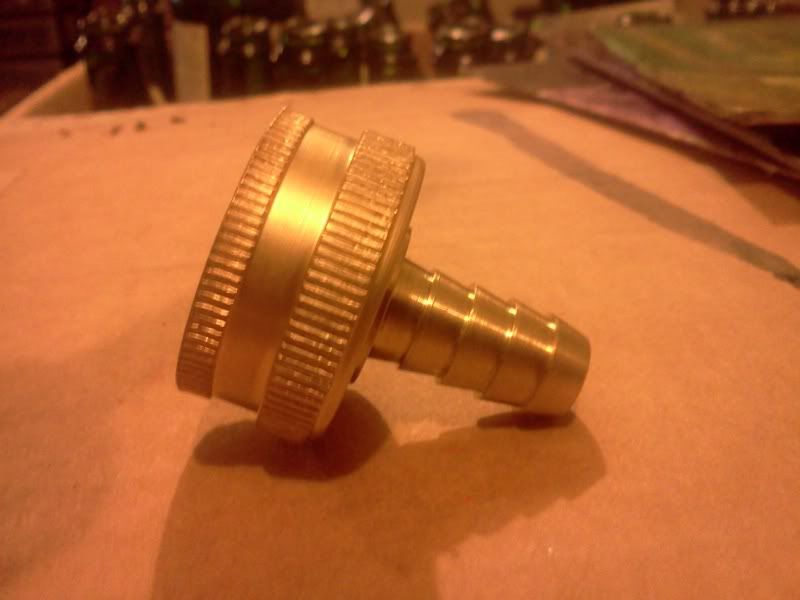
All this to say, I scored a conical from the home brew shop last week, and it is currently holding the Mild I brewed over the weekend. The conical was just the vessel itself, and I had to buy the fittings for it. I went to Lowes and bought a brass ball valve hose bib for $9, and then also bought a 3/4" female threaded hose end to 3/8" barb adapter so I can attach it for bottling or transferring the beer. For running off the trub and yeast the ball valve is good as it has a wider opening (1/2") so nothing will clog. But I don't want the beer flowing at that unimpeded rate (causing excessive splashing, thus defeating the purpose of avoiding oxygen), nor do I want it passing through a tube the size garden hose, which is why I have the adapter, I can now control the flow through the ball valve and the narrower tubing.

One problem I have found is that the thicker wall of the plastic conical makes it harder to know what temperature the fermenting beer is at. At this point I have been removing the airlock and inserting a thermometer a few times a day. To solve this problem I am going to drill a hole in the top of the vessel (between beers of course), insert a small rubber bung and pierce a thermometer through it into the wort so I can have a constant reading on the actual fermentation temperature. I also need to find some way to control the temp on it since I can't put it into a water bath and add ice as I could with my Better Bottle, bucket, or carboy, which may cause a few problems with this beer since it got up to 75*F and the yeast is only supposed to go to 72*F. I would also like to add a sampling port to the side of the conical so I can take taste tests or gravity readings without opening the vessel to air. I am also looking for a tallish cupboard that I can drill a hole in the top of to hold the fermenter, this will allow me to keep it higher and more stable (away from my son who would love to play with it), and to put another vessel under it if needed (bottling bucket, glass carboy for souring, bottles, etc), and if i get a double level cupboard I can attempt to temp control the fermenter.

Thursday, August 11, 2011

3 Beers, 1 Mash

Back at the very end of August I had a difficult brew day, difficult because of what I had planned. I originally had set out to brew 2 beers with wheat. I wanted to do a Bavarian Hefeweisse and an American Wheat w/ fruit for my wife. So I set out to brew them both from 1 mash. I had been tossing around the idea of how I was going to do the American Wheat: blackberry, strawberry, blueberry, all 3, something completely different. This was also the same time that Falconer's Flight proprietary hop blend came out. As I was doing some research on them I thought, "ooh, lots of tropical notes, pineapple, some pine and grapefruit, sounds like a 'fruity' beer to me!", so I approached my wife about doing a hoppy wheat beer that would taste tropical and she loved it (except for the hoppy part). So the plan was set, 1 Bavarian Hefe that I would culture the yeast from Sierra Nevada Kellerweisse to brew, and a hoppy American Wheat with 7oz of hops and a whole pineapple (as if the hops weren't enough). Then, about a week before brew day, I got a wild hair, literally: Berliner Weisse! Berliner Weisse is a very low gravity, low alcohol, super dry, sour German wheat beer with a slight Brett funk, and I could do it from the left over runnings from the other 2 beers. What began as 2 beers became 3!


Here is the grain bill:
7# Pilsner Malt (37%)
10# Wheat Malt (53%)
1# German Dark Wheat Malt (5%)
1# Flaked Wheat (5%)

This was my first attempt at a lot of things, seeing as it was my 6th batch of homebrew, and 3rd all-grain, this was a feat in itself. It was the first attempt at culturing yeast from a bottle. First attempt at doing a double sized mash. First time using wheat (and 63% at that). First attempt at step mashing. First sour mash. First sour. First open fermentation. First time using fruit.

The mash started off difficult, I had to fit 19# of malt into my mash tun, and do a step mash (which requires infusing extra water to take the temperature up to the next level). I started out by doing an acid rest @ 113 to create the precursors for 4 vinyl guaiacol (the clove flavor in Hefe). Then I scrambled to get enough boiling water ready to get it up to 120 for a protien rest. After that I scrambled again to get enough boiling water to get it up to the sacc rest @ 152. Got it to 148... NO! Had to add some more boiling water (wasn't ready) which put it to the brim of my cooler mash tun, and barely hit 152. I thought I would have to do my first decoction mash to get it right, but it worked. Mashed for an hour, then started to vorlauf. I took the first runnings into the kettle to measure, then hit the MLT (mash-lauter tun) with the sparge water. I drained this into a 15 gallon rubbermaid storage container (I had to have all 13 gallons in 1 master volume and then split it for the beers to be equal gravity), as I siphoned the 6.5 gallon from the kettle into it as well and stirred. Mean while I hit the grain bed with more water and added some more pils and some acid malt, and let it rest for a couple hours.

I syphoned 6.5 gallons into the kettle, added .25oz of Simcoe hops, and brought it to a boil for 90 minutes, cooled, topped off with water because I was short on volume, and then syphoned it into my 6.5 gallon fermenting bucket. I added the yeast I had cultured from the SN Kellerweisse, and put one of my large mesh sacks over top and taped it off... that's right, no lid, open fermentation. As you can see in the picture, the krausen got huge, no restraint or stress on those yeasties!

I then added the remaining 6.5 gallons of wort to the kettle and comenced the boiling sequence for it, adding quite a lot of hops as the boil came to a close. I cooled it, syphoned into the Better Bottle, and attached the blow off tube after adding a slurry of 1056 from Oakshire Brewing and aeration.

Now back to the MLT. I added enough cool water to drop the temp to 118 F and fill the MLT to the brim. I didn't put saran wrap or foil on top (to protect from oxygen which feeds the wrong bacteria) like I should have, but it turned out good in the end. I placed it inside an old sleeping bag and put it inside over night. 22 hours later I took it out and popped the top to the most horrid smell ever; like death climbed into my MLT and used it as a jacuzzi. I got it outside and ran off 6.5 gallons, and started the boil with aged hops that made it smell worse. I topped it off as it boiled with more runnings as it boiled for 2.25 hours. Finally I cooled it and racked it into my glass carboy. I added a smack pack of WY 1007 German Ale, and a 2L starter of built up dregs from RR Supplication (Lacto, Pedio, Brett). Sour mash, and souring bugs in primary... what did I get myself into! That thing continued to reek through fermentation.

After a few days I scooped off the krausen from the Hefe and put a lid on it just to ensure that nothing got into it (especially since I had a wild 4 feet away). Then after 2 weeks I racked the hoppy wheat into a 5 gallon bucket and added an entire pineapple that I had cored and chopped up. The next day I added 2 oz of dry hops. After another week, we bottled both "Cavendish and Cloves Collide" and "Harmonious Convergence" (named such as it was a harmonious convergence of my wife's desire for a fruity wheat, and my desire for a hoppy one). "Left Out Left Overs", the Berliner Weisse stayed in primary another 4 weeks. At a total of 7 weeks we bottled "Left Out Left Overs" and let it carb for 2 weeks in the warm garage inside rubbermaid storage containers with lids just in case of bottle bombs (when an over carbonated bottle explodes due to pressure), but none hit. I put one case into the fridge after the 2 weeks, and left another out for 6. They went into the fridge @ 1.007, but after the 6th week bottled, I degassed 2 beers (one of the 2 week crew, and one of the 6 week) to compare gravities. Both clocked in @ 1.004! They dropped another 3 points after bottling; that is amazing they didn't blow.

They all taste great. The Hefe has a lot of over-ripe banana, vanilla, and a clove kick on the back end, very smooth and creamy, superb head and lacing, but they have gone almost crystal clear in just over a month. The hoppy wheat is nice and tropical, lots of pineapple, grapefruit, a little pine, tart wheat, smooth, dry finish, lots of haze, great head retention, and a nice bitter bite. The Berliner is quite sour, smells of ripe fruit, greek yogurt, and funk, with a dry, fizzy, sour punch in the throat; lots of white bubbly head that quickly disipates. Very impressed with all three, but will probably never do the entire thing over again.