Showing posts with label yogurt. Show all posts

Wednesday, April 30, 2014

UPDATE: Failed Lacto Cultures


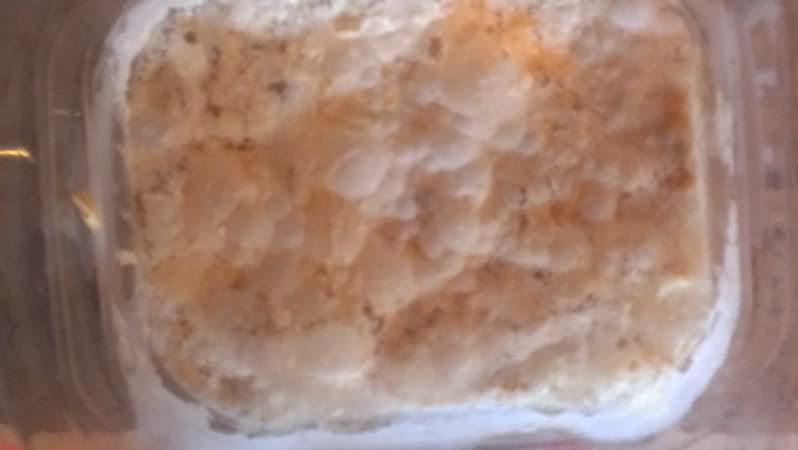
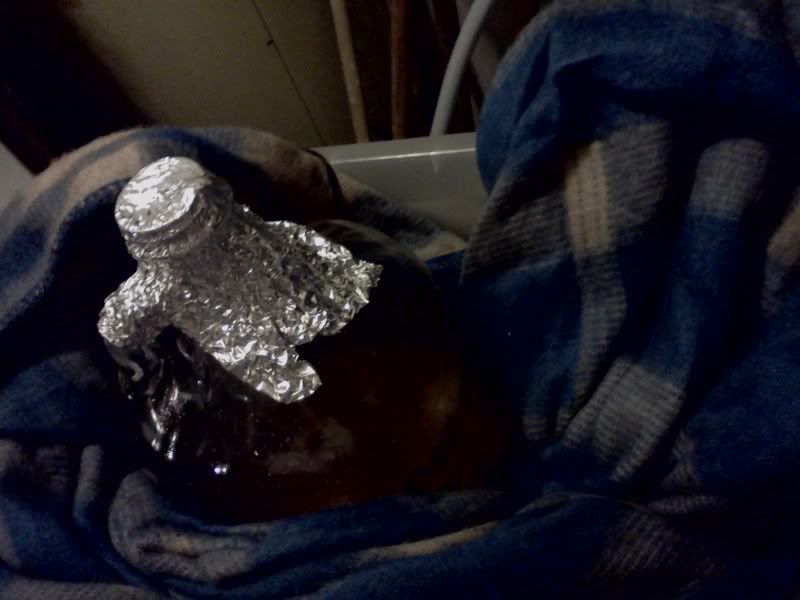
A few weeks ago I posted about stepping up my Brett cultures by reviving older pitches from previous ferments as well as culturing new ones and getting pitches of new stuff from my buddy, Stephen.  At the same time I was working on culturing up Lacto from 3 different sources as well.  Stephen and I had split a Cascade Apricot after dinner on April 7th; he took the bulk of the dregs and I kept a few ml of slurry from the bottle.  His was pitched directly into a small wort starter (1.020 @ 300ml) that he had brought with him, and was left at room temp.  I put mine into about 250ml of Lactose sugar starter the next night and kept it at around 95*F.  I ended up taking this starter and mixing in apple juice to bring it up to 750ml of liquid.  I also added some Zoi Greek Yogurt to a jar and hit it with 750ml of apple juice too.  The third source was some pale malt I had in the garage which I added to to the last 500ml of apple juice.  I placed all of these in the ferm fridge wrapped tight in my heating blanket and kept them at 105*F for a week.  I sampled once or twice to see if I was getting any activity.  On brewday I was going to pitch some of the starters into my Saison along with 2 Saison yeasts and the Bretts.  I went to taste them and nothing.  Not a trace of Lactic acid.  I am thinking that my pasteurized apple juice must have contained sulfites as opposed to heat pasteurization (I swore I checked that though), thus inhibiting the growth of the Lacto in all 3 starters.

Luckily my buddy still had his 2 week old Cascade starter which he said was quite tart, and offered 200ml to me for my pitch which I used 150ml of and kept the other 50ml to grow up for myself.  This new starter of mine spent a week in the ferm fridge with the fermenting Saisons on 250ml of last runnings from the brewday, and had gotten quite sour.  I pitched around 100ml of the starter into my Oud Bruin from this time last year to get it to sour up, and then added the remaining 50ml (after sampling and such) to a 500ml 1.020 DME based starter for further growth.  It is back in the ferm fridge with the Saisons in the mid 80*s souring up nicely.

Thursday, September 5, 2013

Recipe #45: Not So Quick & Easy Extract + Yogurt Berlinerweisse

Inspired by some recent discussions over on BeerAdvocate in the homebrew forum, I decided on a whim to do an easy and quick Berlinerweisse for later this Summer.  There were actually a few things that converged on this idea.  The BA talk was around how White Labs Lacto strain refuses to sour beers no matter how long it is left to work it's magic (even when used alone like the Mad Fermentationist did).  Wyeast seems to be better, but I am not wanting to wait until next Summer for this beer.  I had some success culturing Lacto from Greek yogurt in the past, and I had mentioned this in the BA thread about the WL Lacto fails to a fellow brewer who was going to be doing a few experiments with 20+ gallons of Berlinerweisse.  I have also been working on getting some soda syrups made that can be added to carbonated water (keep my kegs free from the syrupy residue), and I thought, you know, a Key Lime Ginger syrup would go great with a Berliner instead of bubbly water.  Add to this that I am still a few weeks out from an open Saturday after the move to the new house and I am left with an easy and quick extract batch.  The plan is to go back to the roots of beginning homebrewers.  Stove top batch at one gallon, dry malt extract, small addition of hops, chill the pot in the sink, transfer through a strainer, top off with cool water, pitch yeast packet (yogurt), put it in the garage, and let it ferment at ambient temps (had 1 gallon starter that was high on sugar content turn into nail polish at 95*F so I am avoiding super high temps).

Tuesday, July 23, 2013

UPDATE: Hops, Lagers, Experiments


It has been awhile since I last posted, and wanted to get something up here, including a few things that don't need there own individual posts.  After transplanting the hops after the move and installing irrigation for them, only 3 have any growth: Santiam, Chinook, and Blisk.  The growth is very little, maybe a foot or two max, and very thin.  The rest of the hops aren't producing anything at all.  My understanding is that the late move and time out of the ground shocked the plants and they are going to be fine next year.  Keeping them watered to ensure good roots for the next season.

I haven't posted a recipe in awhile now.  The reason for this is because I have brewed 3 batches that take longer to ferment.  I did an extract Berlinerwiesse fermented with only yogurt.  This beer was intended to be a quick sour.  It was quick, only 4 weeks and it was down to 1.003, but it never really soured.  The Lacto strains in the yogurt created CO2 and alcohol instead of acid, and lots of DMS.  I am still debating what to do with this batch.  I have a few strains of Brett right now that I am thinking of adding to it for a few months, then adding fruit to it as well for next summer.

I also brewed 2 American Pilsners, 1 classic with Saaz, Liberty, and Sterling, the other is New School with Simcoe, Mosaic, and Calypso.  They are just starting to lager now and should be kegged by the weekend.  I have found that brewing lagers isn't really my cup of tea.  I can enjoy them when I finally get to drink them, but they just take so long.  My fermentation fridge is locked up for 5 weeks, then I have to clear kegs for them, and then I have to wait another couple weeks for them to lager before I have 2 kegs to drink through before I can put anything else on.  I also find that by the time they are done fermenting and ready to drink I have had a shift in tastes and don't really want to drink 5 gallons of American Pils.

I am also trying to culture up some Lacto off of grains.  I will have a full write up of the process in a few weeks when it is done, but for now, I am using grains and apple juice in a heating blanket set on high to get a culture going and have had success so far.  I will be stepping it up tonight to get more and hopefully with multiple steps should be able to kill off any enterobacter as the pH drops and some alcohol is produced.

Wednesday, June 20, 2012

Sour Blonde Update: Tropicana!

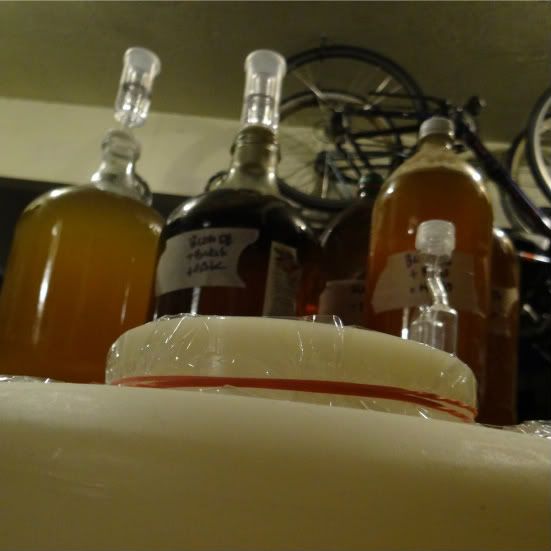
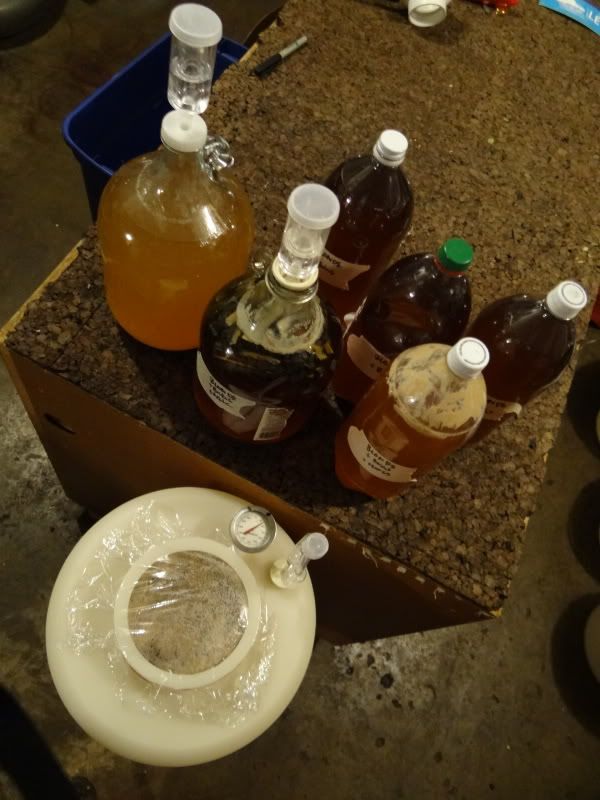
The Blonde Ale has made some advances since I last updated on it.  What started as a test batch to ensure my fermenters were free of the infections that hit my other brews, morphed into a sour project when the experiment revealed that my conical was indeed still infected (and much new information leads to the conclusion that it is actually the source of it all).  The batch was being housed in 4 glass jugs, and the conical, the former containing Lacto, Pedio, Brett, and oak, the latter containing Brett only.  I recently added some 5 gallon glass carboys to the brewhouse, scored at a garage sale for $12 each, couldn't pass it up.  I decided to take the just under 3 gallons of oaked and soured version, the 1 gallon of Lacto from yogurt and honey, and the 6 gallons of Brett Blonde and mix them together split into 2 carboys.  One remains blended and aging for now (will receive some fruit later), the second received fruit now.

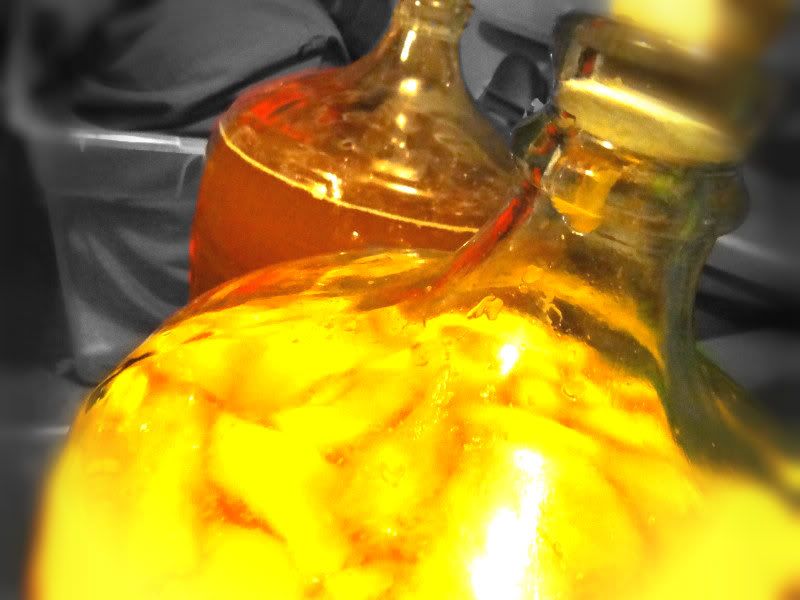
I did some chatting with fellow homebrewers and sour lovers Mike Tonsmeire (and his friend Seth) and Ryan about possibilities for adding tropical fruits.  Both recommended staying away from pineapple unless I was going to back sweeten as they are highly acidic.  After looking at the options of guava, papaya, mango, passionfruit, and dragon fruit, I decided on mango (passion and dragon are too expensive).  I added one papaya and remembered that I don't much care for it, and one won't impact the flavor enough to worry about it.  I also added 3 mangoes skinned and de-seeded.  According to a few sources, I would need between 8-10# of mango, and i only added about 3.  The cost factor does weigh in, so when I found some Mango Nectar (high fructose corns syrup free) on sale for $3.50 1/2 gallon, I jumped on it.  Bought 2 jugs.  The juice weighs in at 1.057 OG.  I added one jug to the carboy and almost overflowed the vessel.  The other I put into one of my glass gallon jugs and then siphoned some of the sour beer in with it to ferment it like a sour/wild Mango cider.  Once they are done souring, I will blend them back together before bottling.  Who knows what else will happen between now and then though.

Friday, May 18, 2012

Bring On The Bugs

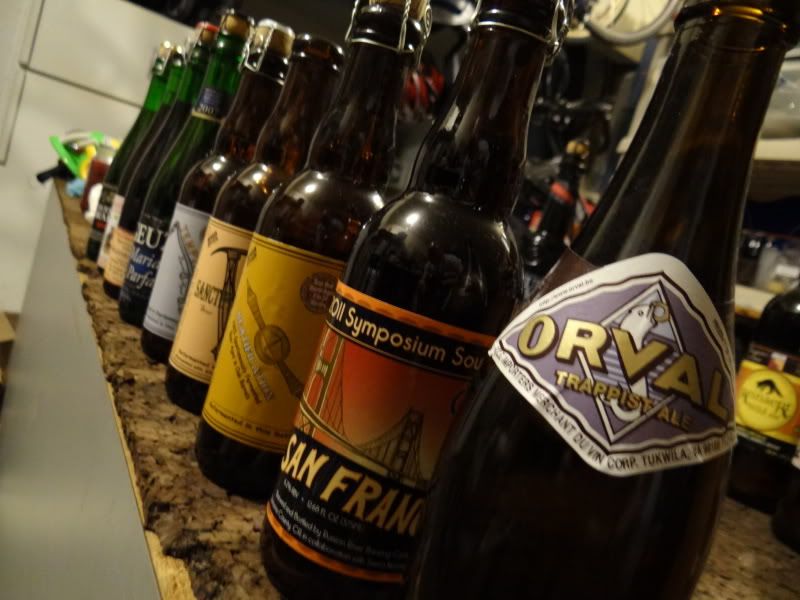
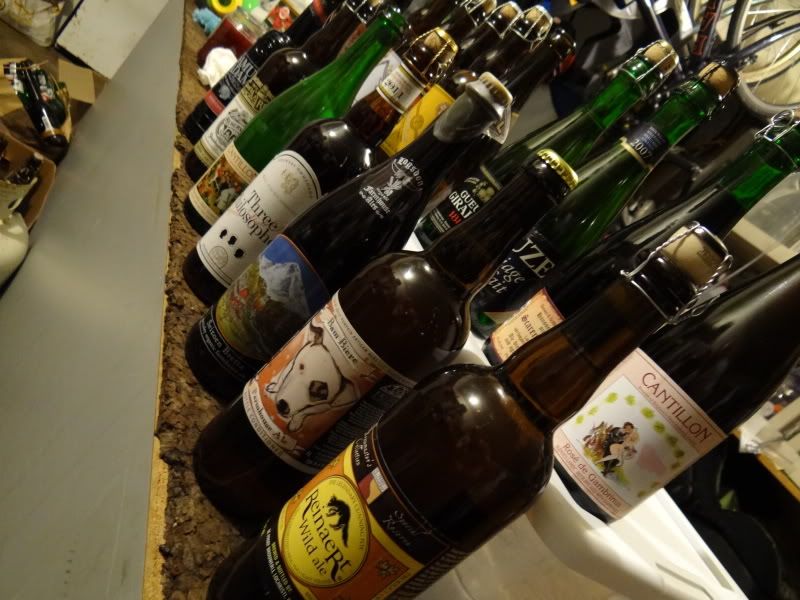
I've been thinking about building up my reserves for sour dregs to add a little more depth and complexity to my sour beers.  The two that have finished were good, but I only used one type of dregs to achieve them and my hope is to add a lot more to the following batches.  Previously I have used Russian River's Supplication and Consecration.  Recently I built up the dregs from there Sanctification which is brewed with only Brett, with Lacto and Pedio in secondary, and bottled with Brett alone (thus removing the champagne yeast that they use in all the other sours at bottling), as well as dregs from a bottle of Jolly Pumpkin Bam Biere which has a great pellicle.  I added the dregs from a bottle of Oude Beersel Oude Geuze Vielle to my Lambic as well as dregs from some of my homebrew, Cantillon, and a dose of Logenberry Mead from my buddy that had gotten infected.  

I've got quite a few bottles of different sours that I was considering culturing from, such as, RR Beatification (among other RR offerings), Cantillon Rose de Gambrinus, Oakshire Scookumchuck, Girardin 1882 Black Label, Boon Oude Geuze Mariage Parfait 2007, and Hannsens Scarenbecca Kriek.  What I was thinking was to make a 1.030 starter wort from DME and Apple Juice, transfer into water bottles and put it in the freezer until I drink one of these bottles, at which point I will pop the cork, pour the beer, flame the lip, and add dethawed starter wort to the dregs in the bottle then place foil on top and leave at ambient to grow.  After some time I will be able to swirl up the starter of which ever one/ones I want to use, pour some off into the beer I am brewing, and add some more starter wort to it to feed it and keep the culture going.  This will give me variety, and since I have lots of 1 gallon jugs, I can add JP to one, Cantillon to another, Hannsens to another and RR to another, and compare how they turn out, then blend to the desired effect I want.


One problem that I hit was with the bottle of Fantome Saiosn D'Erezee Prentemps that I did this with.  I ended up with Icebergs on top (Large clumps of mold) and a Sea Cucumber floating around in the liquid (large carpet of mold).  According to another homebrewer and sour  maker he has had this same issue when the starters are grown in too hot an environment.  Another issue that Mike Tonsmeire threw my way, and I was reminded of again while reading Wild Brews again, is that mixed cultures like this will be very difficult to keep in balance.  Inevitably the Sacc strain will die off and autolize, the Lacto (especially in un-hopped stater wort) and Pedio will multiply rapidly, and the Brett will not keep up with the acid bacteria.  If this were to happen, successive batches would become very sour and not have much other flavor components to keep the beer in balance with the proper flavors and aromas, just sour.  What he recommended, and the way I will probably go, is to just pitch the dregs into a batch, let it age, bottle, and then pitch the dregs from my bottled beers into new sours along with other dregs, age, bottle, repeat, and so on.  This will give me a large diversity of bugs and wild yeasts from different breweries, as well as a house character as my current bugs and yeasts are repitched and morph from batch to batch.  With all the different sours I have going right now, it sounds like a good option.


Add to this my culture of Lacto from yogurt, and my Brett starters - 1 Orval, 1 Reinhardt's Flemish Wild Ale, and I will be getting some Brett C from an all Brett beer that some buddies have going, I should be looking at quite a bit of funk to funk around with.

Wednesday, May 9, 2012

Shortened Brewday Update

As I stated in my last post, I severely tweeked two brews to shorten my brew day and make it much easier and less stressful... thus funner, and it was.  My efficiency was slightly lower than I thought it would be but I still hit my numbers where I wanted to.  1.049 for my Wit, and 1.055 for the Gumballhead... then the curve ball.  I was racking the Gumballhead into the Better Bottle with my airstone going just fine while I emptied my mash tun.  After it finished I looked over to see a plume of foam exiting the top... wait a second... why is Starsan foam coming from the... top... of my... oh... !  Yes, after pouring a half gallon of Starsan into my fermenter, shaking to sanitize, putting the shirt over the top to keep the sun from skunking my beer, and putting the stopper in to keep debris and such out, I forgot to empty the Better Bottle before racking into it.  Luckily Starsan is drinkable, unlike Iodophor, and so it just diluted the beer from 5 gals @ 1.055 to 5.5 gals @ 1.050.  To adjust for this I added a pound of sugar to the fermenter to get the gravity back up to about 1.055 so that I will still hit the right ABV (maybe a little higher with how fermentable the sugar is).

As an added bonus I drew off 6 gallons of 1.011 gravity last runnings and soured them for 50 hours @ 95*F.  Smelled like yogurt, not too tart though.  Went to boil it with 2.5# DME and my burner caught on fire at the hose, so no boil.  I pulled 1 quart of wort and brought it to just under a boil and added 1oz Challenger and 1oz Cascade for a frutiy, spicy, floral, citrus hop nose to it and steeped for about 5 mins, then strained it into the other 6+ gallons of unboiled wort in the bucket.  I added some slurry from the 3/4 gallons of Soured Saison I just bottled, and after 2 days it smells of fruit, lactic, and CO2, and I can see the wort churning when I look inside.  Tossed in a couple of my French Oak cubes as well.  In a few months it should be nice and tart and funky.  My thoughts are to add fruit or maybe flowers to it, possibly dry hop.  We'll see how this one turns out for a last minute, last runnings, sour mash that didn't fully sour and never boiled, hopped nose but not boiled, oaked experiment, that I didn't take a gravity reading on.

Be on the look out for the recipes soon.

Thursday, April 5, 2012

Infecting My Infection Experiment

A few weeks ago I brewed up a basic American Blonde recipe to test my fermenters to see if I had effectively killed off the infection that may have been housed in them from previous batches.  The conical version of the beer seemed to be infected from the start so I decided to sour up the whole lot of it.  After checking the final gravity on the Better Bottle version and tasting it, I decided that I didn't have to have 5 gallons of this one bottled and could go for a half batch or so.  It seems a little thin with a FG of 1.005.  The flavors are nice, but the body is a little off.  I shouldn't have expected much different since I pulled 10.5 gals (post boil) from 12.5# of grain, and with such a low OG (1.037) even taking up the mash temp to 153*F wasn't going to stop it from finishing low.  Thus the decision to purposely infect the infection experiment batch.

On the conical, I diverted 1 gallon to a jug that housed a Brett starter to funk up, and I hit the remainder with 1/4 cup starter from Russian River Consecration and 1/4 cup of my Lambic along with 8 pieces of French Oak.  After a few days it was tasting quite oxidized, so I moved it out of the conical into smaller containers.  I put all the oak into one jug so it will be over oaked and used to blend into the final mix.  The rest was put into 2L bottles with a small addition of sugar.

I bottled 18 bottles worth from the Better Bottle using carb tabs just so I can know exactly how the final batch actually turned out.  The rest I transferred into the conical where I added the entire 2.5 gallons of this wort fermented on all Brett, the gallon of Bretted conical beer, and added 1.25# Clover Honey for added sugars.  I put a piece of saran wrap over the top so that I can easily look inside at what is going on with out allowing oxygen in every time I take a peek.  The saran wrap is kind of fogging up from the honey fermenting, which started out as a ring of foam as is began to dissolve from the bottom of the conical and start to ferment and slowly developed into a full krausen by 2 days later.

The plan is to let the Better Bottle version now in the conical funk up with Brett for a few months while the original conical version sours in the 2L bottles.  After 3 months or so, I will drain off a couple gallons of the Bretted conical into 2L bottles and add a 1 gallon starter of Lacto and honey, as well as a couple of the 2L soured bottles to get the souring bugs going in the Brett only version.  After some time passes I will pull some more form the conical and add the remaining 2L bottles of soured Blonde as well as the oaked sour Blonde to the mix.  Come the end of summer, I will have 2 gallons of Blonde Ale on Brett, and about 8 gallons of soured, oaked, wild Blonde which I will split 3 gallons onto cherries, 3 gallons onto apricots, and keep 2 gallons straight giving me a total of about 10+ gallons.  We will see how time plays this one out. 

Tuesday, March 20, 2012

Yogurt... In My Beer?

So much cleaning, so much sanitizing, so much stressing about whether I would ever be able to brew a clean beer again, and then the inevitable happens... another infected batch. I had stripped apart my conical, soaked it in PBW and hot water for over a day, and then left it in bleach for nearly a week. After brewing up 8 gallons of Blonde Ale to split between the conical and my Better Bottle (that had housed the infection as well) as a test to see if I had rid myself of it, I let them both ferment for a week. I pulled samples of both of them to taste, smell, and check the gravity. What I found from that conical was so much different than the Better Bottle. Dull, lifeless, dirty fruit, watery, and 3 points lower, diagnosis: INFECTED! With that, I resigned my efforts to salvage the fermenter, after all I had done, it was to no avail, and thus, a new fermenter for brewing up sours was born. And with all my renewed passions towards sours, it happened at just the right time. I was already planning on souring half the batch anyways, this just made it easier.


I pulled a gallon of the beer from the ball valve that went straight into a glass jug that had housed my Brett starter before it went into the leftover wort from this brew session, and had yet to be cleaned. Given a few months, the Brett should build up a nice pellicle and funk it up quite a bit. In the conical, I added a 1/4 cup of a starter I had built up from the dregs of Russian River's Consecration last summer, as well as a 1/4 cup of the Lambic I brewed last September using yeast I cultured from blackberries growing wild in my neighbor's backyard. I tossed in about 8 cubes of French Oak that were previously used by a winery in Lodi, CA to revive an old barrel as well. I also have a starter from RR Supplication that I won't be adding, at least not right now, because there is a lot of head space in that vessel right now and that culture has some definite acetobacter from when I used it in a bucket on another brew.


Just for the fun of it, I also made a 1L starter with 750ml water and 250ml Apple Juice, and 100g DME, that I cooled to 115*F, and pitched in 1/3 a serving Zoe Non-Fat Plain Greek Yogurt, which I inserted my temp control probe into and set it to 115*F wrapped in the heating blanket I received from a friend. 3 days later, the temp is constant at about 39*C (~100*F). When I poured a sample it fizzed like Alkaseltzer, which is good, that means carbonation, which means that something is going on. A sniff gives hints of yogurt, clean, nothing off in the aroma. A taste gives off sour apples, and a light yogurt twang. I effectively cultured Lacto from Greek Yogurt! After a few more days, I added 3/4 gallons of water mixed with 1.25# Clover Honey to bring it up to 4L, and give it a week or so at 100*F. Once this gallon of Lacto fermented Mead is ready to go, I will add it to the main Blonde Ale in the conical, along with another 1.25# of Clover Honey in a gallon of water, and let her ride for a good 6-8 months. Then I will add back in the gallon of Brett only portion, and hit it with 2-3# of fresh Apricots this Summer. This will bring the total volume of beer up to 6 gallons, with a new OG of 1.041 (1.037 prior to honey), and a FG of near 1.002 (or less) for a 5% ABV oak aged, wild Honey Blonde Ale.


Here's to innovation and infections!