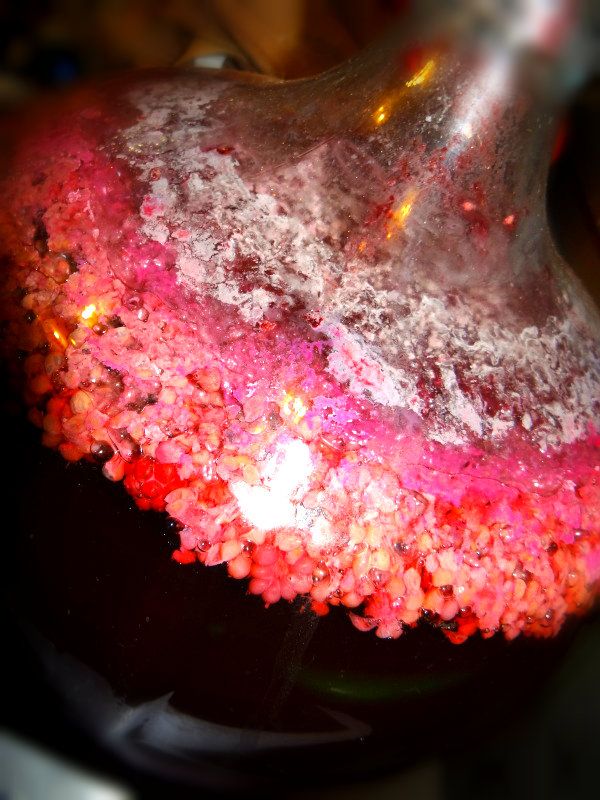
About a year ago, actually, 52 weeks ago, I brewed up a Lambic that I fermented with the yeast I cultured off of blackberries from my backyard and a small starter of yeast from organic peaches grown locally. After making the wort and adding the entire starter from each yeast to the carboy, I had a "funny" fermentation which consisted of small bubbles flowing up to the top quickly to feed a very small fluffy white head that looked like a single centimeter of soda foam. Eventually the fermentation looked a little more like normal, but the krausen never really roared up like a normal yeast would. There were chunks of peach flesh and blackberry, as well as oak chunks on top. I also added some wild grapes after a month for a little extra yeast. After only three weeks it was down from 1.053 to 1.006. Nice and fruity, with a light tartness, mostly tropical and berries.
Over the course of fermentation, I have added dregs from commercial and homebrewed sours to try to get more complexity built up from other sources of Brett and bacteria. I added some Russian River dregs, Cantillon Grand Cru, Jolly Pumpkin, Oude Beersel, Girardin Black, some infected Logen Berry mead a buddy made, and some dregs from a sour I did with Russian River dregs. This will ensure a more complex beer, but it also kills much of the work I did culturing the yeast since the final product isn't a showcase of what that yeast can actually do (part of the reason I am going to brew a new one this year with fruit cultured yeast again and leave it alone).
After a few months I noticed a lot of oak character showing, and seeing that I used 5 oz of French Oak that had come from a wine barrel in Lodi, it wasn't any wonder why. I needed to do something to stop the oaking, but I didn't want to lose all of the goodness in the trub and yeast that is needed for a Lambic to ferment properly. I racked the beer out of the carboy into my sour bottling bucket and then dumped the trub, yeast, fruit, oak, etc., into a vessel while I cleaned the carboy and removed all the oak. After this I added a few pieces of oak to the carboy, opened the valve on the bucket and refilled the carboy. While this was going on I also racked the yeast, trub, and fruit back into the carboy as well.

I noticed an oxidative character beginning to creep in around January, so I brewed a little extra wort on my Saison and added a half gallon to the carboy to displace the head space. The FG was still at 1.005. Only took a few days for the fermentation to kick back up and take on the fresh wort. After about a month or so, it was back down to 1.005.
Given another month, the FG had gotten down to 1.002, and there was a sheen atop the wort slightly resembling an oil slick, not like the pellicles I have seen before on my other sour beers. By mid summer the taste was nice, funky, tart, clean, fruity, spicy, but lots of oak, so I racked it from the 6 gallon carboy into a 5 gallon, taking some of the yeast sediment at the bottom with it. Given another month, the oakiness is starting to fade some. I racked 1/2 gallon out of the carboy and added 1/2 gallon of my sour Blonde ale to try to cut down on the oak a little. A few weeks later I am happy with the results, and am ready to bottle, and seeing that it is sitting at 1.001, not much more for it to do in the short term.
A beer that I have been watching, shaping, tasting, aging, and waiting on for a year is no simple brown bottle beer. For this batch I needed to do something special, at least for a few bottles. I started with 375ml Champagne bottles. At this point I could go with cork and cage, or cork and cap (Cantillon style), but I opted for a cap and wax seeing as they look very nice, and it's super cheap as well as not requiring extra equipment. Add to this full labels with art work and it is a very nice show piece, even if it is only 6 bottles worth.
A beer that I have been watching, shaping, tasting, aging, and waiting on for a year is no simple brown bottle beer. For this batch I needed to do something special, at least for a few bottles. I started with 375ml Champagne bottles. At this point I could go with cork and cage, or cork and cap (Cantillon style), but I opted for a cap and wax seeing as they look very nice, and it's super cheap as well as not requiring extra equipment. Add to this full labels with art work and it is a very nice show piece, even if it is only 6 bottles worth.
I hope that the beer will carbonate quicker than my other sour which has been bottled for nearly 7 months and is still fairly flat. Our club has a competition coming up and in late October that I would like to enter this batch into. I will of course set the bulk of this beer aside to cellar for years to come and continue to develop.
This beer will be the first installment in my new series of beers, dubbed Where the Wild Things Are, named after characters from the children's book made movie. The first is going to be called The Carol. One of the main Wilds, he was impulsive, much like brewing a beer with blackberry yeast, adding dregs at random, and over oaking, only to move the beer twice.
NOTE: This beer took 1st place in Sour Beers and BEST OF SHOW in February 2014 at the KLCC BJCP comp.
NOTE: This beer took 1st place in Sour Beers and BEST OF SHOW in February 2014 at the KLCC BJCP comp.