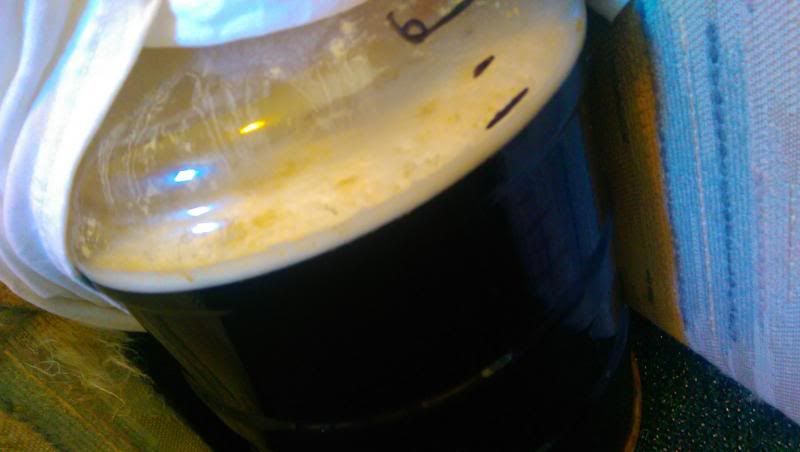
 When I put together my recipe for my Vienna Lager I had to split the mash up for something else. I thought about it and toasty malts, 1.048 OG, sounds like a great canvas for an American Pale. Add to this that I wanted a Pale to enter into the Sasquatch homebrew comp, and I had already blown my keg of IPA with the Black IPA headed to the same demise, I needed a hop bomb. Stephen had done a lot of work to clean up an infected pitch of Conan I had, and I had planned to use it to ferment this batch. Low and behold I didn't ask for it soon enough and didn't have time to get it built up in time. I thought about using the pitch of 1469 I still had from the IPA, since it has a lot of peach notes too, but decided against it. I made that decision because I had 6 strains of Brett built up for the Saison, and have heard very good results from others about Brett Trois and hoppy beers. I had only done one other Brett and Hops beer and didn't care for some my hop choices. I really wanted to do one again, so why not now.
Showing posts with label Winner's Circle Recipes. Show all posts
Showing posts with label Winner's Circle Recipes. Show all posts
Wednesday, May 21, 2014
RECIPE: 1st Place APA #64 Tropic Thunder (Vienna, Amarillo, Simcoe, Brett Trios APA)
When I put together my recipe for my Vienna Lager I had to split the mash up for something else. I thought about it and toasty malts, 1.048 OG, sounds like a great canvas for an American Pale. Add to this that I wanted a Pale to enter into the Sasquatch homebrew comp, and I had already blown my keg of IPA with the Black IPA headed to the same demise, I needed a hop bomb. Stephen had done a lot of work to clean up an infected pitch of Conan I had, and I had planned to use it to ferment this batch. Low and behold I didn't ask for it soon enough and didn't have time to get it built up in time. I thought about using the pitch of 1469 I still had from the IPA, since it has a lot of peach notes too, but decided against it. I made that decision because I had 6 strains of Brett built up for the Saison, and have heard very good results from others about Brett Trois and hoppy beers. I had only done one other Brett and Hops beer and didn't care for some my hop choices. I really wanted to do one again, so why not now.
Thursday, March 13, 2014
Recipe: #59 Dark World (Beer Advocate Crowd Sourced American Stout)

Awhile back Vikeman, a Beer Advocate homebrew forum member, put together a poll to do a crowd sourced Stout recipe. The popular votes fell on American Stout, and a string of new polls ensued to decide the OG, FG, ABV, IBU, grist composition, yeast, mash temps, hops, etc. In the end the recipe was compiled and released with multiple brewers around the country brewing the recipe for themselves. I really enjoyed being a part of the polls, and wanted to brew this beer, so I figured I had my recipe. This recipe included toasted oatmeal so a few days before brewing I put the oatmeal into the oven set at 350*F for about 40 minutes giving it a couple stirs and letting the kitchen smell like cookies, then I placed it in a paper bag to cool for a few days.
Friday, November 22, 2013
RECIPE: 1st Place KLCC #52 The Caleb (Imperial Stout on Elijah Craig Bourbon)
Thursday, November 14, 2013
RECIPE: 1st Place KLCC #53 CUDL Buddy (Winter Warmer)
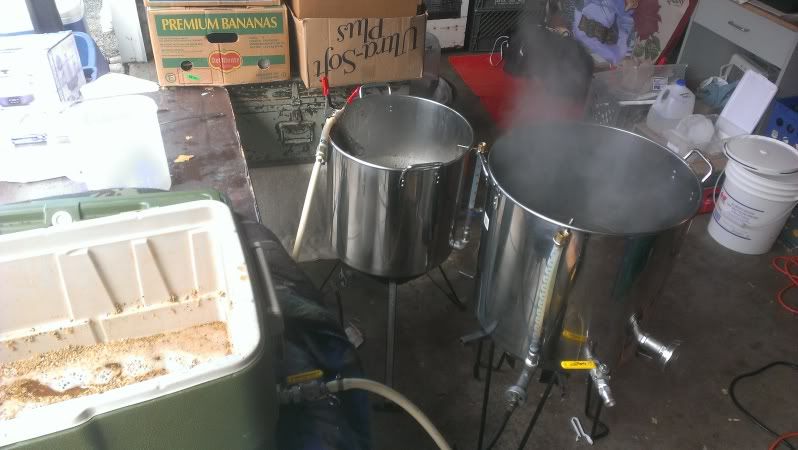
Fall has set in, Thanksgiving (and my Birthday) are only a couple weeks away, Christmas is shortly after. It is that time of year when you really want to have a beer with a little bit of warmth to it, a nice toasty malt character with some sweetness, a good body, and some spiciness to it. I have always enjoyed beers like Full Sail's Wassail, Bridgeport's Ebenezer, Deschutes' Jubelale, all of which are rich, malty, caramelly, with a nice hop character of spice, earth, and pine. Because of my love for these particular Winter Warmer beers, I decided to make my own this year.
Monday, April 8, 2013
Recipe: BANGARANG - The Twins (3rd Place - German Pilsner & Saison)

Friday, February 8, 2013
Recipes: Identity Crisis II (Black IPA) & 2nd Place - Homie's Hop Sock (IPA)

Monday, December 24, 2012
1st Place Recipe: Procrastinator (Dopplebock)
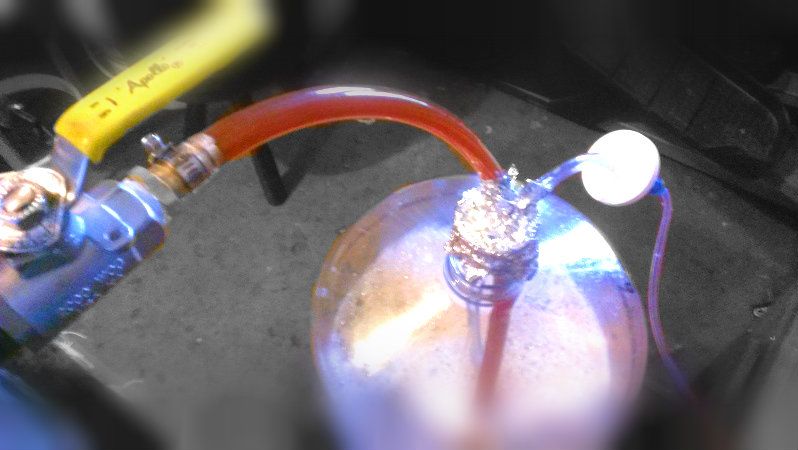
Lagers… the difficult
beers of brewing… temp control, larger pitching rates, clean beers, a showcase
for brewing flaws. Some brewers never make the move. I have avoided
these beers for the 2 years I have been brewing for 2 reasons: 1) pitching
rates, 2) I don’t care for very many lagers. My tastes don’t mesh well
with many of the pale lagers I have tried, thus far I have enjoyed a few Munich
Dunkels, a Schwarzbier or two, and a good, dark Dopplebock, but if the Dopple
is lighter, I tend to not care for it much. Add to this the lack of drive
to build up a 7 liter starter (not too mention the lack of equipment for it)
and there hasn't been much push to brew a lager.
Recently I was at a
brewing friend’s house discussing and crushing hops when the topic switched
over to lagers. He loves to brew them and has a refined palate for
critiquing them from his time in Germany
Friday, September 14, 2012
Where the Wild Things Are: The Carol

About a year ago, actually, 52 weeks ago, I brewed up a Lambic that I fermented with the yeast I cultured off of blackberries from my backyard and a small starter of yeast from organic peaches grown locally. After making the wort and adding the entire starter from each yeast to the carboy, I had a "funny" fermentation which consisted of small bubbles flowing up to the top quickly to feed a very small fluffy white head that looked like a single centimeter of soda foam. Eventually the fermentation looked a little more like normal, but the krausen never really roared up like a normal yeast would. There were chunks of peach flesh and blackberry, as well as oak chunks on top. I also added some wild grapes after a month for a little extra yeast. After only three weeks it was down from 1.053 to 1.006. Nice and fruity, with a light tartness, mostly tropical and berries.
Over the course of fermentation, I have added dregs from commercial and homebrewed sours to try to get more complexity built up from other sources of Brett and bacteria. I added some Russian River dregs, Cantillon Grand Cru, Jolly Pumpkin, Oude Beersel, Girardin Black, some infected Logen Berry mead a buddy made, and some dregs from a sour I did with Russian River dregs. This will ensure a more complex beer, but it also kills much of the work I did culturing the yeast since the final product isn't a showcase of what that yeast can actually do (part of the reason I am going to brew a new one this year with fruit cultured yeast again and leave it alone).
After a few months I noticed a lot of oak character showing, and seeing that I used 5 oz of French Oak that had come from a wine barrel in Lodi, it wasn't any wonder why. I needed to do something to stop the oaking, but I didn't want to lose all of the goodness in the trub and yeast that is needed for a Lambic to ferment properly. I racked the beer out of the carboy into my sour bottling bucket and then dumped the trub, yeast, fruit, oak, etc., into a vessel while I cleaned the carboy and removed all the oak. After this I added a few pieces of oak to the carboy, opened the valve on the bucket and refilled the carboy. While this was going on I also racked the yeast, trub, and fruit back into the carboy as well.

I noticed an oxidative character beginning to creep in around January, so I brewed a little extra wort on my Saison and added a half gallon to the carboy to displace the head space. The FG was still at 1.005. Only took a few days for the fermentation to kick back up and take on the fresh wort. After about a month or so, it was back down to 1.005.
Given another month, the FG had gotten down to 1.002, and there was a sheen atop the wort slightly resembling an oil slick, not like the pellicles I have seen before on my other sour beers. By mid summer the taste was nice, funky, tart, clean, fruity, spicy, but lots of oak, so I racked it from the 6 gallon carboy into a 5 gallon, taking some of the yeast sediment at the bottom with it. Given another month, the oakiness is starting to fade some. I racked 1/2 gallon out of the carboy and added 1/2 gallon of my sour Blonde ale to try to cut down on the oak a little. A few weeks later I am happy with the results, and am ready to bottle, and seeing that it is sitting at 1.001, not much more for it to do in the short term.
A beer that I have been watching, shaping, tasting, aging, and waiting on for a year is no simple brown bottle beer. For this batch I needed to do something special, at least for a few bottles. I started with 375ml Champagne bottles. At this point I could go with cork and cage, or cork and cap (Cantillon style), but I opted for a cap and wax seeing as they look very nice, and it's super cheap as well as not requiring extra equipment. Add to this full labels with art work and it is a very nice show piece, even if it is only 6 bottles worth.
A beer that I have been watching, shaping, tasting, aging, and waiting on for a year is no simple brown bottle beer. For this batch I needed to do something special, at least for a few bottles. I started with 375ml Champagne bottles. At this point I could go with cork and cage, or cork and cap (Cantillon style), but I opted for a cap and wax seeing as they look very nice, and it's super cheap as well as not requiring extra equipment. Add to this full labels with art work and it is a very nice show piece, even if it is only 6 bottles worth.
I hope that the beer will carbonate quicker than my other sour which has been bottled for nearly 7 months and is still fairly flat. Our club has a competition coming up and in late October that I would like to enter this batch into. I will of course set the bulk of this beer aside to cellar for years to come and continue to develop.
This beer will be the first installment in my new series of beers, dubbed Where the Wild Things Are, named after characters from the children's book made movie. The first is going to be called The Carol. One of the main Wilds, he was impulsive, much like brewing a beer with blackberry yeast, adding dregs at random, and over oaking, only to move the beer twice.
NOTE: This beer took 1st place in Sour Beers and BEST OF SHOW in February 2014 at the KLCC BJCP comp.
NOTE: This beer took 1st place in Sour Beers and BEST OF SHOW in February 2014 at the KLCC BJCP comp.
Friday, June 8, 2012
Recipe: Le Ferme du Funke (Brett Saison)

If you haven't caught on yet, I love me some Saison! It wasn't always this way. I went to a Fresh Hop festival 2 1/2 years ago and grabbed a beer that had Saison/Farmhouse Ale as the style. Only beer I've spit out before pouring out the rest of the taste glass. I immediately ran for a refill of something hoppy to get that swill off my tastebuds. Some time later I had Upright Four and really enjoyed it. I had Jolly Pumpkin Bam and Bam Noire and really loved the Noire. I got a 6 pack of Collette from Great Divide. Now I try every Saison I see on tap, and drink quite a few of them. I have a sports bar next to my house that has Upright 5 on tap regularly. The more I drank them the more I love them (unless they are brewed with 3711). I really enjoy Dupont. And I have brewed 4 Saisons now. There wasn't a question when I brewed my first Saisons I was going to use the Dupont strain. Didn't care about the stalling, I wanted that yeast. Did my first Saisons when I didn't have temp control, so I did them in the garage in the high 70s. One turned out to be a great idea, but not much more - a Rye Saison with Apricots. The Apricot puree took over much of my beer which meant either 3 gallons of "clear beer" of 5 gallons of soupy beer. I opted for soupy and bottled most of the Apricot. This lead to lots of sulfur in the nose and bottle bombs as the yeast destroyed the remaining sugars in the fruit. The other batch I did that day is an amazing beer, it took 2nd place in a National BJCP sanctioned comp in the category 16, splitting 1st and 3rd to an amazing brewer. Finished with Brett in the bottles, I'm glad I found, I'm not sure how, a way to keep nearly a case for almost a year.

5 gallons
1.044 OG
1.004 FG
5.3% ABV
20 IBUs
4 SRM
___________________________________________
Fermentables:
7.5# German Pils
1.0# German Vienna
0.75# Faked Oats
0.25# Belgian Aromatic
0.25# Acidulated Malt
60 minutes @ 149*F
68% Efficiency
___________________________________________
90 Minute Boil:
90 0.5 oz Styrian Bobek 3.8AA%
20 0.7 oz Styrian Bobek 3.8AA%
10 0.3 oz Citra 13.4 AA%
5 0.8 oz Styrian Bobek 3.8AA%
___________________________________________
Fermentation:
1L starter WYeast 3724 Belgian Saison
Shook to Aerate
4 weeks @ 75+ (ambient in garage in July)
Bottled w/ 1/2 cup starter made from Orval dregs
___________________________________________
Additional:
Whirfloc Tablet
Wednesday, October 19, 2011
Spontaneous Fermentation Update
The recipe:
6.25# Pilsner Malt (54%)
2.25# Vienna Malt (20%)
2.00# Flaked Wheat (17%)
1.00# Caravienne (9%)
90 minute boil
FW Hops 0.4oz Styrian Bobek 3.8AA pellets
15 min 0.6oz Styrian Bobek 3.8AA pellets
10 min 1.50z Cake Flour
5 min 1tsp Coriander, Crushed
Mashed 60 mins @ 152*F
Sparged w/ Boiling water
5.25 gals
OG 1.057
FG 1.002
IBU 10
ABV 7.2%
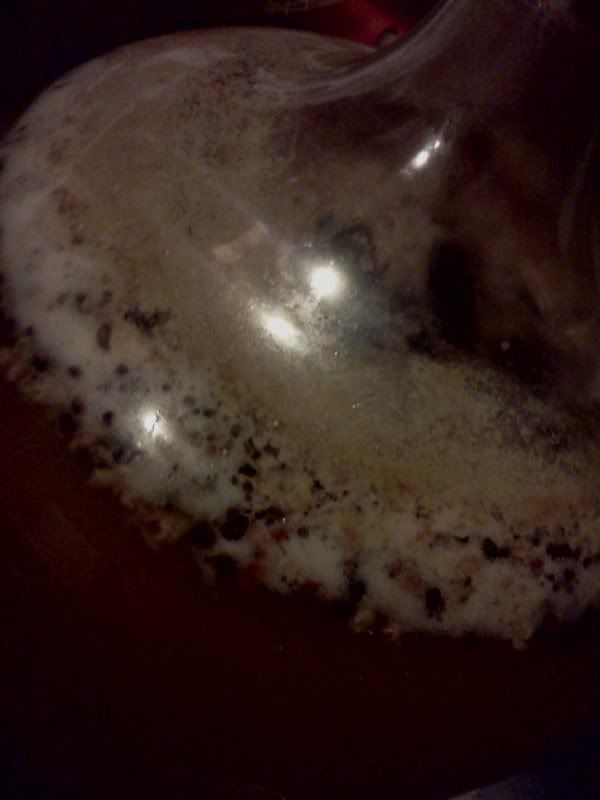
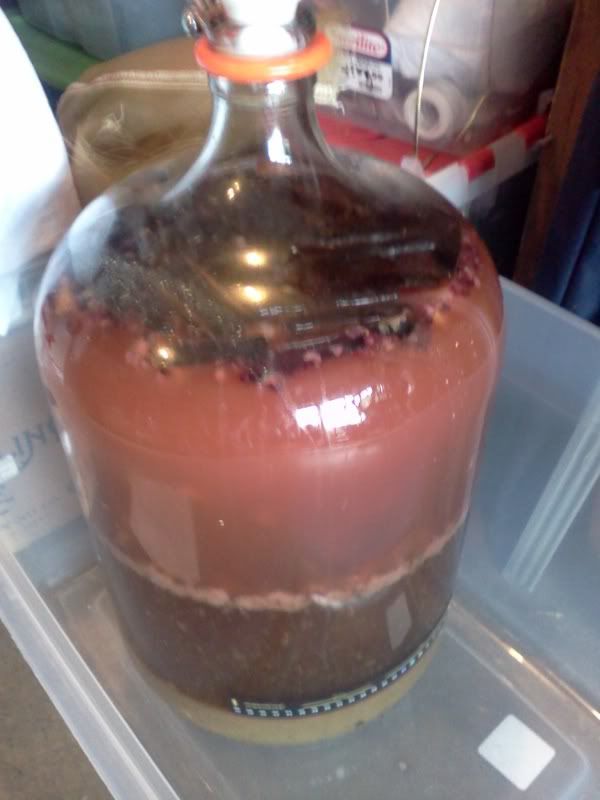
I mashed at 152*F, I was shooting for 154, but added too much cold water when I was too hot, and it cooled it down too much. I sparged with boiling water to try to extract as much sugar as possible and even some tannins as well. At the end of the 90 minute boil I added some cake flour for extra dextrins and starches for the Brett to chew on over the long fermentation. I cooled it as usual and ran it into the fermenter. I added the 2 starters to it whole, all the wort, fruit, bacteria, yeast, a couple ants, everything. I didn't aerate it since oxygen feeds bad bacteria, and inhibits Lacto growth. It looked kind of stratified until the next day as the different parts were layered, wort, trub, break material, fruit, starter, etc.
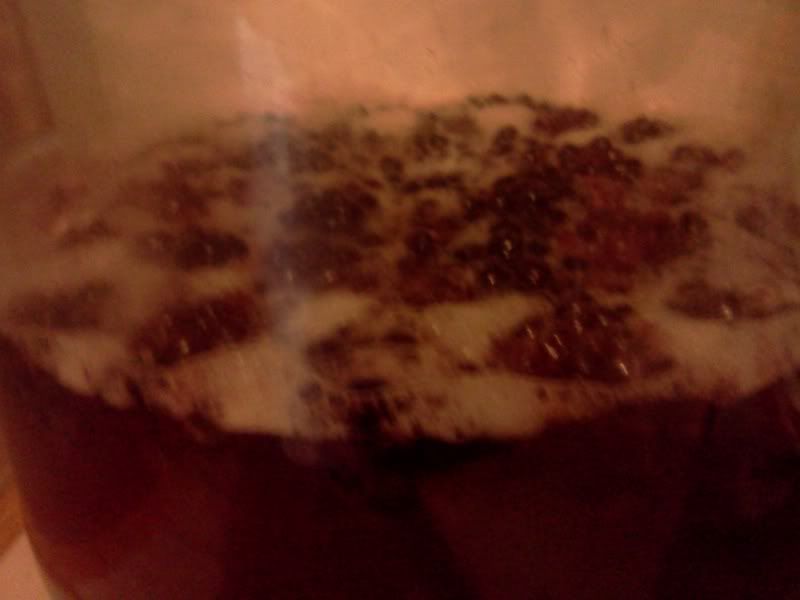
After a few days I noticed some odd activity. There was no krausen, but I had used S-Foam, and foam inhibitor, so it is quite possible that it was fermenting and not putting up a krausen. I did notice lots of little tiny bubbles shooting up and feeding a fluffy foam at the top though, and I assume this was from the Lacto working since it releases CO2. Another day later and I saw the wort churning away like any other beer fermentation, so things were going good.
I let it go for a few weeks with out tasting it, and finally on week 3 I gave it a taste. Nice, light, clean tartness, clean fermentation, no off flavors, mild funkiness, slightly fruity, not much oak character, gravity was 1.005. Quite happy with it. I tasted it again 1 week later and the oak is starting to show some; I will be watching this since I don't want it to be too oaky. If it gets where I want it I am going to rack the beer off, remove the oak, and add the beer back to the trub, yeast, and fruit for longer conditioning and funkdifying. So far I am very pleased. I even used the yeast to ferment a cider.
NOTE: This beer took 1st place in Sour Beers and won BEST OF SHOW in February 2014 at the KLCC BJCP comp.
NOTE: This beer took 1st place in Sour Beers and won BEST OF SHOW in February 2014 at the KLCC BJCP comp.
Friday, August 19, 2011
A Yeast Starter w/o Yeast?
I am preparing to make a beer in 3 weeks that will not have yeast added to it for fermentation... well, not directly; I will be adding fruit directly to the unfermented wort to do what is called a Spontaneous Fermentation. Spontaneous fermentation is used in Belgium to make Lambics; the hot wort is pumped into a cool ship (a flat, shallow steel container with no lid) that sits high in a pathway for good night time breezes and awaits the breeze to bring local microflora: wild yeasts, and beer souring bacteria. After a night of cooling and being innoculated with these wild strains, it is transfered into a wooden barrel that is home to wild yeasts and bacterias, and it ferments here for years.
I will be doing something like this, but not quite. The wild yeasts and bacteria that are in the air used by Lambic brewers are mostly from fruit. Fruit have all the organisms needed to make a wild ale: Saccharomyces, Lactobiccilus, Pediococcus, and Brettanomyces. My plan is to add the fruit with these microflora on them directly to the beer and allow the resident critters to do what they naturally do. The fruits contain sugars that will be eaten and increase the alcohol in the beer as well as helping to dry it out, and they contain acids that will help add another layer of sourness to the finished product. I am going to use blackberries and peaches, the blackberries will give a nice acidic and fruitiness, and the peaches will have a large amount of Brett living on the fuzzy skins. I also will be adding French Oak cubes to primary to add some more depth, as well as any microflora living in the wood.
One huge risk I run by doing this is if there is too much oxygen, acetobacterer can grow which can turn the beer to vinegar. So to avoid a slow start to fermentation, I am taking a precaution. I am making starters from the fruit, that I will pitch along with more fruit when it comes time to ferment. So far I have made the starter wort: 200ml Simply Apple Juice and 800ml of water, to 50 grams of light DME, boiled with yeast nutrients. To this I added 15-20 fresh blackberries from my neighbor's bush. It has been 4 days, and it has hit high krausen, has a substantial amount of yeast on the bottom, and is forming a pellicle. It tastes great. Lots of fruit, light alcohol, clean sourness that is more than straight tart blackberry. Here is a progression:
 12 Hours - Some signs of growth as the slurry on the bottom is larger than before.
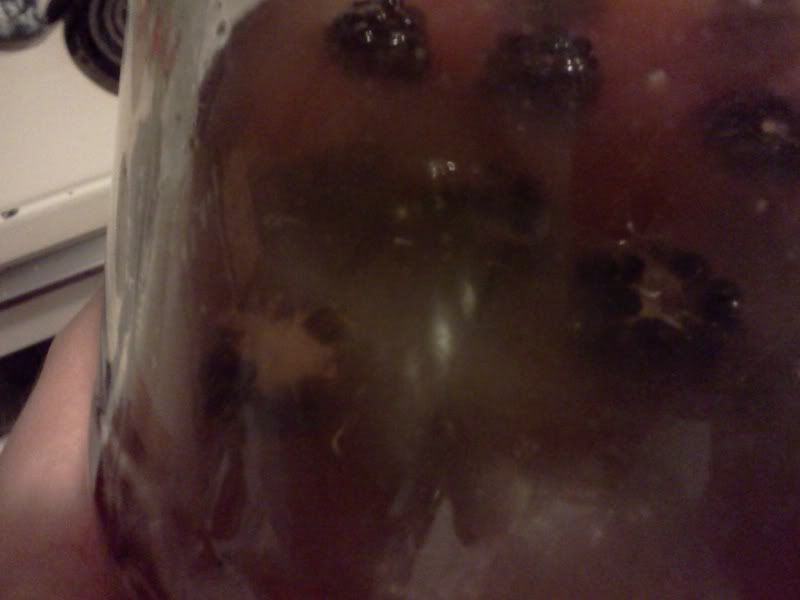 24 hours - the blackberries are starting to float around a bit, and there is quite a bit of yeast (I assume) on the berries on the cores.
36 hours - many of them floating on top and what appears to be fermentation signs on the top. Progressing nicely.
24 hours - the blackberries are starting to float around a bit, and there is quite a bit of yeast (I assume) on the berries on the cores.
36 hours - many of them floating on top and what appears to be fermentation signs on the top. Progressing nicely.
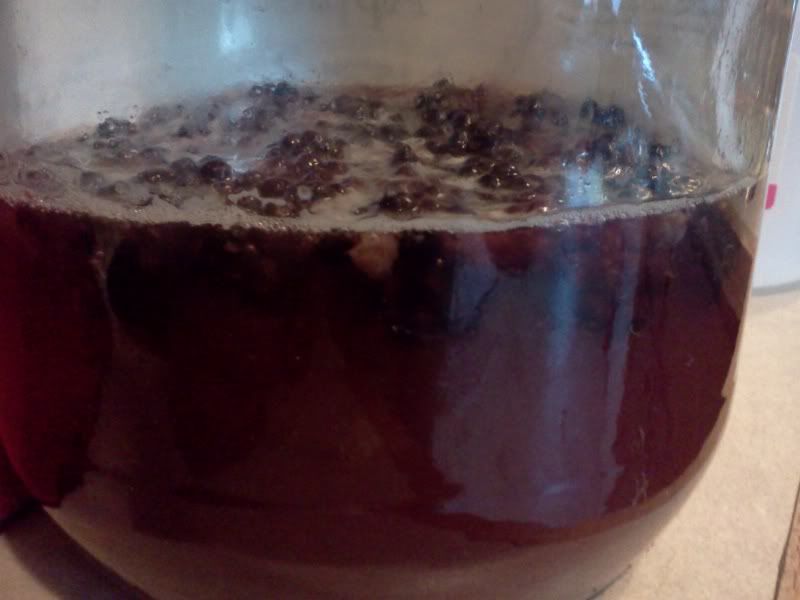 44 hours - definite signs of a good fermentation.
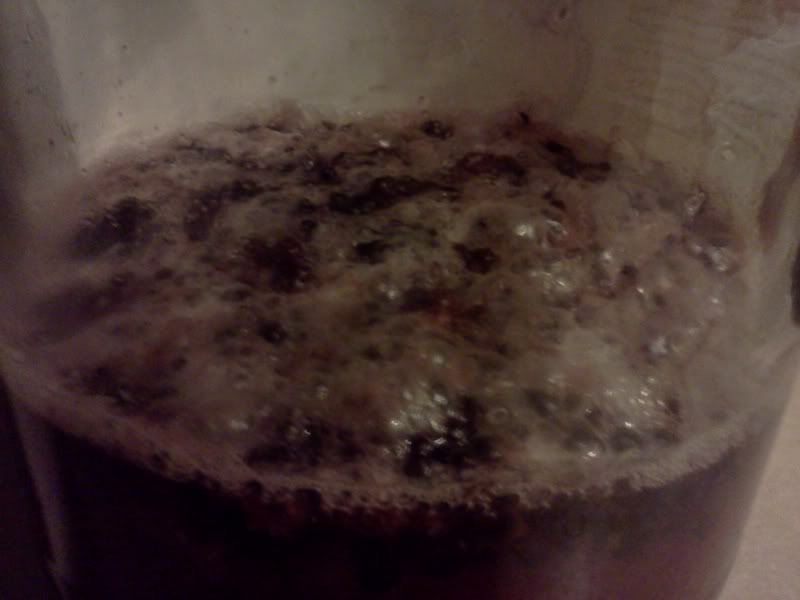 48 hours - krausen has formed, and smells of fermentation.
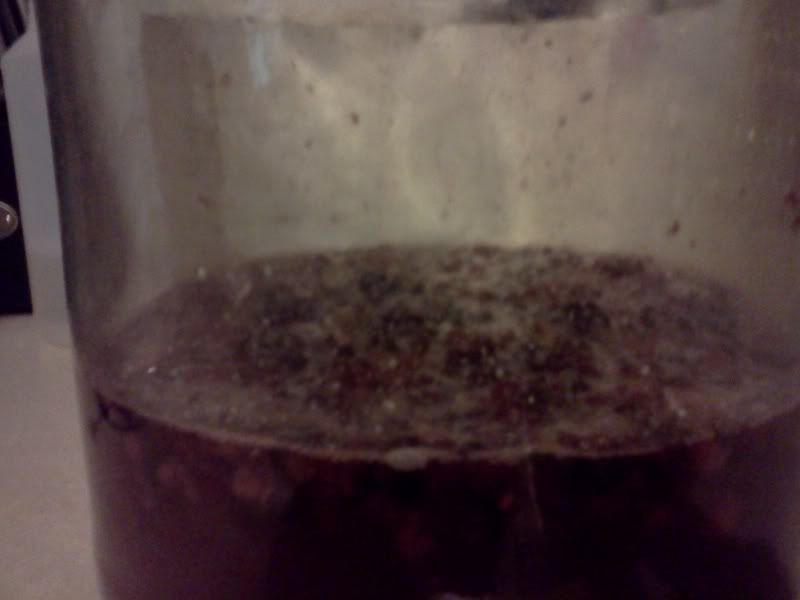 84 hours - fermentation seems about done, there is a substantial amount of yeast on the bottom, and I see signs of a pellicle forming on top.
I will be updating again soon as I do the starter for the peaches (the Farmer's Market was sold out the other day, hoping to get some tomorrow morning), and again as I step them up, and of course, brew day!
NOTE: This beer took 1st place in Sour Beers and BEST OF SHOW in February 2014 at the KLCC BJCP comp.
NOTE: This beer took 1st place in Sour Beers and BEST OF SHOW in February 2014 at the KLCC BJCP comp.
Subscribe to:
Posts (Atom)