Showing posts with label pH. Show all posts

Wednesday, June 25, 2014

Review: #55 The Callen 2013 (2nd Place Oaked Wee Heavy)

Scottish Wee Heavy.  I really enjoy them, but have not been able to make one I enjoyed in my 2 previous attempts.  One was infected and had lots of cherry pie.  The other was left to age on the yeast too long and tastes like pot roast (great for cooking stew, chili, or Corned Beef).  For this one I used a base of Golden Promise for a richer and sweeter malt character, and layered on top of it Cara-Pils for body, and British Dark Crystal, Carastan, and a hint of Special B to play up the rich toffee and dark fruits.  I wanted this one to hit hard on all cylinders.  Add to that aging it in the keg for a few months on second round oak chips and some Bourbon.  Almost perfect.  Needs a couple tweaks.  10.4% tastes nice, should drink great this fall after a few more months in the cellar.

Aroma: 10/12
The first thing to hit the nose is dark plums, caramelized figs, and rich toffee.  Behind this is a dark crusty bread.  Layered in and around the malts are medium-low notes of vanilla, barrel juice, and char.  Notes of molasses and burnt raisin linger in the back with a finish of alcohol.  The malts are dominant, but the level of aroma is medium high at most which is too style, malty, but doesn't jump out of glass like other styles.

Appearance: 3/3
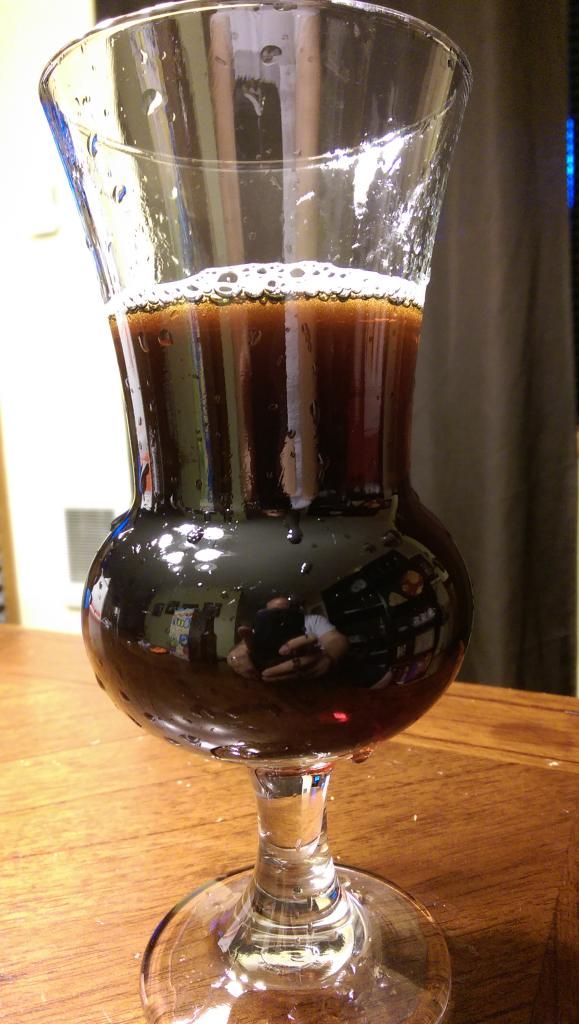
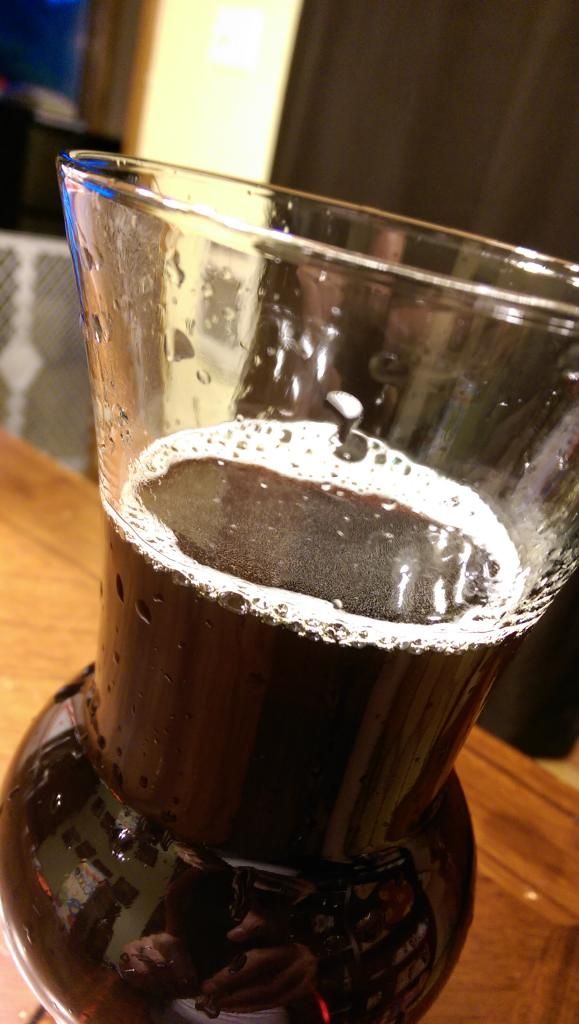
Poured into a traditional Scottish Thistle glass at cellar temps, the beer is a clear dark brown with deep garnet highlights under a thin wispy khaki head that remains as a ring all the way through.  Leaves no lace, but lots of legs slip on the glass with each sip.

Taste: 12/20
As you sip you're greeted with rich malts, dark bread crust dominates.  Not much of the dark fruits from the nose though which is sad, but there is a good medium level note of burnt sugar.  Touch of age is on the palate with a hint of Sherry, but this is behind the woody oak, Bourbon juice, notes of vanilla, and a deep char from the wood.  The Bourbon character is low, the wood a little more expressive, but not by much.  Quite sweet.

Mouthfeel: 2/5
The beer is full and chewy, sweet, borderline cloying.  Low carbonation as to style.  The finish is sweet and full and rich, not really a trace of hop bitterness.  Definite warmth from the high alcohol, but it is clean.  The finish is flabby, needs some pH adjustment to finish a little cleaner on the palate.  Also need to use fresh hops instead of homegrown ones that are a little old, needs a touch of bitterness to balance it out.

Overall:  6/10
This beer is rich.  Super malty, with big alcohol warmth.  Great blend of oak and dark fruits and melanoidins in the nose, and caramel and oak on the tongue.  As far as a base recipe, I am thinking I hit it on this rendition, but still needs some tweaks on water and pH to help the finish, as well as a beefier IBU to help with all the sweetness and aging.  The oak and Bourbon need some help.  I actually think that this beer would be better with a little more oak, and Rum instead of Bourbon.  A touch of acid in the glass helps the finish round out better and cleanses the palate on the swallow.

33/50

1/31/15*** This beer took 2nd Place in Wood Aged Beers at the 2015 KLCC Homebrew Competition***

Friday, April 4, 2014

Review: Hop Hedonist IPA

There is something about a good West Coast IPA, lots of hops bursting out of the glass, complex layers of fruits, resin, pine, and dankness atop a subtle malt background and a dry finish.  That's how I like 'em, and that's how I make 'em.  The layers of hop aroma and flavor are great on this beer, though the bitterness needs a boost.  Both this beer and the Black IPA that was made with it really hit the spot.  The use of Munic. Maybe Malt and Dark Wheat really get the color to a deep orange w/o the raisin flavors and sweetness associated with oxidized crystal malts.

Look:
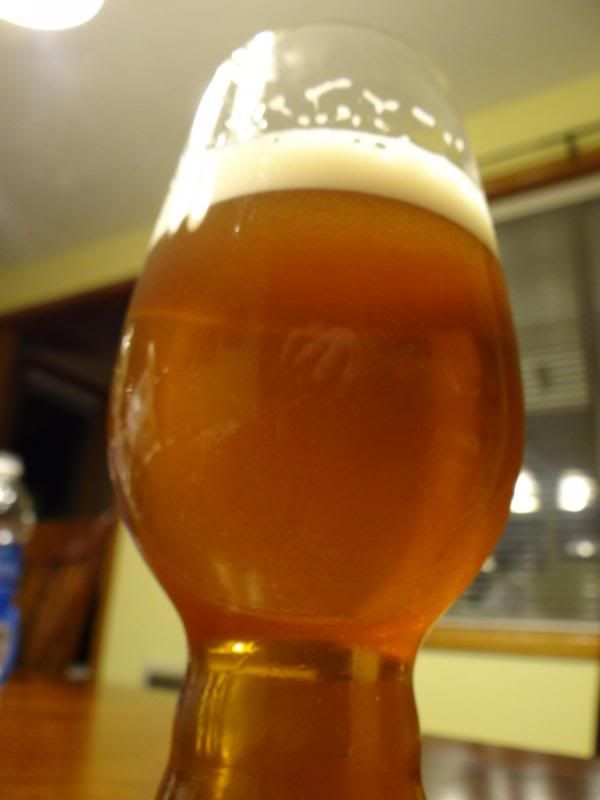
Pours a slightly hop hazed burnished orange with a dense off-white head fades slow to to a cap and leaves great rings of lace all the way down the glass.   Tiny bubbles feed up from the bottom.  Some hop particles in suspension.

Aroma:
Hops leap out of the glass, peach and mango, blueberry, pine needles, followed by hop resin and grapefruit with onion in the background.  Just a touch of floral hops.  There is a sweet and toasty malt note behind it all.  The peach esters from the West Yorkshire yeast really pull it together.

Flavor:
The taste follows the nose, big burst of juicy hops, peach, tropical fruits, pine, and a grapefruit kick.  Dank hop resins follow with lots of hop oils and toasty malts below.  Hard to tell if the peach is all hops or all yeast, but they blend well.

Mouthfeel:
Medium body is rich and smooth, slightly full on the palate, but not heavy, which is part of the hallmark of the West Yorkshire yeast.  Semi-dry finish, needs to be drier for my tastes.  Bitterness balances well, but really is too soft, needs a boost.  The finish is slightly flabby which I am beginning to believe is from the addition of pickling lime to my mash.  I think it is taking the finished pH up a little and leaving the beer without that dry crisp punch I really want to see.  Lactic acid in the glass makes it pop a little more.

Overall:
Big burst of juicy hops in the nose and tongue, complex hop notes, toasty malt sweetness, good lacing.  This beer is well on it's way to becoming a great IPA (last year's version took 2nd place after 3 months).  We will see what happens with this one when I enter it in June.  The finish needs tweeking, up the IBUs, dry it out a bit more, and get the pH down a tad.  Other than that this beer really quenches that need for lupulin.  Maybe a touch more dankness to round out the big fruits.

Monday, December 12, 2011

Brewing Better Beer by Gordon Strong

Thought it would be a good idea to pull some of the little gems and tidbits that I am gleaning from Gordon Strong's book Brewing Better Beer.

One thing that he points out that is good to know, and I wish I had known before I brewed my massive stout a week ago, is that when brewing a beer with dark grains, they do not have to be in the mash. Dark grains are pre converted, so the sugars are easily accessible and do not require mashing to convert (crystal malts work the same way). The character is also easily imparted without mashing as well. Strong gives 4 ways to use dark and crystal grains in a beer without mashing them.
  1. Steep them in your wort after it has run off into the kettle, and then remove them and boil as normal. Doing this will still impart some of the harsh and astringent bitterness that comes from the dark grains, so this method is good for stouts.
  2. Add the grains to the mash after it is complete, and stir them in, then lauter (drain) and sparge. This will impart all of the desired character, and the harsh and astringent just like steeping (effectively this is steeping in the mash instead of in the kettle).
  3. Cold steep and short boil. With this trick you will steep the grains in cold water for 24 hours, then, after removing the grains, you will give it short boil to sanitize before adding it to the fermenter (after cooling, of course), or, if you plan ahead, you can add the cold steeped wort to the kettle the last 5 minutes of the boil and then cool and move with the rest. This will add a little bit of the harsh and astringent character, but not much since it is a very short boil.
  4. Cold steep, no boil. In this method, you cold steep the grains for 24 hours, remove the grain, and then add it to the fermenter during fermentation, relying on the pH of the fermented beer, and the alcohol to inhibit any bacterial infection.

Using these would greatly benefit my mash. In a big stout like the one I just brewed, I would need lots of kettle salts to buffer the mash and ensure the mash pH is prime for conversion. If I were to leave the dark grains (chocolate, Carafa, black patent, roast barley) out of the mash, the pH would have been perfect for conversion, then adding them in afterwards and running off, would have given me all the character I was looking for without needing to add mash salts.

Another thing that I picked up from the book is that adding rice hulls to the mash will help even out the temperature in the mash. At any given point in the mash, the temperature can range quite a bit. On this last beer I brewed (a 10.5% Imperial Stout) one corner of the mash was 151*F, while the rest of the mash ranged from 142*F to 145*F. Using rice hulls would help the temp to even out consistently around the entire MLT.

Concerning boil overs, bittering hops, and hot break, Strong recommends waiting 15 minutes after the boil starts to add the hops to help keep boil overs at bay, or adding the hops before the boil. The reason for this is that as the wort begins to boil it is releasing oxygen that is in suspension, but this will be accelerated if a large dose of hops are added causing nucleation sites. Also, the tannins in the hops can facilitate boil over.

There were many other things that were interesting and helpful for brewing. In the section on finishing beer, he talks about different ways to correct your beer if it hasn’t finished as you’d liked. For flavoring he talks extensively about blending. Using a fairly dry, clean beer in a sweet beer can help to balance it and dry it out. Using a slightly sour beer can help balance a flabby beer, as can adding lactic or phosphoric acid, but too much will make the beer watery and sour. Some things are unfixable like soured infections and oxidation. If the maltiness or bitterness do not pop as you were wanting, he also talks briefly about adding Gypsum or Calcium Chloride after the fermentation.

Another beneficial section is on balance in beer. Sweetness and bitter balance each other. Sweet and sour balance each other. Sweet and alcohol balance each other. Sour and bitterness clash, as in a local brewer who decided to try his hand at souring one of his beers but used his Winter Warmer and made a train wreck. He states that dark grains and citrus hops clash, though I am not sure I agree. I did a Black IPA with Cascade and Simcoe hops, i.e., Grapefruit & Pine Sap, and it worked great, and I have had quite a few Black IPAs that use many of the citrusy and fruity hops. In a stout or porter this may be true, but the dark grain character just doesn’t come through on a Black IPA.

All in all, some of the stuff is fairly common sense, like changing only one thing at a time when trying to dial in a recipe. Others, as I have already stated are very helpful and beneficial. He also stresses learning how to critically judge beer so that you can find issues related to style, balance, infections, off flavors, oxidation, and the like. The more I critically assess commercial beers, the more I feel comfortable assessing where I need to make changes in my own beers.