
 |
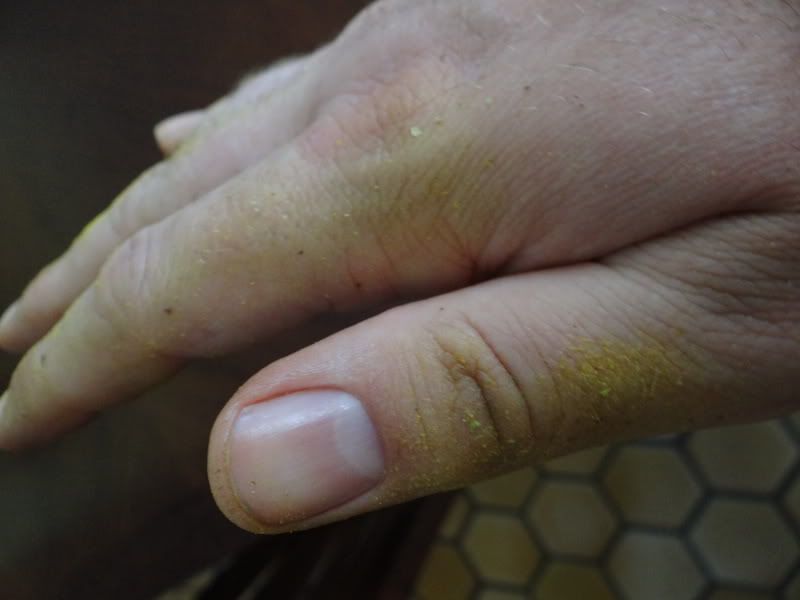
| Lupulin On Hands From Pushing Through Funnel |
The best way to keep hops at there freshest is to flush them with inert gas like nitrogen, and vacuum package them in mylar bags that are then stored cold. Of course, for homebrewers, this is a bit excessive. For us, the best option is to vacuum seal them and store them cold, the colder the better. Some people try to cram as much into a vacuum seal bag as possible, packaging them in 1# blocks. This at first seems like a great idea, but as I thought about it more, I changed the way I packaged hops. I was influenced by Matt Brynildson from Fierstone Walker Brewing, and a local brew-farm. Matt talked about how Chinook taken out of the package and left exposed to oxygen in a refridgerator awaiting the late boil additions goes from pine bomb and wonderfully fruity to cat pee in a very short time. Our brew club also had the hop guy come talk last month from a local brew-farm. They grow their own hops, chiles, spices, and even some grains for use in their beers. He was talking about how they have started packaging their hops in recipe quantities. So if they know their recipe uses a total of 3# of Cascade in the boil, they package as many 3# Cascades as they need for the year.
