Wednesday, March 7, 2012

Laminated Envelope

After all of the infections in my past 8 batches, then cleaning and sanitizing all the equipment, it was finally time to test it. I made some new adjustments to my brew house to help facilitate the brewday as well. I split my cold and hot water lines for my laundry and added Fresh Water hoses to it so I have water in the brew house now (no more running back and forth to the bathroom for strike and sparge water, or cleaning). I also got some plastic 4.5 cup measuring cups for hops. While my strike water was heating, I thought it best to calibrate my thermometer only to find it was 7*F off, meaning that on the past few batches when I thought I was mashing at 147*F, I was really at 140*F... thus 83% attenuation on my Bitters with yeast that stops at 72%. This also made my mash hit 159*F instead of 153*F, so I hit it with cold water until it evened out at 153*F.
After I ran off my first runnings, I hit it with my sparge water and gave it a good mix. Started to run off the second runnings and noticed that it was quite slow from 7.5-8 gallons, then no movement at all... my very first stuck sparge (23 batches). I gave it a good stir, recirculated, and ran off the remainder to 10 gallons @ 1.040. 1.040 was supposed to be my OG post boil. I hit 90% efficiency. Had to think on the fly for this one. I didn't want a 1.050 Blonde Ale, so I topped it off with cold water to hit 12 gallons preboil @ 1.033, and added another 0.10 oz of Zeus for the adjusted bittering. Boiled it down to 10.5 gallons in an hour for an OG of 1.037 (should have boiled another 15-20 minutes to get it closer to my desired OG of 1.040). My Immersion Chiller - designed for 5 gallon batches - took the 10.5 gallons from boiling to 90*F in about 22 minutes, not bad (another 15 minutes to get it to 65*F).

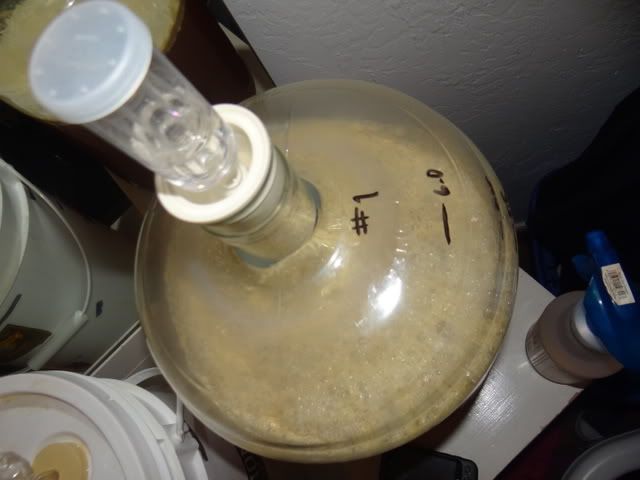
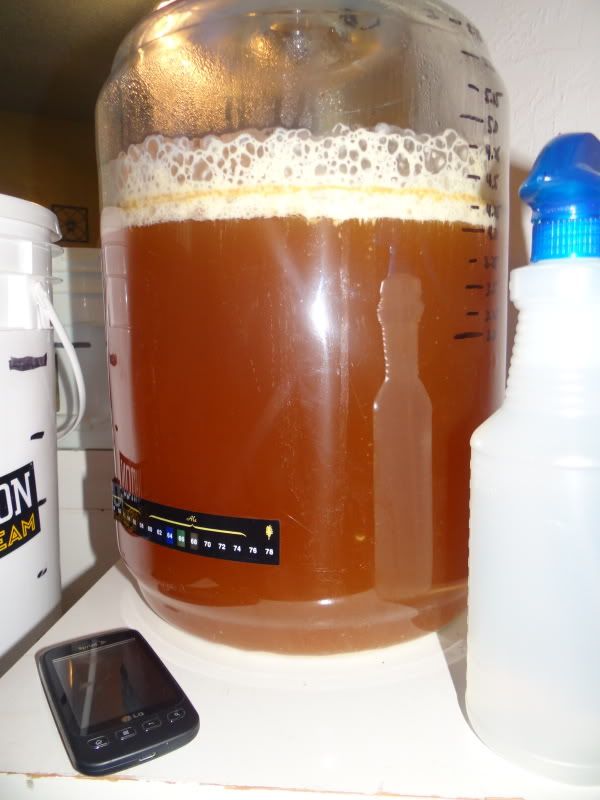
After letting it settle, and sanitizing my Better Bottle, conical, and a 6.5 gallon plastic bucket, I started running it off into the Better Bottle (measurements are fully calibrated on it). At about 1.75 gallons, I stopped the flow and dumped it from the BB to the bucket, then filled the BB to 4 gallons and dumped it into the conical (which was severely off on its measurements). Then I sent 4 gallons to the BB and the last of it to the bucket (2.5 gallons total). I aerated the BB and conical and pitched the 1.5L West Yorkshire starter into the two batches. I pitched a starter of Brett I made from Orval previously into the bucket for a Brett Blonde with the extra wort (didn't want to pitch the yeast for 8 gallons into 10.5).
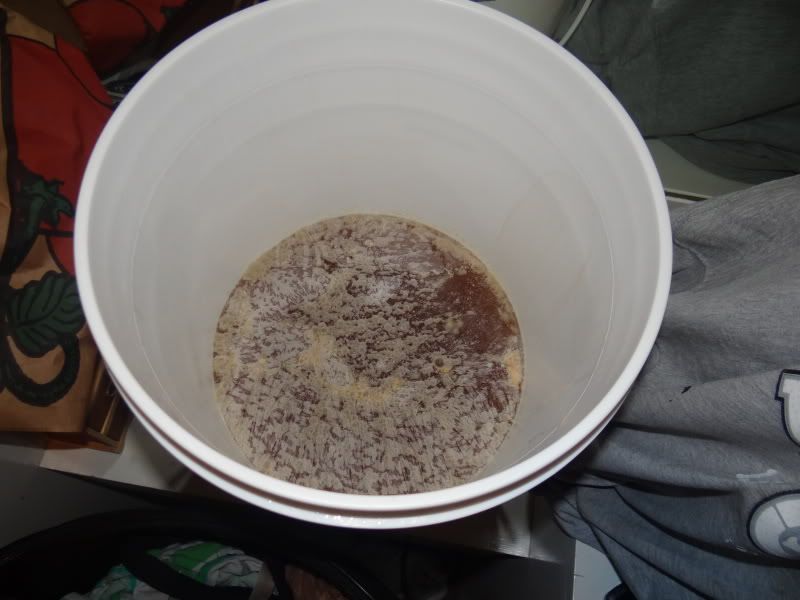
The Blondes were rocking within 16 hours, and full bore by 30 hours, but the Brett Blonde was still a no-go at 42 hours, so I dumped the rest of the Orval starter into it before work and came home to a nice pelicle. After another 36 hours the pelicle is full bore and bubbled up nicely. Another 24 hours later and the Brett Blonde has a krausen. Wort stability test was still showing no activity at one week, which is awesome, I opened it and it is pure fresh wort.

After one week, I took samples and readings on all of them. The Better Bottle smells of peaches, melons, and a touch of sweet malt at 1.010. The conical is at 1.007, the aroma is lightly phenolic and has a light dirty fruit smell... I am thinking the conical is infected and will now house sours only which sucks since it would be perfect for lagers, yet I want to do more sours so that works too. The Brett Blonde is acidic, light, funky, a little fruity, and slightly oxidized (I dumped the whole 2L 8 month old starter into 2.5 gallons, to be expected), and it is @ 1.007 as well.

_______________________

American Blonde Ale
10.5 gallons
20 IBUS
4 SRM
3.5 ABV
_______________________

11# Pale Malt
1# Carafoam
0.5# Honey Malt
45 minute mash @ 153*F
90% Efficiency
_______________________

60 minute boil
60 mins 0.20 oz Zeus 15.4% AA
25 mins 1.00 oz Amarillo 10.4% AA
0 mins 1.00 oz Amarillo 10.4% AA
_______________________


1/4 tsp Gypsum - Mash
3/8 tsp Calcium Chloride - Mash
1/4 tsp Gypsum - Boil
1/2 tsp Calcium Chloride - Boil
1/4 tsp Yeast Nutrient 12 mins
1 tab     Whirfloc 12 mins
_______________________

Chill to 62*F
Pitch 1.5L Starter WY 1469 West Yorkshire
Split to 3 fermenters
Ferment 68*F for 7 days
Ambient for 21 days
Bottled 18 - 12 oz bottles w/ 4 carb tabs each from Better Bottle only
Soured all remaining beer
_______________________

OG 1.037
FG 1.010


Just for fun... the name of the beer came from an infamous day for a co-worker that she will never live down. Back when our new branch was just opening and didn't have their own laminating machine, they would send any items for laminating to our main branch. The branch sent a couple new membership cards over to have laminated and placed into an envelope that was ready to mail to the members. The sticky note said "Please laminate and mail to the members" meaning, laminate the cards, place in envelope, and mail. The blonde of all blondes placed the cards into the envelope, then laminated the envelope and sent it back to the branch with a big question mark. Thus, an apt name for a Blond Ale... Laminated Envelope.

Friday, February 24, 2012

Here's To Hoping It's Gone

Over the 3 day weekend I took the time to thoroughly clean and sanitize some of my equipment. As I was able to deduce that the infection spread through 1 yeast into 2 fermenters, I knew what I needed to care for. I started by giving all 3 fermenters a 17 hour soak in hot PBW over night. I gave it the recommended ½ cup dosage for the 15-25 minutes, and left it for 17 hours. I came to find out that I actually didn’t need to use that much if I was doing an elongated soaking, but at least this way I know they are clean. After this I filled a bucket with the PBW solution from one of the Better Bottles, removed the brass ball valve from my conical (it smelled like mushrooms – not cool), and placed the conical into the bucket so that the threads could get a good soak. At this point I filled the Better Bottles with cold water and 3 cap fulls of bleach. After a few hours I removed the bleach water and refilled the Better Bottles with PBW solution to help clean out any bleach. I then rinsed each one 5 times with hot water, and had my wife smell test them for any bleach. I also added the bleach to the bucket that previously contained the PBW and soaked the bottom and threads of the conical overnight. The next morning I put my bottling bucket spigot on the conical (same size threading) and filled it up with the bleach water as well (topped off with more cold water and extra bleach), and that has been soaking for 5 days. Tonight I will give it a thorough rinse with PBW and hot water and then let it dry out.


Next week I have an extra day off after taking the youth group to the coast for a weekend retreat, and I am going to brew up a batch of beer to test the Better Bottle and Conical. After talking to Michael Tonsmeire (Mad Fermentationist), I decided to do an American Blonde Ale since this style will show any signs of infection, and will probably still taste good if it does get infected. I worked up a recipe for it and will finally get to use the Amarillo hops I have in the freezer. Typically an American Blonde only has about 0.5oz flavor and 0.5oz aroma hops, but I am brewing an 8 gallon batch as opposed to 5, and I am going to (if it stays clean) enter it in a Club Only Competition in May and still want the hops to be around for it, so I am going to use 1oz each for flavor and aroma. I am putting this against a malt back drop of Pale Malt, Carafoam, and Honey Malt so it will have a nice honey sweet flavor, body, and retain a light, smooth, dry finish. I am choosing to use the WY 1469 West Yorkshire strain that I used to brew my ESB since I really liked the stone fruit aroma, and think it would compliment this beer well. Only issue with this yeast is that it doesn’t flocc out well, so it will get a little longer in the fridge before I transfer and bottle. For bottling, I am going to use a brand new bottling rig for the Better Bottle version, and will bottle straight from the conical for the other to keep them as separate as possible and to isolate any possible place that an infection may still be harbored. I am going to purposefully divert a few gallons of this brew to my gallon jugs where I will intentionally sour, wild, and oak it just because I can, and I don’t want to actually bottle another 8 gallons of the same beer like I did on the ESBs, and of course, I like souring stuff (intentionally). I will of course keep the blog up to date as that brew progresses.

Thursday, February 16, 2012

Beyond Just Bottles

As previously posted, I had a bad score from my Brown Ale at a BJCP home brew competetion that showed signs of infection, and after some research and questions about cleaning and cleaning products, and sanitization, I seemed to be getting some headway... or I thought. I was under the impression that this was a bottle here, and bottle there, and had established what I was going to do to fix it...that was until last night. I opened another Brown Ale to see if it would have issues, and was met with Old Faithful. I grabbed that last 5 bottles and one, after the other, nothing but gushers. Alarmed doesn't begin to describe it; neither does rage, but that wassn't the end of it. I grabbed one of the Ambers that I had made 2 weeks after the Brown, that consequently I had repitched the yeast on. No gushing, but the flavor is lacking all the crystal malt character and it is watery. Open the 90- (repitched the yeast into this as well) from the partigyle I had done: GUSHER! Run to the cellar and grab the Wee Heavy from that same partigyle (which got the same repitch as the 90-): GUSHER! Grabbed the Session Stout with Orange Zest and Cinammon (repitched from 90-): GUSHER! This beer had been entered into the same competion and received remarks about over carbonation and lack of flavor. This beer was also a partigyle with my 10.6% Imperial Stout that also received the same yeast; it is carbing up right now, and have no clue about how far the infection has gotten on it, but over the course of the month it aged on cherries the FG dropped from 1.028 to 10.24. I will be crash cooling this one and drinking quicker than expected.


I thought it was all about the bottles, but with the rapid advance of the infection in all the batches it appears to be the repitching of the yeast. The Brown took 5 months to show signs of infection. The Amber 4.5, and is not fully there yet (only a 6 pack left). The 90- and Wee Heavy 3 months, the Stout, less than 2. I am still going to have to get all new bottling equipment as well since all 5 batches went through it all and I'd rather not risk the infection having taken hold of in my nozzle, tubing, wand, bucket, etc., and end up in my other beers as well. This is causing some paranioa as well; my 8 gallons of ESB had all new yeast, and I under primed due to a mishap with the app I use, and thought it would never carbonate. But now it has a decent amount of carbonation. Could just be the time and temp finally giving it what it needed. Could be the same infection (they have the same "oil slick" on the top of the beer as all these others had, could be residual cleaner, could be infected). I am going to get all the ESB in the fridge and drink quick. I will leave out a few bottles for a couple months and see if they turn into gushers as well just so I can know for sure. If the Saison gets infected, I am not too concerned, but still would like it to stay clean. I also am now concerned about the West Yorkshire and 3726 Farmhouse Ale yeasts I used, since I washed them and kept them, but I used the same mason jar lids w/ rubber seals that I used for storing the 1056 that infected all the others, and I didn't boil my jars or lids, just StarSan.


Time to go back to the basics again. Gonna drain-pour multiple batches this weekend, have to buy new Bottling Bucket, spigot, tubing, wand, and I have an email out to the Mad Fermentationist about the best way to kill any bacteria in my Better Bottles since he moves from wild to clean to wild to clean in his with no ill effects.

Wednesday, February 15, 2012

Beating the Bottle Bugs

One thing that came of my debacle was a reevaluation of my cleaning and sanitizing procedures. I got a fairly large forum discussion going back and forth over on Tasty Brew. What has seemed to come of it is that my cleaning and sanitizing is fairly tight, but every-so-often I miss a few bottles. This problem could be stemming from micro scratches inside the bottles that are harboring the bacteria that ravage my beer post packaging. I could always throw these bottles away when I end up with a gusher or two. Another option allows me to tighten up my process to have the best beer packaging available.
Cleaning: I told the guys at the LHBS that I wash with Sun Oxygen Cleaner and they stated that this was bad. They told me that it had detergents in it that would coat the walls of my equipment and bottles, that it was difficult to wash off, and that it would de-activate StarSan. I started the forum thread and did some reading and snooping. According to John Palmer, a very good cleaner for your brewery is a Sodium Percarbonate cleaner like PBW and One-Step. Turns out that the Sun Oxygen Cleaner that I use is simply Sodium Percarbonate, just like the expensive stuff they were trying to sell me. According to the forum thread, I wasn't rinsing them well enough, and the Sun MSDS sheet does state that the Sun Oxygen Cleaner doesn't work correctly with acids. To properly rinse the cleaner from the bottles (or any equipment) it should get a good 3-5 rinses with hot water. I would fill the sink with warm-hot water and submerge the bottle once, drain, then sanitize. I wasn't rinsing the first bottles thoroughly, and then I was diluting the rinse water each time as well. To rectify this issue I am going to purchase a jet type bottle washer that attaches to the sink. You turn on the hot water, turn the bottle over, press it down over the nozzle, and it sprays the hot water all over the inside. Repeat a few times and then sanitize. Another cool thing about a hot water Oxy soak is that it removes labels easily, and typically breaks up any gunk inside the bottles (still give it a good scrub with a bottle brush to be sure).


Sanitizing: This is where you take the previously cleaned (all debris, gunk, etc, removed) bottles and kill off most (if not all) of the bacteria and wild yeast that might be in/on them. Options for effectively sanitizing the bottles include baking, boiling, and steaming them. Baking will effectively sterilize the bottles killing any and everything in them. It will also degrade the stability of the glass which may lead to bottle bombs, or broken necks in the future. Boiling is very effective, yet how do you fit ~ 60 bottles into a pot of water? And even if you can get them in, how do you avoid the current of the boil crashing the bottles into the wall or each other? The third option is using the dishwasher. In this method, you remove all dishes from the dishwasher and give it a good cleaning inside (wipe down the walls, make sure there are no food particles on the bottom). Some may want to open up the insides and give it a through cleaning (be prepared, I hear this is putridly disgusting). Once it is clean, fill it with bottles, and run it with out any detergents and have it set to high heat and heated dry/sanitize cycle. Once this is done, your bottles are clean, sanitary, and on a sanitized shelf for bottling. If you bottle from the dishwasher (as I do) then any beer that spills on the opened door is just dumped into the dishwasher once you are done, and goes down the drain. Of course with as anal as I am now with everything that has happened, I will most likely take these bottles and hit them with StarSan, then place them back into the dishwasher to double sanitize.

Monday, February 13, 2012

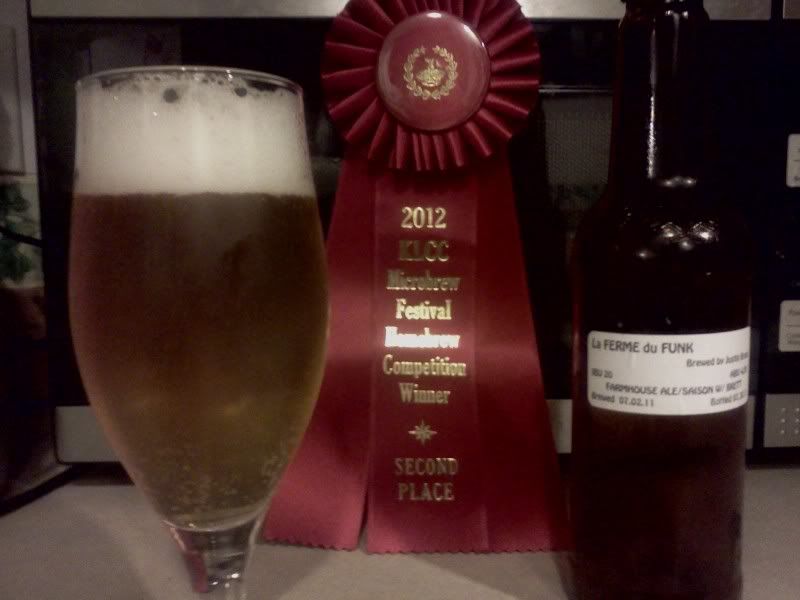
2nd Place Saison... And Broke Down Brown: Now With Brett!

The KLCC Brewfest was this past weekend, and I was quite bummed when they announced the winners and my name wasn't called at all. Kind of put a damper on the night. I got hopeful that maybe I took Second Place in the categories I entered. I rushed to the home brew shop on my break to get my score sheets to find that my Saison took 2nd in the Belgian and French Ale category. 2nd place out of 12 entries. I was very overwhelmed. Comments included: "Spicy hop aroma, nice golden color, big head, Brett flavor up front, spicy, great [mouthfeel], great beer, no major flaws, like the hint of Brett"; "distinctly tart, citrus fruit aromas with some 'funk' and peppery phenols, hint of Brett?, light straw in color, brilliant clarity, frothy lasting head, good fruity flavor, pear-lemon, with a gentle spiciness that finishes dry & refreshing, a hint of tartness and complexity, a great example of a Saison", and "spicy fruity, some hop, spice profile clean with sweet finish, very refreshing Farmhouse Ale." The criticisms all seemed to revolve around low hop and malt flavor and aroma, and a possible boost in fermentation temp. But all in all, very good.

And then comes the bitter-sweet moment. My other two beers (which I entered for fun) tanked. All three score sheets on my Brown Ale had very low scores and bad remarks: Brett! I had been concerned about a possible infection in a few of my beers that I had reused yeast on and had seen a small slick on top of the beer in the bottles. I had talked to others and had a few BJCP judges try two of the other beers and they said there is not Brett. But the remarks on my Brown were unanimous. One said that the Barrel quality is dominant on the beer, but I hadn't wood aged it. Another, Jamie Floyd, Brewmaster for Ninkasi, stated "Phenolic, Brettanomyces, cheesy hops... Brett flavor hides the nice caramel and chocolate... sweaty socks". The third judge, who owns the home brew shop I use and just opened a brew pub stated, "musty & cheesy... super foamy pour... horse blanket, old cheese, seems like a wild yeast infection... tightening up sanitation protocols would seem to be in order." 3 BJCP certified judges, all hit infection. If that doesn't take the wind out of your sails quick, I don't know what else would.


Live and learn. Trying hard not to let it tear away from the placing of the Saison, but it sure is hard.


EDIT: I took another bottle of the Brown into the shop today and had the same judge taste it again. Before he was able to pour it the foam was rising up through the neck, and after he poured 2 tasters worth, the space in the bottle filled with foam that overflowed the top. The body was very watery, and the taste was muddled and off as well. Looks like I definitely have a few things living in at least a few of these bottles. Brett on one. Pedio in another. Guess Broke Down Brown turned out to be the proper name after all.

Friday, February 10, 2012

It's Been Awhile

As you can easily see, it's been awhile since I posted on the blog, and I thought that an update might be in order. Here are a few things I have been working on and brewing. After the last brew when I tested my efficiency, stabilized my system, and began to work on my own brewing "software" a lot has happened.

I brewed a partigyle Wee Heavy with Heather Tips and a Scottish 90- that was aged on Oak and Laproiage Islay Scotch. The beers didn't turn out as I'd liked. They are way too fruity and not very malty. The 90- is much further down this line than the Wee Heavy. All of this is recipe based. I added both c120 & Special B which added tons of fruit and none of the caramel and subtle dark fruits I was looking for. The peat malt came off quite phenolic. Using 1056 subdued any maltiness I was looking for and through off lots of fruit. I have already reworked the recipe to remove the c120 and Special B, and added French CaraMunich and CaraVienna for light caramel and toasted sugar, and British Dark Crystal for more of the same, and went for 1968 London ESB to pull of a heavily malty character.

I also brewed a second partigyle, a 10.6% Imperial Stout with Chipotle & Cherries, and a Session Stout with Orange and Cinnamon. The big beer was fermented for 3 1/2 weeks, then aged 1 week with Chipotle and 3.75# Sweet Cherries, then another 3 weeks with just the cherries, then aged 1 more week on its own before bottling. It is quite smooth, fruity, dark, rich, chocolaty, and a slight roast. The second beer was quite devoid of character. I took a tip from Gordon Strong and cold steep some more Chocolate Malt, C75, and Black Patent, boiled it with more orange zest, and added it to the fermenter. I also added Malto-Dextrin at bottling for some more body and also offset all the oil from the orange zest so there is still great foam and head retention.

For Christmas I got my refractometer and and an aquarium temp control unit (I will post more about this in another post). I also got a second Better Bottle which was great for my next brew session. I did a "SmAsH" (Single Malt and Single Hop) type beer. I say type because I used Magnums for the bittering addition since EKGs are low in Alpha Acids and way too expensive. I used Great Western Pale Malt, and finished the batch with 3oz of EKG hops in the last 15 minutes of the boil. I then split the 8 gallon batch into 2 Better Bottles and pitched 2 different yeasts: WY 1968 London ESB and WY 1469 West Yorkshire. Come end of fermentation I used the new temp controller to up the temp for a Diacetyl Rest. I then crashed the beers to clear them. The whole thing went great, but I ended up under carbonating them since the app calculates based on temp and I used the crashed temp not the ferment temp.

My library finally got Farmhouse Ales after a year of waiting for it. While reading it I brewed a simple Saison using the WY special Farmhouse Ale strain. I mashed at 147*F, the same that I did last Summer when I brewed my two Saisons using the Dupont strain WY 3724 Belgian Saison, but the beer didn't finish as low as I had hoped (the 3724 took the beers down to 1.004 & 1.005, 3726 to 1.008). After a week in the Better Bottle at a constant 75*F, I primed and bottled in champagne bottles for added stability against the higher carbonation and the possibility that the beer might not have been finished at bottling.

I have also made a lot more adjustments to the brewing spread sheet I created. I added a refractometer adjustment section that takes the Brix and calculates OG, efficiency, and once fermentation is finished converts for alcohol to give FG, and ABV. I also added all of the malts with gravity, Lovibond, and cost from the homebrew shop as well as flavor descriptions. I was able to get a list compiled of all the hops in one of the fridges with all the Alpha Acids. I will be adding the cost and flavor aroma profiles for all of the hops as well and adding the second fridge's stock as well.

I also used my temp controlled fridge to maintain a constant 71*F to carbonate the Saison and my Imperial Stout. I will be posting some taste reviews soon on all these beers once they are carbed up and ready, so be watching for these blogs as well as a how-to-build your own dual stage temp controller for $40 (why pay $150 for a Johnson or Ranco).